
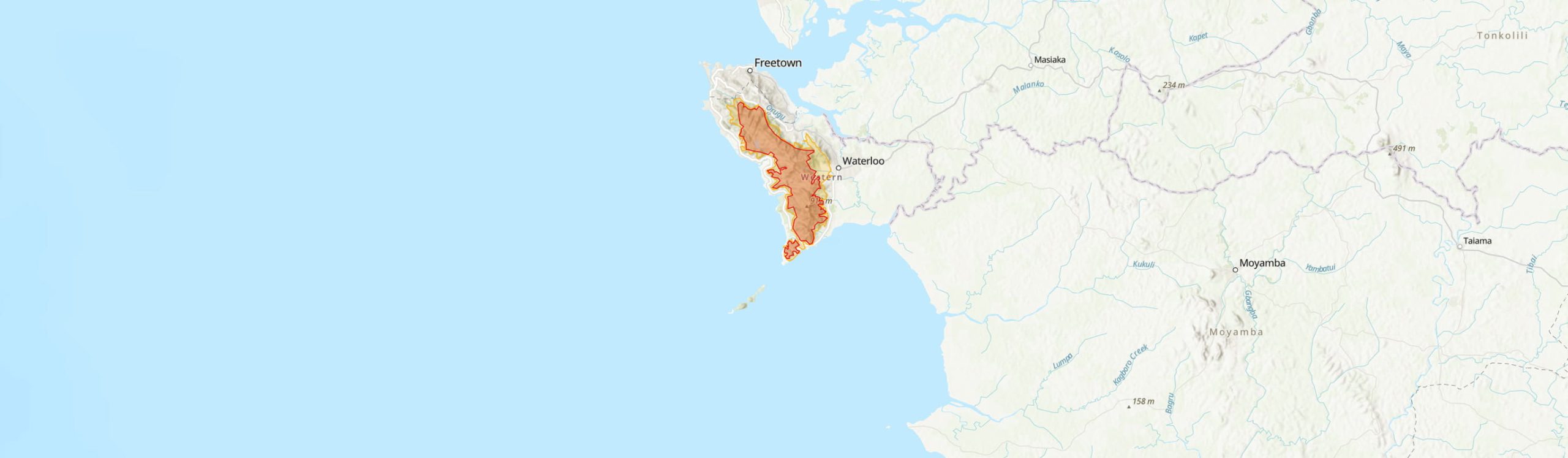
Country: Sierra Leone
Administrative region: Western Area (Region)
Central co-ordinates: 8.33940 N, 13.148 W
Area: 193km²
Qualifying IPA Criteria
A(i)Site contains one or more globally threatened species, C(i)Site contains globally threatened or restricted habitat or vegetation types
IPA assessment rationale
This site qualifies as an IPA as it contains 35 threatened species that trigger A(i), as well as two endemics that trigger A(iii). This site contains a significant number of species of high conservation importance, thus triggering criterion B(ii).
Site description
The Western Area IPA is situated on the Freetown Peninsula in the Western Area Rural District of Sierra Leone. This forested mountainous peninsula lies adjacent to the capital city, Freetown, and forms part of the landscape originally referred to as “Serra Lyoa” or “Lion Mountain” by the Portuguese, a name that later gave rise to the country's name, Sierra Leone.
This IPA largely overlaps with the Western Area National Park, a protected area encompassing the westernmost remnant of the Upper Guinean forest. The IPA also includes the Tacugama Chimpanzee Sanctuary, as well as the Guma Valley and Congo Dam reservoirs.
Botanical significance
This site is an important reserve of the Guinean Forests of West Africa Biodiversity Hotspot. It contains many species endemic to these forests, and is an important refuge for many threatened plants across this region. Such examples include the understory trees Aulacocalyx divergens (VU), Pavetta leonensis (EN), Pleioceras afzelii (EN); large trees such as Brachystegia leonensis (VU) and Tessmannia baikiaeoides (VU); as well as the liana Dalbergia hepperi (EN).
Of particular botanical significance is Bulbophyllum parvum, an epiphytic orchid known only from the Western Area and documented from a single collection in 1951 (Jones #235). While sterile Bulbophyllum spp. were observed at suitable habitat during recent fieldwork in February 2025, follow-up surveys during the wet season flowering window (October/November) are required to confirm its persistence. This orchid is assessed as Data Deficient (in draft), highlighting the urgent need for further study of this narrow-range endemic. The site's inselberg habitats support additional national endemics including Dryopteris amblyodonta (EN in draft) and Loudetia jaegeriana (NE), along with the near-endemic rare grass Anadelphia trichaeta (VU). The bowal habitat at this IPA is also crucial for the conservation of the rare herb Eriocaulon adamesii (CR), containing most of its known distribution (Mesterházy 2020). This is a large site and has not exhaustively botanically explored, therefore likely that additional species of conservation concern remain to be recorded within this IPA.
Habitat and geology
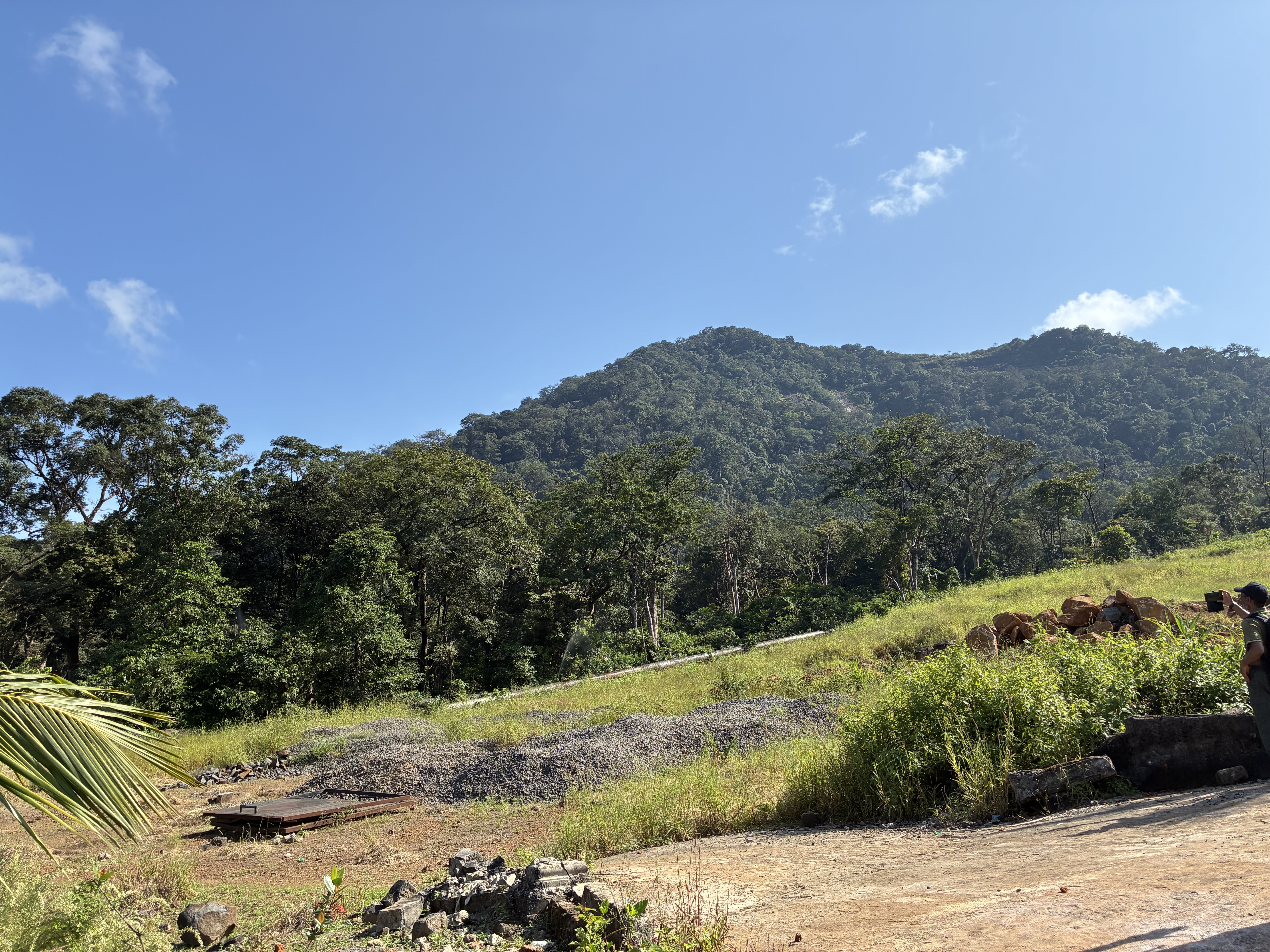
The Western Area IPA is characterised by closed evergreen and semi-deciduous forests forming part of the West African forest ecosystem, however the area comprises a mosaic of habitat types. Extensive areas of moist evergreen and semi-deciduous forests cloak the slopes and valleys, but forest has almost entirely been cleared from the flats. Additionally, rocky river species feature along drainage lines. At lower elevations, mangrove swamps fringe estuaries, dominated by Rhizophora spp. and Avicennia spp. Scattered throughout the hills are inselbergs—steep, isolated rock outcrops, at 400 – 850 m altitude, with small patches of vegetation occurring in cracks in the rock. Dominant species may include Ficus spp., Eremomastax speciosa, Dracaena spp., Vepris spp., Psorospermum sp., and various grasses. Bowal habitat is scattered along the coastline, and these areas are characterised by shallow, ferraltic pans that support sparse grassland vegetation (A. Lebbie pers. comms. 2024). These areas may be easily mistaken for cleared areas, however, they support a unique assemblage of species of conservation importance.
Geologically, the peninsula is underlain by the Freetown Complex, a mesozoic mafic intrusion associated with the continental rifting and opening of the Atlantic Ocean (Goodenough et al. 2018). This gives rise to rugged topography at the site, with steep, forested slopes descending directly into the Atlantic Ocean. Recent Bullom Group marine and estuarine sediments occur along coastal margins (Goodenough et al. 2018).
Conservation issues
The site experiences significant threats from unsustainable human activities including illegal farming, logging, wood-cutting, sand and stone extraction, unplanned urbanization, land grabbing, poor waste management, mining, and hunting; all exacerbated by rapid population growth in Freetown and associated infrastructure expansion (Okoni-Williams et al. 2001). These pressures are compounded by enforcement challenges, as National Protected Area Authority (NPAA) forest guards lack adequate resources to effectively patrol and protect the reserve boundaries, while changing administrative boundaries create additional management complications. Fire represents a persistent threat that alters vegetation composition and degrades habitat quality for sensitive species. Climate change impacts, particularly increased frequency and severity of coastal erosion, flooding, and storm surges, severely affect the coastal areas around the park. The establishment of new settlements along park borders has intensified encroachment pressures (Okoni-Williams et al. 2001), while the dense human population of Freetown continues to drive illegal resource extraction activities. Bowal habitats are under development pressure also, with patch of bowal habitat currently being developed into a new campus for the University of Sierra Leone (A. Lebbie pers. comm. 2024). These combined pressures have resulted in alarming deforestation rates and habitat loss for many threatened species, highlighting the urgent need for integrated conservation action and sustainable development approaches.
Ecosystem services
The Western Area IPA provides critical ecosystem services, especially to the capital city Freetown. Most significantly, the forested slopes protect the headwaters of the Guma Valley and Congo Dam reservoirs, which together supply approximately 90% of the city’s drinking water (World Bank 2020). These forests play a vital role in intercepting rainfall, reducing surface runoff, promoting infiltration, and maintaining dry season baseflow (Hackman 2017). Vegetation also provides essential slope stabilisation across the region’s steep terrain, helping to prevent landslides and soil erosion. The devastating 2017 Regent landslide, which killed over 1,000 people, occurred adjacent to the Western Area National Park and was strongly linked to deforestation and unregulated urban expansion (Haile et al., 2019). Scientific assessments following the disaster have confirmed that intact forest cover significantly increases slope stability by binding soil and reducing saturation during extreme rainfall events (Hackman, 2017; Haile et al., 2019). In addition, the Western Area is an ecotourism hotspot, due to the presence of the Tacugama Chimpanzee Sanctuary, which is currently building a botanic gardens at the site.
Site assessor(s)
Assessed by:
Gabriella Hoban, Royal Botanic Gardens, Kew
Xander van der Burgt, Royal Botanic Gardens, Kew
Aiah Lebbie, The University of Sierra Leone
Momoh Plato Sesay, The National Herbarium of Sierra Leone
Samuel Sokpo, Njala University
Fanny Massally, Royal Botanic Gardens, Kew
Date of first assessment: 1st Aug 2024
Date of latest reassessment: 1st May 2025
IPA criterion A species
| Species | Qualifying sub-criterion | ≥ 1% of global population | ≥ 5% of national population | 1 of 5 best sites nationally | Entire global population | Socio-economically important | Abundance at site |
|---|---|---|---|---|---|---|---|
| Anadelphia trichaeta (Reznik) Clayton | A(i) |  |
|
|
 |
|
Scarce |
| Aulacocalyx divergens (Hutch. & Dalziel) Keay | A(i) | |
|
|
|
|
|
| Bulbophyllum parvum Summerh. | A(iii) | |
|
|
|
|
Unknown |
| Dactyladenia smeathmannii (Baill.) Prance & White | A(i) | |
|
|
|
|
|
| Brachystegia leonensis Hutch. & Burtt Davy | A(i) | |
|
|
|
|
|
| Dryopteris amblyodonta J.P.Roux | A(i) | |
|
|
|
|
|
| Eriocaulon adamesii Meikle | A(i) | |
|
|
|
|
Unknown |
| Eriosema arenicola (Verdc.) Maesen & Wieringa | A(i) | |
|
|
|
|
|
| Loudetia jaegeriana A.Camus | A(iii) | |
|
|
|
|
Scarce |
| Pavetta leonensis Keay | A(i) | |
|
|
|
|
|
| Pleioceras afzelii (K.Schum.)Stapf | A(i) | |
|
|
|
|
|
| Stonesia gracilis G.Taylor | A(i) | |
|
|
|
|
|
| Tessmannia baikieaoides Hutch. & Dalziel | A(i) | |
|
|
|
|
|
| Tristemma involucratum Benth. | A(i) | |
|
|
|
|
|
| Utricularia tetraloba P.Taylor | A(i) | |
|
|
|
|
|
| Lophira alata Banks ex Gaertn.f. | A(i) | |
|
|
|
|
Scarce |
| Stonesia heterospathella G.Taylor | A(i) | |
|
|
|
|
Scarce |
| Gilbertiodendron aylmeri (Hutch. & Dalziel) J.Léonard | A(i) | |
|
|
|
|
|
| Milicia regia (A.Chev.) C.C.Berg | A(i) | |
|
|
|
|
|
| Guibourtia copallifera Benn. | A(i) | |
|
|
|
|
Occasional |
| Cryptosepalum tetraphyllum (Hook.f.) Benth. | A(i) | |
|
|
|
|
|
| Garcinia kola Heckel | A(i) | |
|
|
|
|
Scarce |
| Amanoa bracteosa Planch. | A(i) | |
|
|
|
|
Frequent |
| Cola umbratilis | A(i) | |
|
|
|
|
|
| Garcinia afzelii Engl. | A(i) | |
|
|
|
|
|
| Ixora nigerica | A(i) | |
|
|
|
|
|
| Nauclea diderrichii (De Wild. & T.Durand) Merrill | A(i) | |
|
|
|
|
|
| Placodiscus pseudostipularis Radlk. | A(i) | |
|
|
|
|
|
| Placodiscus oblongifolius | A(i) | |
|
|
|
|
|
| Synsepalum tsounkpe | A(i) | |
|
|
|
|
|
| Terminalia ivorensis A.Chev. | A(i) | |
|
|
|
|
|
| Trichilia ornithothera | A(i) | |
|
|
|
|
|
| Zanthoxylum atchoum | A(i) | |
|
|
|
|
|
| Turraeanthus africana (Welw. ex C.DC.) Pellegr. | A(i) | |
|
|
|
|
|
| Trichoscypha cavalliensis | A(i) | |
|
|
|
|
Anadelphia trichaeta (Reznik) Clayton
Qualifying sub-criterion:
A(i)
≥ 1% of global population:
≥ 5% of national population:
1 of 5 best sites nationally:
Entire global population:
Socio-economically important:
Abundance at site:
Scarce
Aulacocalyx divergens (Hutch. & Dalziel) Keay
Qualifying sub-criterion:
A(i)
≥ 1% of global population:
≥ 5% of national population:
1 of 5 best sites nationally:
Entire global population:
Socio-economically important:
Abundance at site:
Bulbophyllum parvum Summerh.
Qualifying sub-criterion:
A(iii)
≥ 1% of global population:
≥ 5% of national population:
1 of 5 best sites nationally:
Entire global population:
Socio-economically important:
Abundance at site:
Unknown
Dactyladenia smeathmannii (Baill.) Prance & White
Qualifying sub-criterion:
A(i)
≥ 1% of global population:
≥ 5% of national population:
1 of 5 best sites nationally:
Entire global population:
Socio-economically important:
Abundance at site:
Brachystegia leonensis Hutch. & Burtt Davy
Qualifying sub-criterion:
A(i)
≥ 1% of global population:
≥ 5% of national population:
1 of 5 best sites nationally:
Entire global population:
Socio-economically important:
Abundance at site:
Dryopteris amblyodonta J.P.Roux
Qualifying sub-criterion:
A(i)
≥ 1% of global population:
≥ 5% of national population:
1 of 5 best sites nationally:
Entire global population:
Socio-economically important:
Abundance at site:
Eriocaulon adamesii Meikle
Qualifying sub-criterion:
A(i)
≥ 1% of global population:
≥ 5% of national population:
1 of 5 best sites nationally:
Entire global population:
Socio-economically important:
Abundance at site:
Unknown
Eriosema arenicola (Verdc.) Maesen & Wieringa
Qualifying sub-criterion:
A(i)
≥ 1% of global population:
≥ 5% of national population:
1 of 5 best sites nationally:
Entire global population:
Socio-economically important:
Abundance at site:
Loudetia jaegeriana A.Camus
Qualifying sub-criterion:
A(iii)
≥ 1% of global population:
≥ 5% of national population:
1 of 5 best sites nationally:
Entire global population:
Socio-economically important:
Abundance at site:
Scarce
Pavetta leonensis Keay
Qualifying sub-criterion:
A(i)
≥ 1% of global population:
≥ 5% of national population:
1 of 5 best sites nationally:
Entire global population:
Socio-economically important:
Abundance at site:
Pleioceras afzelii (K.Schum.)Stapf
Qualifying sub-criterion:
A(i)
≥ 1% of global population:
≥ 5% of national population:
1 of 5 best sites nationally:
Entire global population:
Socio-economically important:
Abundance at site:
Stonesia gracilis G.Taylor
Qualifying sub-criterion:
A(i)
≥ 1% of global population:
≥ 5% of national population:
1 of 5 best sites nationally:
Entire global population:
Socio-economically important:
Abundance at site:
Tessmannia baikieaoides Hutch. & Dalziel
Qualifying sub-criterion:
A(i)
≥ 1% of global population:
≥ 5% of national population:
1 of 5 best sites nationally:
Entire global population:
Socio-economically important:
Abundance at site:
Tristemma involucratum Benth.
Qualifying sub-criterion:
A(i)
≥ 1% of global population:
≥ 5% of national population:
1 of 5 best sites nationally:
Entire global population:
Socio-economically important:
Abundance at site:
Utricularia tetraloba P.Taylor
Qualifying sub-criterion:
A(i)
≥ 1% of global population:
≥ 5% of national population:
1 of 5 best sites nationally:
Entire global population:
Socio-economically important:
Abundance at site:
Lophira alata Banks ex Gaertn.f.
Qualifying sub-criterion:
A(i)
≥ 1% of global population:
≥ 5% of national population:
1 of 5 best sites nationally:
Entire global population:
Socio-economically important:
Abundance at site:
Scarce
Stonesia heterospathella G.Taylor
Qualifying sub-criterion:
A(i)
≥ 1% of global population:
≥ 5% of national population:
1 of 5 best sites nationally:
Entire global population:
Socio-economically important:
Abundance at site:
Scarce
Gilbertiodendron aylmeri (Hutch. & Dalziel) J.Léonard
Qualifying sub-criterion:
A(i)
≥ 1% of global population:
≥ 5% of national population:
1 of 5 best sites nationally:
Entire global population:
Socio-economically important:
Abundance at site:
Milicia regia (A.Chev.) C.C.Berg
Qualifying sub-criterion:
A(i)
≥ 1% of global population:
≥ 5% of national population:
1 of 5 best sites nationally:
Entire global population:
Socio-economically important:
Abundance at site:
Guibourtia copallifera Benn.
Qualifying sub-criterion:
A(i)
≥ 1% of global population:
≥ 5% of national population:
1 of 5 best sites nationally:
Entire global population:
Socio-economically important:
Abundance at site:
Occasional
Cryptosepalum tetraphyllum (Hook.f.) Benth.
Qualifying sub-criterion:
A(i)
≥ 1% of global population:
≥ 5% of national population:
1 of 5 best sites nationally:
Entire global population:
Socio-economically important:
Abundance at site:
Garcinia kola Heckel
Qualifying sub-criterion:
A(i)
≥ 1% of global population:
≥ 5% of national population:
1 of 5 best sites nationally:
Entire global population:
Socio-economically important:
Abundance at site:
Scarce
Amanoa bracteosa Planch.
Qualifying sub-criterion:
A(i)
≥ 1% of global population:
≥ 5% of national population:
1 of 5 best sites nationally:
Entire global population:
Socio-economically important:
Abundance at site:
Frequent
Cola umbratilis
Qualifying sub-criterion:
A(i)
≥ 1% of global population:
≥ 5% of national population:
1 of 5 best sites nationally:
Entire global population:
Socio-economically important:
Abundance at site:
Garcinia afzelii Engl.
Qualifying sub-criterion:
A(i)
≥ 1% of global population:
≥ 5% of national population:
1 of 5 best sites nationally:
Entire global population:
Socio-economically important:
Abundance at site:
Ixora nigerica
Qualifying sub-criterion:
A(i)
≥ 1% of global population:
≥ 5% of national population:
1 of 5 best sites nationally:
Entire global population:
Socio-economically important:
Abundance at site:
Nauclea diderrichii (De Wild. & T.Durand) Merrill
Qualifying sub-criterion:
A(i)
≥ 1% of global population:
≥ 5% of national population:
1 of 5 best sites nationally:
Entire global population:
Socio-economically important:
Abundance at site:
Placodiscus pseudostipularis Radlk.
Qualifying sub-criterion:
A(i)
≥ 1% of global population:
≥ 5% of national population:
1 of 5 best sites nationally:
Entire global population:
Socio-economically important:
Abundance at site:
Placodiscus oblongifolius
Qualifying sub-criterion:
A(i)
≥ 1% of global population:
≥ 5% of national population:
1 of 5 best sites nationally:
Entire global population:
Socio-economically important:
Abundance at site:
Synsepalum tsounkpe
Qualifying sub-criterion:
A(i)
≥ 1% of global population:
≥ 5% of national population:
1 of 5 best sites nationally:
Entire global population:
Socio-economically important:
Abundance at site:
Terminalia ivorensis A.Chev.
Qualifying sub-criterion:
A(i)
≥ 1% of global population:
≥ 5% of national population:
1 of 5 best sites nationally:
Entire global population:
Socio-economically important:
Abundance at site:
Trichilia ornithothera
Qualifying sub-criterion:
A(i)
≥ 1% of global population:
≥ 5% of national population:
1 of 5 best sites nationally:
Entire global population:
Socio-economically important:
Abundance at site:
Zanthoxylum atchoum
Qualifying sub-criterion:
A(i)
≥ 1% of global population:
≥ 5% of national population:
1 of 5 best sites nationally:
Entire global population:
Socio-economically important:
Abundance at site:
Turraeanthus africana (Welw. ex C.DC.) Pellegr.
Qualifying sub-criterion:
A(i)
≥ 1% of global population:
≥ 5% of national population:
1 of 5 best sites nationally:
Entire global population:
Socio-economically important:
Abundance at site:
Trichoscypha cavalliensis
Qualifying sub-criterion:
A(i)
≥ 1% of global population:
≥ 5% of national population:
1 of 5 best sites nationally:
Entire global population:
Socio-economically important:
Abundance at site:
IPA criterion C qualifying habitats
| Habitat | Qualifying sub-criterion | ≥ 5% of national resource | ≥ 10% of national resource | 1 of 5 best sites nationally | Areal coverage at site |
|---|---|---|---|---|---|
| Waterfalls with endemic Podostemaceae | C(i) | |
|
|
|
| Lowland Evergreen Forest | C(iii) | |
|
|
|
| Submontane forest | C(i) | |
|
|
Waterfalls with endemic Podostemaceae
Qualifying sub-criterion:
C(i)
≥ 5% of national resource:
≥ 10% of national resource:
Areal coverage at site:
Lowland Evergreen Forest
Qualifying sub-criterion:
C(iii)
≥ 5% of national resource:
≥ 10% of national resource:
Areal coverage at site:
Submontane forest
Qualifying sub-criterion:
C(i)
≥ 5% of national resource:
≥ 10% of national resource:
Areal coverage at site:
Threats
| Threat | Severity | Timing |
|---|---|---|
| Residential & commercial development | High | Ongoing - increasing |
Residential & commercial development
Severity:
High
Timing:
Ongoing - increasing
Protected areas
| Protected area name | Protected area type | Relationship with IPA | Areal overlap |
|---|---|---|---|
| Western Area Peninsula Forest National Park | National Park | protected/conservation area overlaps with IPA | |
Western Area Peninsula Forest National Park
Protected area type:
National Park
Relationship with IPA:
protected/conservation area overlaps with IPA
Areal overlap:
Bibliography
Geological Mapping of Sierra Leone: Baseline Assessment and Next Steps (unpublished)
The Vegetation of Sierra Leone
Eriocaulon adamesii
The IUCN Red List of Threatened Species
A comparative geological, tectonic and geomorphological assessment of the Charlotte, Regent and Madina landslides, Western area, Sierra Leone
Geoenviron Disasters, Vol 8(16)
THE COMPENDIUM OF RARE AND THREATENED FOREST FLORA IN SIERRA LEONE
ENVIRONMENTAL PROTECTION AGENCY-SIERRA LEONE Available online


Recommended citation
Gabriella Hoban, Xander van der Burgt, Aiah Lebbie, Momoh Plato Sesay, Samuel Sokpo, Fanny Massally (2026) Tropical Important Plant Areas Explorer: Western Area (Sierra Leone). https://tipas.kew.org/site/western-area/ (Accessed on 25/08/2026)