
Country: Uganda
Administrative region: Northern (Region)
Central co-ordinates: 3.58762 N, 34.28161 E
Area: 381km²
Qualifying IPA Criteria
A(i)Site contains one or more globally threatened species, C(iii)Site contains nationally threatened or restricted habitat or vegetation types, AND/OR habitats that have severely declined in extent nationally
IPA assessment rationale
Timu qualifies as an IPA as it triggers sub-criteria A(i), encompassing the entire global population of the Critically Endangered Aloe ikiorum, and C(iii), due to the presence of a large and high-quality area of Uganda Dry Combretum wooded grassland. Further collecting, in the escarpment area in particular, may well yield additional, rare plant species.
Site description
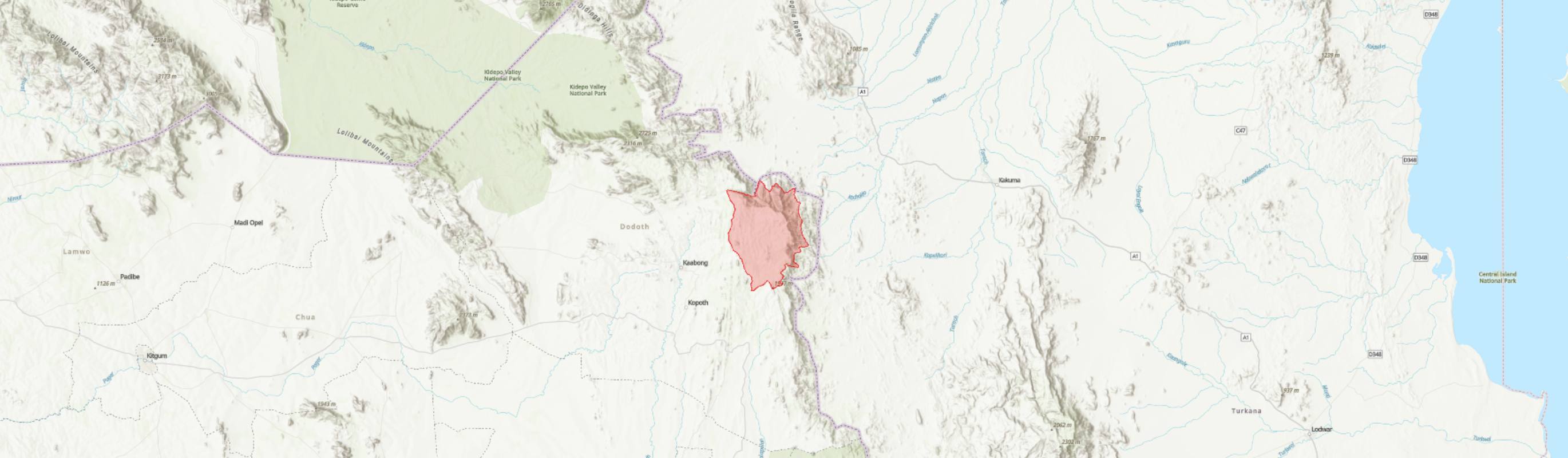
Timu IPA is located in Kaabong District in Karamoja sub-region, adjacent to the Uganda-Kenya border. The IPA is situated on the edge of the Uganda plateau overlooking the Rift Valley. The IPA expands upon Timu Central Forest Reserve, covering a total area of 381 km2, including parts of the escarpment leading towards the international border in the east and in the west towards Lopedo town.
Botanical significance
Timu is of botanical significance as it encompasses the entire global population of Aloe ikiorum, a Critically Endangered aloe species. This species was first described in 2011, it grows solitarily amongst tall Hyparrhenia grass on the escarpment overlooking the Kenya-Uganda border (Dioli 2011). Its species name “ikiorum” is derived from the Ik community (Dioli 2011). Several individuals were observed at the type locality, although no further localities have been identified. This area is near agricultural land and anthropogenic pressures here may be increasing (Google Earth 2025; Richards et al. 2022). The species was assessed as Critically Endangered and conservation of A. ikiorum within Timu IPA is therefore essential to preventing the extinction of this species.
There are few botanical collections from this site, more recent research in the area has only focused on succulents. It is highly likely there are more plant species of conservation significance within this IPA, particularly the escarpment vegetation which is limited in extent in Uganda.
This site is also valuable as a large, high-quality area of dry Combretum woodland, a nationally Vulnerable habitat type. While this habitat is relatively widespread in Uganda, there has been significant declines since the 1960s (Richards et al. 2024). Timu is, by contrast, a relatively undisturbed and continuous area of habitat that could be managed as a single site for conservation purposes.
Habitat and geology
The area is dominated by Dry Combretum wooded grassland, which is characterised by species such as Acacia (Vachellia) hockii, A. gerardii var. gerardii, Erythrina abyssinica and Combretum molle (Dawkins 1954; Dioli 2011). Grass communities in the understorey consist of tall Hyparrhenia-Themeda or, when disturbance is more frequent, shorter Sporobolus dominated grassland. This wooded grassland is influenced by fire, while the small areas of forest within this IPA are intolerant to such disturbance. These Juniperus procera forests are largely restricted to the upper escarpment ridges and are likely promoted by mist precipitation (Dawkins 1954; Dioli 2011; World Resources Institute 2023). It is likely that this forest was formerly more widespread, occurring within Timu CFR where little to no forest remains today (see Conservation Issues).
Conservation issues
Timu IPA encompasses Timu Central Forest Reserve (CFR) which was established in 1942 in recognition of its value as a water catchment area and dry season grazing site (Dawkins 1954). Part of the site has also been recognised as a Key Biodiversity Area, named Timu extension, also triggered by the presence of Aloe ikiorum (Plumptre et al. 2019).
The site is threatened by gold mining, which has expanded rapidly since 2023 after the IUCN Red List Assessment was completed. On the escarpment, at the northeast boundary of Timu CFR near Kanadap, mining sites have been established on the escarpment, the same habitat as that of Critically Endangered A. ikiorum. There may well, therefore, be individual mortalities of A. ikiorum associated with mining if individuals occur within such suitable habitat. Much of the mining is artisanal, however, the area is covered entirely by exploratory mining licenses (Spatial Dimension 2024) and so there may well be expansion of mining in the future. It has also been reported recently that people from the Turkana region of Kenya are also crossing the border to mine these areas (Lule 2023). Expansion of the mines further west will directly threaten the only known population of A. ikiorum.
Armed cattle raids, drought and food insecurity has led to the migration of Ik communities to the Timu area from the highlands in the far northeast corner of Uganda in recent decades (Cole 2015). This may have increased pressure on land for agriculture and harvesting of resources such as wood for charcoal and construction. However, the area is still sparsely populated compared to much of Uganda (Brinkhoff 2024).
The site likely had a greater extent of forest than at present. Dawkins (1954) described in his work, “Timu, and the vanishing forests of north-east Karamoja”, forests within Timu CFR between 5,000 and 6,000 ft (ca. 1,500 – 1830 m) – Juniperus forest at higher altitudes and Acacia-Euphorbia-Olea forest occurring at the lower end of this altitudinal range. At the time of Dawkins’ research, forest patches were receding due to fire and associated colonisation of forest edges with fire tolerant grasses that further exacerbate the impact of fire on the forest patches. Langdale-Brown (1964) later described the plateau in the Timu area as a mosaic of Juniperus forest and Dry Combretum grassland. However, apart from the riverine areas, the plateau has almost no forest today (World Resources Institute 2023). Alongside increased fire frequency, overgrazing by both wild and domestic animals may have contributed towards forest loss at this site (Rusetuka 2023). Dawkins (1954) suggests that the excessive grazing may reduce the flood tolerance of grassland areas, leading to water runoff and subsequent soil erosion and tree death within forest areas, although there was not extensive evidence of this at the time of his research. In addition, it was noted that there was little Juniperus regeneration within Timu CFR at this time (Dawkins 1954), which may well have led to complete loss of these forest patches after extreme disturbance events. Climate change in the region, including increasing temperatures and longer periods of drought, may well have also contributed to forest loss and prevention of forest re-establishment. Juniperus forest, also known as Afromontane undifferentiated forest, has been assessed as a Critically Endangered habitat nationally, with losses such as those at Timu contributing to the national decline in area of this habitat (Richards et al. In review).
Ecosystem services
The site is an important area for water catchment, one of the key reasons for designating this site as a CFR. The second reason for the designation of this site as a protected area is its value as a dry season grazing site (Dawkins 1954). The site also provides fuel, food and medicines for local communities. During the rainy season in Karamoja, runoff from grassland areas can be high (Dawkins 1954). The vegetation of this site likely stabilises the soils, particularly the forests on the steep escarpment sides.
The area is home to both Dodoth and Ik communities who are Indigenous to the north-east of Uganda. The escarpment area is also a tourist destination, with an eco-camp located north-east of the forest reserve. Tourism focuses on cultural exchange with Indigenous communities and hikes along the escarpment edge (Kara-Tunga 2024).
Site assessor(s)
Assessed by:
Sophie Richards, Royal Botanic Gardens, Kew
Iain Darbyshire, Royal Botanic Gardens, Kew
James Kalema, Makerere University Herbarium
Samuel Ojelel, Makerere University Herbarium
IPA criterion A species
| Species | Qualifying sub-criterion | ≥ 1% of global population | ≥ 5% of national population | 1 of 5 best sites nationally | Entire global population | Socio-economically important | Abundance at site |
|---|---|---|---|---|---|---|---|
| Aloe ikiorum Dioli & G.Powys | A(i) |  |
|
|
|
 |
Occasional |
Aloe ikiorum Dioli & G.Powys
Qualifying sub-criterion:
A(i)
≥ 1% of global population:
≥ 5% of national population:
1 of 5 best sites nationally:
Entire global population:
Socio-economically important:
Abundance at site:
Occasional
IPA criterion C qualifying habitats
| Habitat | Qualifying sub-criterion | ≥ 5% of national resource | ≥ 10% of national resource | 1 of 5 best sites nationally | Areal coverage at site |
|---|---|---|---|---|---|
| Dry Combretum wooded grassland (VU) | C(iii) | |
|
|
311.7 |
Dry Combretum wooded grassland (VU)
Qualifying sub-criterion:
C(iii)
≥ 5% of national resource:
≥ 10% of national resource:
Areal coverage at site:
311.7
General site habitats
| General site habitat | Percent coverage | Importance |
|---|---|---|
| Savanna - Dry Savanna | |
Major |
| Forest - Subtropical/Tropical Moist Montane Forest | |
Minor |
| Grassland - Subtropical/Tropical High Altitude Grassland | |
Major |
| Artificial - Terrestrial - Pastureland | |
Unknown |
Savanna - Dry Savanna
Percent coverage:
Importance:
Major
Forest - Subtropical/Tropical Moist Montane Forest
Percent coverage:
Importance:
Minor
Grassland - Subtropical/Tropical High Altitude Grassland
Percent coverage:
Importance:
Major
Artificial - Terrestrial - Pastureland
Percent coverage:
Importance:
Unknown
Land use types
| Land use type | Percent coverage | Importance |
|---|---|---|
| Nature conservation | |
Major |
| Agriculture (pastoral) | |
Minor |
| Residential / urban development | |
Minor |
Nature conservation
Percent coverage:
Importance:
Major
Agriculture (pastoral)
Percent coverage:
Importance:
Minor
Residential / urban development
Percent coverage:
Importance:
Minor
Threats
| Threat | Severity | Timing |
|---|---|---|
| Residential & commercial development - Housing & urban areas | Low | Ongoing - increasing |
| Agriculture & aquaculture - Livestock farming & ranching - Nomadic grazing | Unknown | Ongoing - trend unknown |
| Energy production & mining - Mining & quarrying | High | Ongoing - increasing |
| Natural system modifications - Fire & fire suppression | Unknown | Ongoing - trend unknown |
Residential & commercial development - Housing & urban areas
Severity:
Low
Timing:
Ongoing - increasing
Agriculture & aquaculture - Livestock farming & ranching - Nomadic grazing
Severity:
Unknown
Timing:
Ongoing - trend unknown
Energy production & mining - Mining & quarrying
Severity:
High
Timing:
Ongoing - increasing
Natural system modifications - Fire & fire suppression
Severity:
Unknown
Timing:
Ongoing - trend unknown
Protected areas
| Protected area name | Protected area type | Relationship with IPA | Areal overlap |
|---|---|---|---|
| Timu Central Forest Reserve | Forest Reserve (conservation) | IPA encompasses protected/conservation area | 122 |
Timu Central Forest Reserve
Protected area type:
Forest Reserve (conservation)
Relationship with IPA:
IPA encompasses protected/conservation area
Areal overlap:
122
Conservation designation
| Designation name | Protected area | Relationship with IPA | Areal overlap |
|---|---|---|---|
| Timu extension | Key Biodiversity Area | IPA encompasses protected/conservation area | 43 |
Timu extension
Protected area:
Key Biodiversity Area
Relationship with IPA:
IPA encompasses protected/conservation area
Areal overlap:
43
Bibliography
Conservation of vertebrates and plants in Uganda: Identifying Key Biodiversity Areas and other sites of national importance
Conservation Science and Practice, Vol 1, page(s) e7 Available online
The Vegetation of Uganda and its Bearing on Land-Use
Global Forest Watch 2023
Improving the application of Important Plant Areas to conserve threatened habitats: A case study of Uganda
Conservation Science and Practice, page(s) e13246
Uganda: Administrative Division (Regions and Districts) - Population Statistics, Charts and Map
Aloe lukeana: A New, Caulescent Aloe from Uganda
Cactus and Succulent Journal, Vol 87, page(s) 152-159
Timu, and the Vanishing Forests of North-East Karamoja
The East African Agricultural Journal, Vol 19, page(s) 164-167 Available online
Aloe ikiorum: A new species from Uganda
Cactus and Succulent Journal, Vol 83, page(s) 270-274 Available online
Deforestation and its Impacts on the Population in Uganda
PhD Thesis (pub. United University of Peace)
Timu Escarpment Walk
Security arrests 30 suspected Turkana illegal miners in Kaabong
New Vision Available online
Aloe ikiorum. The IUCN Red List of Threatened Species 2022: e.T110727150A110727173
Uganda Mining Cadastre Map Portal
Kaabong to tax artisanal miners to boost local revenue
Uganda


Recommended citation
Sophie Richards, Iain Darbyshire, James Kalema, Samuel Ojelel (2026) Tropical Important Plant Areas Explorer: Timu (Uganda). https://tipas.kew.org/site/timu/ (Accessed on 26/08/2026)