
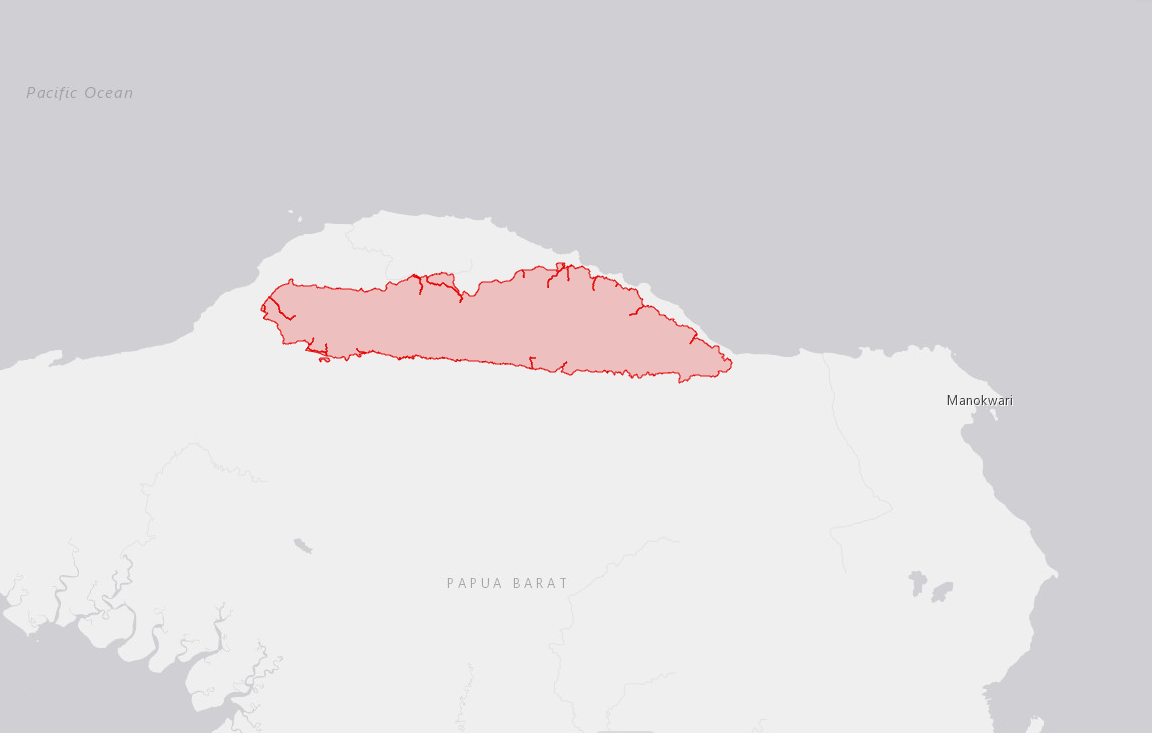
Country: New Guinea
Administrative region: Papua (Province)
Central co-ordinates: 0.72928 S, 133.03329 E
Qualifying IPA Criteria
A(i)Site contains one or more globally threatened species
IPA assessment rationale
Nine species are single site endemics to Mount Nettoti in the North Tambrauw range: Calamus kebariensis (LC), Agalmyla dentatisepala, Agalmyla wekariensis, Kania nettotensis, Falcatifolium sleumeri (NT), Grenacheria royenii, Leichhardtia kebarensis (DD), Vaccinium xerampelinum and Acronychia similaris.
There are also several other records of Bird's Head endemic plants from this area, some of which are assessed as threatened, for example Hydnophytum kebarense (from North Tambrauw and Ayawasi), and Tetractomia kostermansii (EN).
Site description
Tambrauw Utara comprises a large part of the Tambrauw Regency in the administrative area of Southwest Papua Province. The area, which is already allocated as a Nature Reserve (Cagar Alam Pegunungan Tambrauw Utara), lies to the north of the Trans Papua Highway, which runs approximately east to west in between the mountain ranges of Tambrauw Utara and Tambrauw Selatan. This site adjoins the Kebar Selatan TIPA on its southern boundary.
Botanical significance
The Tambrauw Utara region is mountainous, with the lowest elevation at around 100m, and the majority of the area between 500 and 2200m. The vegetation comprises mainly lower- to mid-montane forest, which is relatively undisturbed and lacking any major urban developments although small scale settlements are present throughout. Many plant species endemic (or subendemic) to the Bird’s Head are known to occur in Tambrauw Utara. Of these, seven have a threatened status according to IUCN Criteria: one is CR, four have a status of EN, and two are VU. Additionally, eight species of Bird’s Head endemics with a conservation status of Near Threatened (NT) are known to occur in Tambrauw Utara.
Habitat and geology
The majority of this area comprises montane forest, but the range of elevations present mean that there are diverse types of forest present, from lower montane forest with Lithocarpus and Elaeocarpus, to mossy montane forests with numerous epiphytes, and high elevation dwarf forests. The vegetation of the Tambrauw Utara area is classified as Vogelkop montane rainforest in the WWF Ecoregions scheme.
Conservation issues
Although the whole area is designated as a Nature Reserve, which affords some protection, it is still impacted by the resident human population. Small-scale forest clearance in proximity to human settlements is widespread, and subsistence hunting impacts local populations of birds and mammals.
The percentage of forest cover in the Tambrauw Lifescape region as a whole has decreased from 95% in 1994 to 89% in 2019 (Tetuka et al. 2020). Whilst the forest cover remains high, the rate of decrease has accelerated since 2010 (Tetuka et al. 2020), and this trend should be monitored.
The forests of Tambrauw are indicated to be part of a government initiative to return to a model of community-based forest management in some areas (Fatem 2019). This is seen as a potential way to sustainably manage forest resources. However, social forestry can be complex to implement and maintain, and may if improperly done represent a threat to the conservation of the forests (Parsch et al. 2022).
Furthermore, although Tanah Papua has the largest area of forest resources in Indonesia, research on and about the region is severely lacking (Fatem 2019). A significant risk to the forest of Tambrauw Utara is a lack of baseline data concerning which species occur there and their distributions. This applies to all groups of organisms including plants, birds, invertebrates, fish and mammals.
The entire area of Tambrauw Utara falls within the designated ‘Crown Jewel of Tanah Papua’ initiative area, which is expected to confer some level of protection from future deforestation.
Ecosystem services
The Tambrauw forest ecosystem provides many resources for local communities. The watersheds protect fisheries, the forest provides timber and other construction materials, hunting, ecotourism, crop pollination, soil fertility regeneration during shifting agricultural practice, and many non-timber forest products
Site assessor(s)
Assessed by:
Ruth Clark, Royal Botanic Gardens Kew
Laura Jennings, Royal Botanic Garden Kew
Jimmy Wanma, State University of Papua
Charlie D. Heatubun, The Provincial Government of West Papua and Universitas Papua
Date of first assessment: 3rd Nov 2025
IPA criterion A species
| Species | Qualifying sub-criterion | ≥ 1% of global population | ≥ 5% of national population | 1 of 5 best sites nationally | Entire global population | Socio-economically important | Abundance at site |
|---|---|---|---|---|---|---|---|
| Calamus kebariensis Maturb., J.Dransf. & W.J.Baker | A(iii) |  |
|
 |
|
|
Unknown |
| Agalmyla dentatisepala Hilliard & B.L.Burtt | A(iii) | |
|
|
|
|
Unknown |
| Agalmyla wekariensis Hilliard & B.L.Burtt | A(iii) | |
|
|
|
|
Unknown |
| Falcatifolium sleumeri de Laub. & Silba | A(iii) | |
|
|
|
|
Unknown |
| Leichhardtia kebarensis (P.I.Forst.) P.I.Forst. | A(iii) | |
|
|
|
|
Unknown |
| Vaccinium xerampelinum Sleumer | A(iii) | |
|
|
|
|
Unknown |
| Acronychia similaris T.G.Hartley | A(iii) | |
|
|
|
|
Unknown |
Calamus kebariensis Maturb., J.Dransf. & W.J.Baker
Qualifying sub-criterion:
A(iii)
≥ 1% of global population:
≥ 5% of national population:
1 of 5 best sites nationally:
Entire global population:
Socio-economically important:
Abundance at site:
Unknown
Agalmyla dentatisepala Hilliard & B.L.Burtt
Qualifying sub-criterion:
A(iii)
≥ 1% of global population:
≥ 5% of national population:
1 of 5 best sites nationally:
Entire global population:
Socio-economically important:
Abundance at site:
Unknown
Agalmyla wekariensis Hilliard & B.L.Burtt
Qualifying sub-criterion:
A(iii)
≥ 1% of global population:
≥ 5% of national population:
1 of 5 best sites nationally:
Entire global population:
Socio-economically important:
Abundance at site:
Unknown
Falcatifolium sleumeri de Laub. & Silba
Qualifying sub-criterion:
A(iii)
≥ 1% of global population:
≥ 5% of national population:
1 of 5 best sites nationally:
Entire global population:
Socio-economically important:
Abundance at site:
Unknown
Leichhardtia kebarensis (P.I.Forst.) P.I.Forst.
Qualifying sub-criterion:
A(iii)
≥ 1% of global population:
≥ 5% of national population:
1 of 5 best sites nationally:
Entire global population:
Socio-economically important:
Abundance at site:
Unknown
Vaccinium xerampelinum Sleumer
Qualifying sub-criterion:
A(iii)
≥ 1% of global population:
≥ 5% of national population:
1 of 5 best sites nationally:
Entire global population:
Socio-economically important:
Abundance at site:
Unknown
Acronychia similaris T.G.Hartley
Qualifying sub-criterion:
A(iii)
≥ 1% of global population:
≥ 5% of national population:
1 of 5 best sites nationally:
Entire global population:
Socio-economically important:
Abundance at site:
Unknown
General site habitats
| General site habitat | Percent coverage | Importance |
|---|---|---|
| Forest - Subtropical/Tropical Moist Montane Forest | |
Major |
Forest - Subtropical/Tropical Moist Montane Forest
Percent coverage:
Importance:
Major
Land use types
| Land use type | Percent coverage | Importance |
|---|---|---|
| Nature conservation | |
Major |
Nature conservation
Percent coverage:
Importance:
Major
Protected areas
| Protected area name | Protected area type | Relationship with IPA | Areal overlap |
|---|---|---|---|
| Cagar Alam Pegunungan Tambrauw Utara | National Nature Reserve | protected/conservation area overlaps with IPA | |
Cagar Alam Pegunungan Tambrauw Utara
Protected area type:
National Nature Reserve
Relationship with IPA:
protected/conservation area overlaps with IPA
Areal overlap:
Conservation designation
| Designation name | Protected area | Relationship with IPA | Areal overlap |
|---|---|---|---|
| Tamrau Utara | Key Biodiversity Area | protected/conservation area overlaps with IPA | |
Tamrau Utara
Protected area:
Key Biodiversity Area
Relationship with IPA:
protected/conservation area overlaps with IPA
Areal overlap:


Recommended citation
Ruth Clark, Laura Jennings, Jimmy Wanma, Charlie D. Heatubun (2026) Tropical Important Plant Areas Explorer: Tambrauw Utara (New Guinea). https://tipas.kew.org/site/tambrauw-utara/ (Accessed on 23/08/2026)