
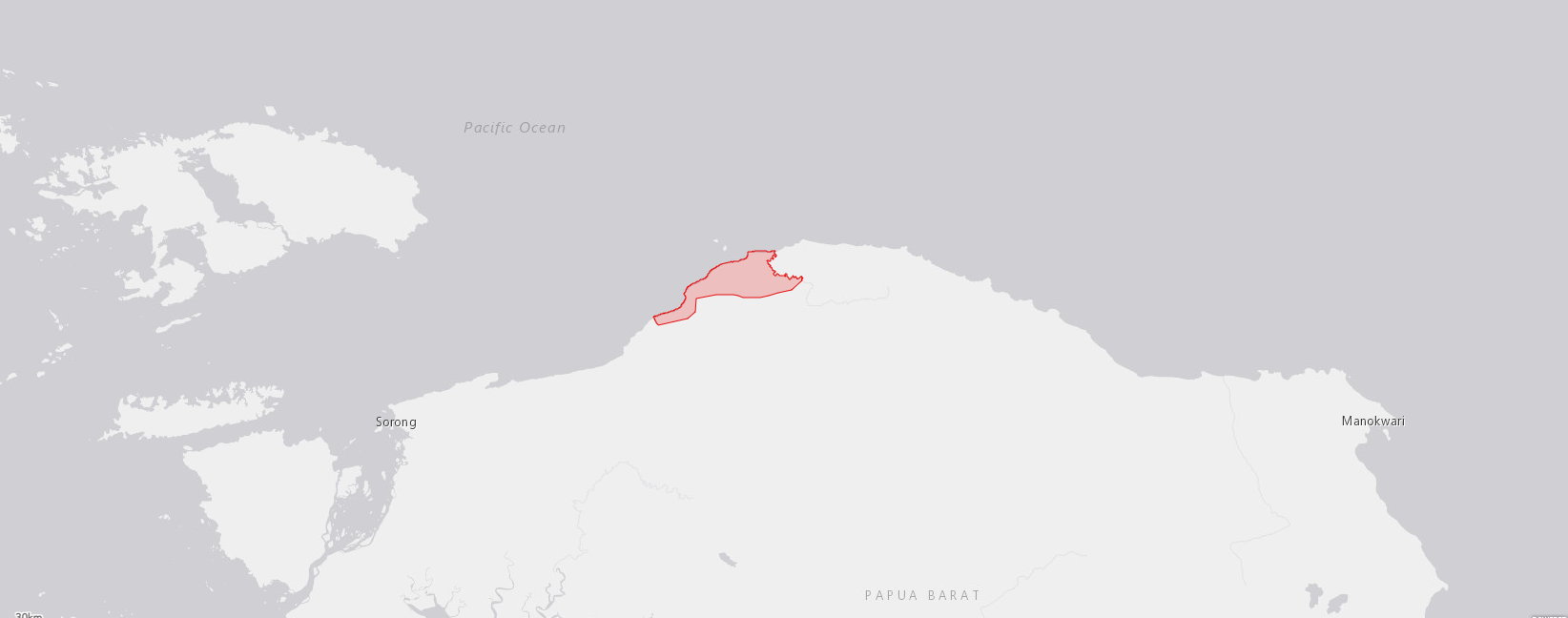
Country: New Guinea
Administrative region: Papua (Province)
Central co-ordinates: 0.46322 S, 132.24881 E
Qualifying IPA Criteria
A(i)Site contains one or more globally threatened species
IPA assessment rationale
Forest landscape contains a population of Melicope exuta, a species endemic to the Bird’s Head and assessed as Vulnerable. The more widely distributed Planchonella xylocarpa (NT) and Koordersiodendron pinnatum (VU) are also recorded here. Populations of other lowland forest species are close to the major cities of Sorong and Manokwari making the Sausapor forests a critical reservoir of diversity.
Site description
This lowland area in Papua Barat Dhaya province is bordered by the mountainous north Tambrauw nature reserve and marine protected areas on the coast (Purwanto et al. 2021). Sausapor is the largest town with a population of about c. 8000. The beaches are a hub of turtle conservation and intact vegetation restricts sedimentation that would harm these efforts particularly around the town of Koor (Fatem et al. 2020). Conserving these lowland forests is also critical to efforts to conserve the Bird’s Head seascape (Purwanto et al. 2021).
Botanical significance
This area is a rare tract of lowland rainforest in the Northern Bird’s Head with riverine and coastal habitats. Such so that under ecoregion classifications it is deemed montane rainforest despite being below 400 m. Whilst we have evidence of presence of at least one Bird’s Head endemic species (Melicope exuta) we expect more lowland forest species which have been recorded in better surveyed areas closer to Sorong and Manokwari to also occur here.
Habitat and geology
There is sedimentary geology to the south of the TIPA with volcanic band in the north. These rocks are overlain by lowland wet tropical forests that are highly threatened in Indonesia (Margono et al. 2014 https://doi.org/10.1038/nclimate2277). Coastal and riverine habitats are also present. Recent forest plot surveys near Sausapor found that the dominant tree species were Pimelodendron amboinicum and Xanthophyllum papuanum, with Gomphandra papuana, Adina multifolia, and Palaquium amboinense also notable.
Conservation issues
The lowland areas have least protection in the Tambrauw district that despite the Sausapor declaration requires information on the significance of the diversity in these rare intact lowland forests (Fatem et al. 2020). Useful species in this language area of Papua are predicted to be some of the most threatened by climate change (Camara-Leret et al. 2019).
Ecosystem services
The Sausapor forest ecosystem provides many resources for local populations. The watersheds protect fisheries, timber and other construction materials, hunting, ecotourism, crop pollination, soil fertility regeneration during shifting agricultural practice and provides many non-timber forest products (Fatem 2019 https://journal.unhas.ac.id/index.php/fs/article/view/5865/pdf_1, Fatem et al. 2020).
Site assessor(s)
Assessed by:
Liam Trethowan, Royal Botanic Gardens, Kew
Laura Jennings, Royal Botanic Garden Kew
Jimmy Wanma, State University of Papua
Charlie D. Heatubun, The Provincial Government of West Papua and Universitas Papua
Date of first assessment: 2nd Mar 2025
IPA criterion A species
| Species | Qualifying sub-criterion | ≥ 1% of global population | ≥ 5% of national population | 1 of 5 best sites nationally | Entire global population | Socio-economically important | Abundance at site |
|---|---|---|---|---|---|---|---|
| Koordersiodendron pinnatum Merr. | A(i) |  |
|
|
|
|
Unknown |
| Melicope exuta T.G.Hartley | A(i) | |
 |
|
|
|
Unknown |
Koordersiodendron pinnatum Merr.
Qualifying sub-criterion:
A(i)
≥ 1% of global population:
≥ 5% of national population:
1 of 5 best sites nationally:
Entire global population:
Socio-economically important:
Abundance at site:
Unknown
Melicope exuta T.G.Hartley
Qualifying sub-criterion:
A(i)
≥ 1% of global population:
≥ 5% of national population:
1 of 5 best sites nationally:
Entire global population:
Socio-economically important:
Abundance at site:
Unknown
General site habitats
| General site habitat | Percent coverage | Importance |
|---|---|---|
| Forest - Subtropical/Tropical Moist Lowland Forest | |
Forest - Subtropical/Tropical Moist Lowland Forest
Percent coverage:
Importance:
Bibliography
Indigenous Knowledge of New Guinea’s Useful Plants: A Review
Economic botany, Vol 73, page(s) 405–415
The Bird's Head Seascape Marine Protected Area network—Preventing biodiversity and ecosystem service loss amidst rapid change in Papua, Indonesia
Conservation Science and Practice, Vol 3, page(s) e393
The Sausapor Declaration: Challenges in promoting good governance to protect customary communities and natural resources in Tambrauw district, West Papua
Forest and Society, Vol 4(2), page(s) 330-337


Recommended citation
Liam Trethowan, Laura Jennings, Jimmy Wanma, Charlie D. Heatubun (2026) Tropical Important Plant Areas Explorer: Sausapor (New Guinea). https://tipas.kew.org/site/sausapor/ (Accessed on 25/08/2026)