
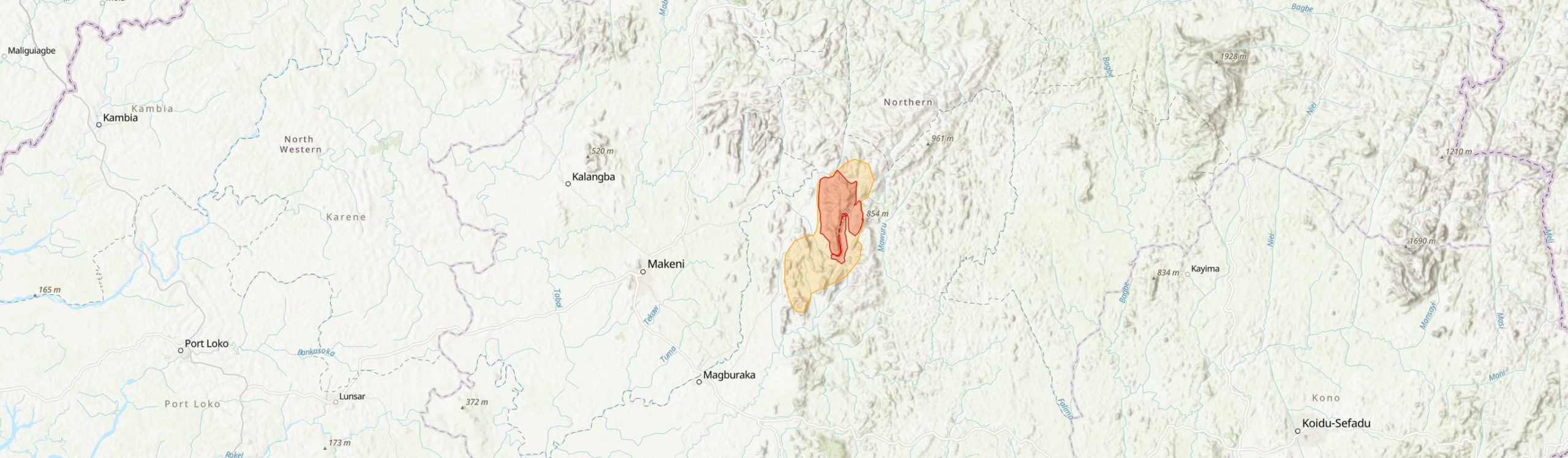
Country: Sierra Leone
Administrative region: Northern (Province)
Central co-ordinates: 8.97000 N, 11.73000 E
Area: 223.2km²
Qualifying IPA Criteria
A(i)Site contains one or more globally threatened species, B(i)Site contains a high number of species within defined habitat or vegetation types, C(i)Site contains globally threatened or restricted habitat or vegetation types
IPA assessment rationale
This site qualifies as an IPA as it contains globally significant populations of 53 threatened taxa that trigger criterion A(i). The IPA is one of the five best sites nationally for botanical richness and therefore falls under criterion B(i).It also has the presence of Sierra Leone's low evergreen forest, waterfalls with threatened species such as Ledermanniella aloides and one of the best sites for montane forest(the Sula Mountain) in Sierra Leone therefore falls in criterion C(i)
Site description
The Farangbaya Forest Reserve and Tonkolili River IPA is located in the southern Sula Mountains of the Northern Province of Sierra Leone. The Farangbaya Forest Reserve is a range of steep hills of about 13 km long and arranged from north to south. The highest hill is 865 m high and has a communications mast that is only accessible on foot. The Tonkolili River flows from north to south along the eastern side of the Farangbaya hills, then circles around the southernmost hill and continues to the northwest.
Botanical significance
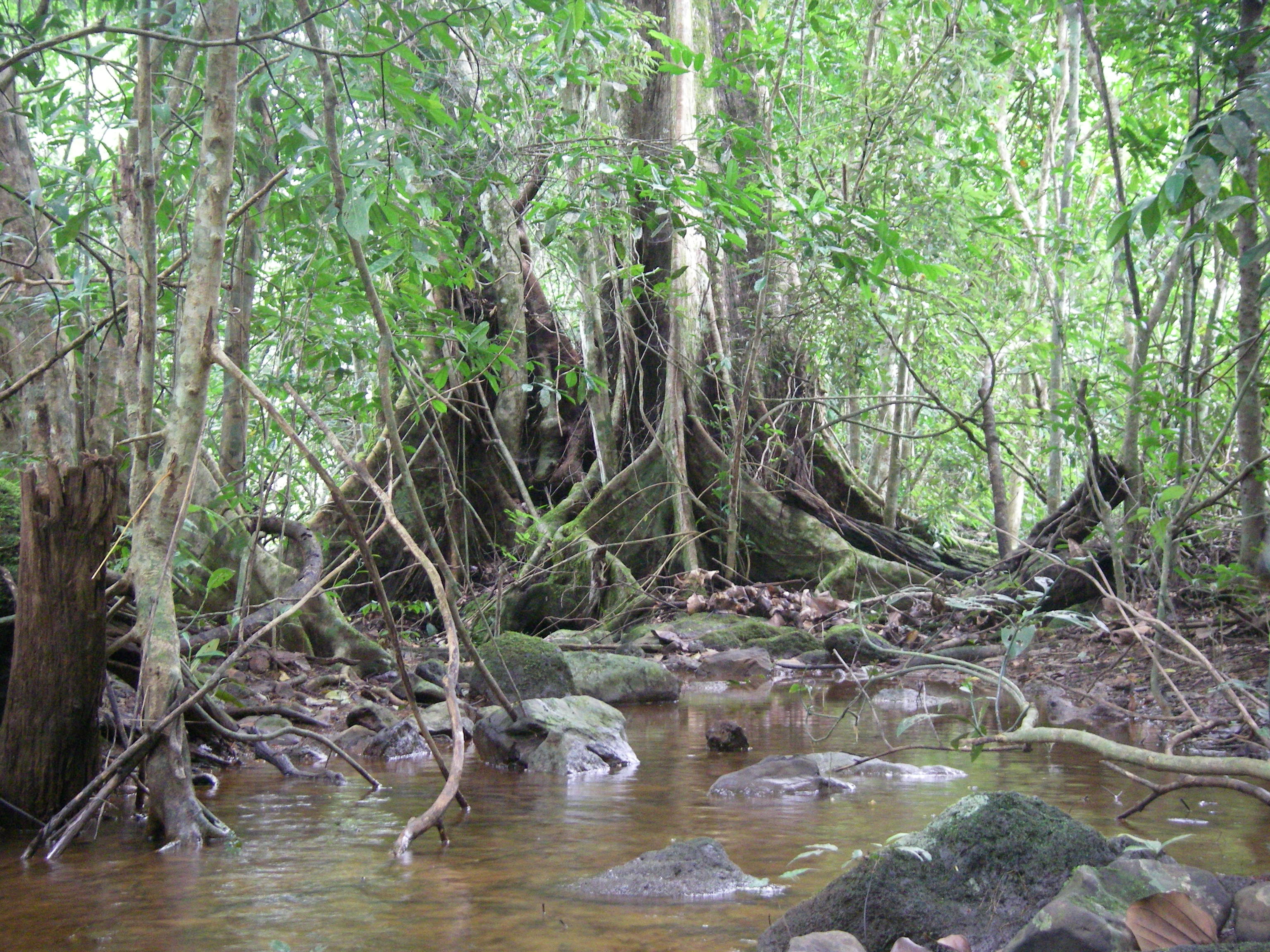
The Farangbaya Forest Reserve and Tonkolili River support globally significant populations of threatened and rare forest and riverine plant species. The gallery forest and riverbed of the Tonkolili River are rich in rare plant species. Two Critically Endangered species of Eriocaulon (Eriocaulaceae) were first described from collections made in the riverbed at this site: Eriocaulon petraeum and Eriocaulon sulanum (Phillips et al., 2012). Eriocaulon petraeum is endemic to the Sula Mountains, while E. sulanum was initially thought to be endemic but has since been recorded in Guinea. In total, two plant species endemic to Sierra Leone have been recorded at this site: Eriocaulon petraeum (CR) and Millettia leonensis (EN).
In the gallery forest along the Tonkolili River, several Endangered species were recorded: Baphia spathacea, Cola angustifolia, Dactyladenia smeathmannii, Eremospatha dransfieldii, Gilbertiodendron tonkolili, Placodiscus pseudostipularis, and Sericanthe trilocularis subsp. paroissei. Paleodissotis leonensis is only known from Guinea and Sierra Leone and is listed as Endangered because it is not resistant to fire. Paleodissotis leonensis was found on a rocky slope near the Tonkolili River; the species may also occur on rocky slopes near the summits. Napoleonaea alata (EN) was collected in the forest. Several widespread but threatened timber species have been recorded at the site, including Afzelia africana, Cryptosepalum tetraphyllum, Copaifera salikounda, Entandrophragma cylindricum, Lophira alata, Ansellia africana and Terminalia ivorensis (all listed as Vulnerable). The site also presents range-restricted Vulnerable species, for example Anubias gracilis, Brachystegia leonensis, Dialium pobeguinii, Didelotia afzelii, Gilbertiodendron aylmeri, Guibourtia leonensis and Tessmannia baikiaeoides.
Ansellia africana VU, Pavetta lasioclada VU, Baphia spathacea EN, and Nauclea diderrichii NT, have only been recorded within this IPA site in the country though they might occur in other areas if more research is conducted.
Habitat and geology
Vegetation at the Farangbaya Forest Reserve and Tonkolili River includes riverine forest, along the steep and rocky banks of the Tonkolili River; a remnant of what was once more continuous forest. River channel communities support herbaceous species rooted in the riverbed, particularly in areas with rapids and waterfalls. In most areas the original forest has been replaced by farmland, fallow land, and secondary vegetation, though small patches of high-quality forest persist in culturally significant “society bushes” at the site. The different vegetation types within the area provide a habitat for rare and threatened plant species.
The IPA is located within the Tonkolili Formation, consisting of metasedimentary rocks, including banded iron formations that are extracted at the nearby Tonkolili Mine (Kingho Mining), one of the country's major mining operations (Goodenough et al., 2018; GoSL, 2024).
Conservation issues
Mining activities at the Tonkolili iron ore mine, an active mining concession upstream and partly within the IPA (GoSL, 2024), is having significant impacts on habitats and plants at the site. Artisanal gold mining activities and farming are also having large impacts.
Rare aquatic herbs that are known to occur in the Tonkolili River, including rheophytic species such as members of the Eriocaulaceae family, are vulnerable to changes in water quality and flow regime caused by current mining activities. Satellite imagery indicates the presence of a dam where the IPA boundary meets the Tonkolili River, as well as significant sedimentation levels, which will adversely affect these sensitive species. Rheophytes, such as Eriocaulon petraeum and E. sulanum, rely on suitable water levels to trigger flowering and adequate high-water quality to photosynthesize. Although these species have been translocated to nearby suitable habitats, ongoing monitoring is required to ensure their survival at the IPA and translocation sites. Water pollution from mining activities poses a significant threat to the survival of the threatened plant species recorded at the site (van der Burgt et al., unpublished report, 2016).
The forest within the southern Sula Mountains, once only interrupted by a few grassland patches, has been extensively degraded through slash-and-burn agriculture, leaving only a narrow strip of forest along the steep and rocky banks of rivers and streams, including the Tonkolili River. This remnant forest, rich in rare plant species, remains under threat from mining waste sedimentation, gold digging, farming, and the proliferation of weedy species (van der Burgt et al. 2016, unpublished report). Conservation actions are critical to protect these threatened plant populations. Restoration efforts, coupled with water quality management and habitat monitoring, are urgently needed to mitigate these threats and safeguard the ecological integrity of this IPA.
Ecosystem services
The Tonkolili River is a water source for nearby villages such as Sokoya, Nerekoro and Baliaa, and is a tributary of the Rokel (Seli) River, the longest river in Sierra Leone, which is a water source to over 40% of the country's population. Additionally the riparian vegetation at the site regulates water quality and mitigates flooding.
Site assessor(s)
Assessed by:
Reviewed by:
Gabriella Hoban, Royal Botanic Gardens, Kew
Xander van der Burgt, Royal Botanic Gardens, Kew
Fanny Massally, Royal Botanic Gardens, Kew
Date of latest reassessment: 12th Jan 2026
Reviewed by:
Martin Cheek, The Royal Botanic Gardens Kew
Fanny Massally, The Royal Botanic Gardens, Kew
IPA criterion A species
| Species | Qualifying sub-criterion | ≥ 1% of global population | ≥ 5% of national population | 1 of 5 best sites nationally | Entire global population | Socio-economically important | Abundance at site |
|---|---|---|---|---|---|---|---|
| Anubias gracilis A.Chev. ex Hutch. | A(i) |  |
|
|
 |
|
Scarce |
| Aphanocalyx pteridophyllus (Harms) Wieringa | A(i) | |
|
|
|
|
Frequent |
| Brachystegia leonensis Hutch. & Burtt Davy | A(i) | |
|
|
|
|
Occasional |
| Cola angustifolia K.Schum. | A(i) | |
|
|
|
|
Scarce |
| Dactyladenia smeathmannii (Baill.) Prance & White | A(i) | |
|
|
|
|
Occasional |
| Paleodissotis leonensis (Hutch. & Dalziel) Ver.-Lib. & Burgt | A(i) | |
|
|
|
|
Scarce |
| Baphia spathacea Hook.f. | A(i) | |
|
|
|
|
Scarce |
| Eremospatha dransfieldii Sunderl. | A(i) | |
|
|
|
|
Occasional |
| Eriocaulon petraeum S.M.Phillips & Burgt | A(i) | |
|
|
|
|
Unknown |
| Eriocaulon sulanum S.M.Phillips & Burgt | A(i) | |
|
|
|
|
Unknown |
| Gilbertiodendron aylmeri (Hutch. & Dalziel) J.Léonard | A(i) | |
|
|
|
|
Frequent |
| Guibourtia leonensis J. L�onard | A(i) | |
|
|
|
|
Occasional |
| Landolphia macrantha (K.Schum.) Pichon | A(i) | |
|
|
|
|
Occasional |
| Millettia leonensis Hepper | A(i) | |
|
|
|
|
Occasional |
| Rinorea afzelii Engl. | A(i) | |
|
|
|
|
Scarce |
| Tessmannia baikieaoides Hutch. & Dalziel | A(i) | |
|
|
|
|
Abundant |
| Napoleonaea alata Jongkind | A(i) | |
|
|
|
|
|
| Placodiscus pseudostipularis Radlk. | A(i) | |
|
|
|
|
|
| Sericanthe trilocularis (Scott Elliot) Robbr. | A(i) | |
|
|
|
|
|
| Aulacocalyx divergens (Hutch. & Dalziel) Keay | A(i) | |
|
|
|
|
|
| Afzelia africana Sm. ex Pers. | A(i) | |
|
|
|
|
|
| Turraeanthus africana (Welw. ex C.DC.) Pellegr. | A(i) | |
|
|
|
|
|
| Entandrophragma cylindricum (Sprague) Sprague | A(i) | |
|
|
|
|
|
| Milicia regia (A.Chev.) C.C.Berg | A(i) | |
|
|
|
|
|
| Dialium pobeguinii Pellegr. | A(i) | |
|
|
|
|
|
| Lophira alata Banks ex Gaertn.f. | A(i) | |
|
|
|
|
|
| Anopyxis klaineana (Pierre) Engl. | A(i) | |
|
|
|
|
|
| Copaifera salikounda Heckel | A(i) | |
|
|
|
|
|
| Homalium smythei Hutch. & Dalziel | A(i) | |
|
|
|
|
|
| Didelotia afzelii Taub. | A(i) | |
|
|
|
|
|
| Neolemonniera clitandrifolia A.Chev. | A(i) | |
|
|
|
|
|
| Cryptosepalum tetraphyllum (Hook.f.) Benth. | A(i) | |
|
|
|
|
|
| Placodiscus oblongifolius | A(i) | |
|
|
|
|
|
| Strychnos melastomatoides Gilg. | A(i) | |
|
|
|
|
|
| Drypetes afzelii (Pax) Hutch. | A(i) | |
|
|
|
|
|
| Garcinia kola Heckel | A(i) | |
|
|
|
|
|
| Pavetta platycalyx Bremek. | A(i) | |
|
|
|
|
|
| Pavetta lasioclada (K.Krause) Mildbr. ex. Bremek. | A(i) | |
|
|
|
|
|
| Terminalia ivorensis A.Chev. | A(i) | |
|
|
|
|
|
| Stylochaeton pilosus Bogner | A(i) | |
|
|
|
|
|
| Pseudovigna sulaensis R.Clark & Burgt | A(i) | |
|
|
|
|
|
| Neolemonniera clitandrifolia A.Chev. | A(i) | |
|
|
|
|
|
| Millettia warneckei Harms | A(i) | |
|
|
|
|
|
| Nauclea diderrichii (De Wild. & T.Durand) Merrill | A(i) | |
|
|
|
|
|
| Monocyclanthus vignei Keay | A(i) | |
|
|
|
|
|
| Ledermanniella aloides (Engl.) C.Cusset | A(i) | |
|
|
|
|
|
| Khaya grandifoliola C.DC. | A(i) | |
|
|
|
|
|
| Garcinia afzelii Engl. | A(i) | |
|
|
|
|
|
| Ansellia africana Lindl. | A(i) | |
|
|
|
|
|
| Stonesia gracilis G.Taylor | A(i) | |
|
|
|
|
Scarce |
| Gilbertiodendron tonkolili Burgt & Estrella | A(i) | |
|
|
|
|
|
| Monocymbium lanceolatum C.E.Hubb. | A(i) | |
|
|
|
|
|
| Schizachyrium lomaense A.Camus | A(i) | |
|
|
|
|
Anubias gracilis A.Chev. ex Hutch.
Qualifying sub-criterion:
A(i)
≥ 1% of global population:
≥ 5% of national population:
1 of 5 best sites nationally:
Entire global population:
Socio-economically important:
Abundance at site:
Scarce
Aphanocalyx pteridophyllus (Harms) Wieringa
Qualifying sub-criterion:
A(i)
≥ 1% of global population:
≥ 5% of national population:
1 of 5 best sites nationally:
Entire global population:
Socio-economically important:
Abundance at site:
Frequent
Brachystegia leonensis Hutch. & Burtt Davy
Qualifying sub-criterion:
A(i)
≥ 1% of global population:
≥ 5% of national population:
1 of 5 best sites nationally:
Entire global population:
Socio-economically important:
Abundance at site:
Occasional
Cola angustifolia K.Schum.
Qualifying sub-criterion:
A(i)
≥ 1% of global population:
≥ 5% of national population:
1 of 5 best sites nationally:
Entire global population:
Socio-economically important:
Abundance at site:
Scarce
Dactyladenia smeathmannii (Baill.) Prance & White
Qualifying sub-criterion:
A(i)
≥ 1% of global population:
≥ 5% of national population:
1 of 5 best sites nationally:
Entire global population:
Socio-economically important:
Abundance at site:
Occasional
Paleodissotis leonensis (Hutch. & Dalziel) Ver.-Lib. & Burgt
Qualifying sub-criterion:
A(i)
≥ 1% of global population:
≥ 5% of national population:
1 of 5 best sites nationally:
Entire global population:
Socio-economically important:
Abundance at site:
Scarce
Baphia spathacea Hook.f.
Qualifying sub-criterion:
A(i)
≥ 1% of global population:
≥ 5% of national population:
1 of 5 best sites nationally:
Entire global population:
Socio-economically important:
Abundance at site:
Scarce
Eremospatha dransfieldii Sunderl.
Qualifying sub-criterion:
A(i)
≥ 1% of global population:
≥ 5% of national population:
1 of 5 best sites nationally:
Entire global population:
Socio-economically important:
Abundance at site:
Occasional
Eriocaulon petraeum S.M.Phillips & Burgt
Qualifying sub-criterion:
A(i)
≥ 1% of global population:
≥ 5% of national population:
1 of 5 best sites nationally:
Entire global population:
Socio-economically important:
Abundance at site:
Unknown
Eriocaulon sulanum S.M.Phillips & Burgt
Qualifying sub-criterion:
A(i)
≥ 1% of global population:
≥ 5% of national population:
1 of 5 best sites nationally:
Entire global population:
Socio-economically important:
Abundance at site:
Unknown
Gilbertiodendron aylmeri (Hutch. & Dalziel) J.Léonard
Qualifying sub-criterion:
A(i)
≥ 1% of global population:
≥ 5% of national population:
1 of 5 best sites nationally:
Entire global population:
Socio-economically important:
Abundance at site:
Frequent
Guibourtia leonensis J. L�onard
Qualifying sub-criterion:
A(i)
≥ 1% of global population:
≥ 5% of national population:
1 of 5 best sites nationally:
Entire global population:
Socio-economically important:
Abundance at site:
Occasional
Landolphia macrantha (K.Schum.) Pichon
Qualifying sub-criterion:
A(i)
≥ 1% of global population:
≥ 5% of national population:
1 of 5 best sites nationally:
Entire global population:
Socio-economically important:
Abundance at site:
Occasional
Millettia leonensis Hepper
Qualifying sub-criterion:
A(i)
≥ 1% of global population:
≥ 5% of national population:
1 of 5 best sites nationally:
Entire global population:
Socio-economically important:
Abundance at site:
Occasional
Rinorea afzelii Engl.
Qualifying sub-criterion:
A(i)
≥ 1% of global population:
≥ 5% of national population:
1 of 5 best sites nationally:
Entire global population:
Socio-economically important:
Abundance at site:
Scarce
Tessmannia baikieaoides Hutch. & Dalziel
Qualifying sub-criterion:
A(i)
≥ 1% of global population:
≥ 5% of national population:
1 of 5 best sites nationally:
Entire global population:
Socio-economically important:
Abundance at site:
Abundant
Napoleonaea alata Jongkind
Qualifying sub-criterion:
A(i)
≥ 1% of global population:
≥ 5% of national population:
1 of 5 best sites nationally:
Entire global population:
Socio-economically important:
Abundance at site:
Placodiscus pseudostipularis Radlk.
Qualifying sub-criterion:
A(i)
≥ 1% of global population:
≥ 5% of national population:
1 of 5 best sites nationally:
Entire global population:
Socio-economically important:
Abundance at site:
Sericanthe trilocularis (Scott Elliot) Robbr.
Qualifying sub-criterion:
A(i)
≥ 1% of global population:
≥ 5% of national population:
1 of 5 best sites nationally:
Entire global population:
Socio-economically important:
Abundance at site:
Aulacocalyx divergens (Hutch. & Dalziel) Keay
Qualifying sub-criterion:
A(i)
≥ 1% of global population:
≥ 5% of national population:
1 of 5 best sites nationally:
Entire global population:
Socio-economically important:
Abundance at site:
Afzelia africana Sm. ex Pers.
Qualifying sub-criterion:
A(i)
≥ 1% of global population:
≥ 5% of national population:
1 of 5 best sites nationally:
Entire global population:
Socio-economically important:
Abundance at site:
Turraeanthus africana (Welw. ex C.DC.) Pellegr.
Qualifying sub-criterion:
A(i)
≥ 1% of global population:
≥ 5% of national population:
1 of 5 best sites nationally:
Entire global population:
Socio-economically important:
Abundance at site:
Entandrophragma cylindricum (Sprague) Sprague
Qualifying sub-criterion:
A(i)
≥ 1% of global population:
≥ 5% of national population:
1 of 5 best sites nationally:
Entire global population:
Socio-economically important:
Abundance at site:
Milicia regia (A.Chev.) C.C.Berg
Qualifying sub-criterion:
A(i)
≥ 1% of global population:
≥ 5% of national population:
1 of 5 best sites nationally:
Entire global population:
Socio-economically important:
Abundance at site:
Dialium pobeguinii Pellegr.
Qualifying sub-criterion:
A(i)
≥ 1% of global population:
≥ 5% of national population:
1 of 5 best sites nationally:
Entire global population:
Socio-economically important:
Abundance at site:
Lophira alata Banks ex Gaertn.f.
Qualifying sub-criterion:
A(i)
≥ 1% of global population:
≥ 5% of national population:
1 of 5 best sites nationally:
Entire global population:
Socio-economically important:
Abundance at site:
Anopyxis klaineana (Pierre) Engl.
Qualifying sub-criterion:
A(i)
≥ 1% of global population:
≥ 5% of national population:
1 of 5 best sites nationally:
Entire global population:
Socio-economically important:
Abundance at site:
Copaifera salikounda Heckel
Qualifying sub-criterion:
A(i)
≥ 1% of global population:
≥ 5% of national population:
1 of 5 best sites nationally:
Entire global population:
Socio-economically important:
Abundance at site:
Homalium smythei Hutch. & Dalziel
Qualifying sub-criterion:
A(i)
≥ 1% of global population:
≥ 5% of national population:
1 of 5 best sites nationally:
Entire global population:
Socio-economically important:
Abundance at site:
Didelotia afzelii Taub.
Qualifying sub-criterion:
A(i)
≥ 1% of global population:
≥ 5% of national population:
1 of 5 best sites nationally:
Entire global population:
Socio-economically important:
Abundance at site:
Neolemonniera clitandrifolia A.Chev.
Qualifying sub-criterion:
A(i)
≥ 1% of global population:
≥ 5% of national population:
1 of 5 best sites nationally:
Entire global population:
Socio-economically important:
Abundance at site:
Cryptosepalum tetraphyllum (Hook.f.) Benth.
Qualifying sub-criterion:
A(i)
≥ 1% of global population:
≥ 5% of national population:
1 of 5 best sites nationally:
Entire global population:
Socio-economically important:
Abundance at site:
Placodiscus oblongifolius
Qualifying sub-criterion:
A(i)
≥ 1% of global population:
≥ 5% of national population:
1 of 5 best sites nationally:
Entire global population:
Socio-economically important:
Abundance at site:
Strychnos melastomatoides Gilg.
Qualifying sub-criterion:
A(i)
≥ 1% of global population:
≥ 5% of national population:
1 of 5 best sites nationally:
Entire global population:
Socio-economically important:
Abundance at site:
Drypetes afzelii (Pax) Hutch.
Qualifying sub-criterion:
A(i)
≥ 1% of global population:
≥ 5% of national population:
1 of 5 best sites nationally:
Entire global population:
Socio-economically important:
Abundance at site:
Garcinia kola Heckel
Qualifying sub-criterion:
A(i)
≥ 1% of global population:
≥ 5% of national population:
1 of 5 best sites nationally:
Entire global population:
Socio-economically important:
Abundance at site:
Pavetta platycalyx Bremek.
Qualifying sub-criterion:
A(i)
≥ 1% of global population:
≥ 5% of national population:
1 of 5 best sites nationally:
Entire global population:
Socio-economically important:
Abundance at site:
Pavetta lasioclada (K.Krause) Mildbr. ex. Bremek.
Qualifying sub-criterion:
A(i)
≥ 1% of global population:
≥ 5% of national population:
1 of 5 best sites nationally:
Entire global population:
Socio-economically important:
Abundance at site:
Terminalia ivorensis A.Chev.
Qualifying sub-criterion:
A(i)
≥ 1% of global population:
≥ 5% of national population:
1 of 5 best sites nationally:
Entire global population:
Socio-economically important:
Abundance at site:
Stylochaeton pilosus Bogner
Qualifying sub-criterion:
A(i)
≥ 1% of global population:
≥ 5% of national population:
1 of 5 best sites nationally:
Entire global population:
Socio-economically important:
Abundance at site:
Pseudovigna sulaensis R.Clark & Burgt
Qualifying sub-criterion:
A(i)
≥ 1% of global population:
≥ 5% of national population:
1 of 5 best sites nationally:
Entire global population:
Socio-economically important:
Abundance at site:
Neolemonniera clitandrifolia A.Chev.
Qualifying sub-criterion:
A(i)
≥ 1% of global population:
≥ 5% of national population:
1 of 5 best sites nationally:
Entire global population:
Socio-economically important:
Abundance at site:
Millettia warneckei Harms
Qualifying sub-criterion:
A(i)
≥ 1% of global population:
≥ 5% of national population:
1 of 5 best sites nationally:
Entire global population:
Socio-economically important:
Abundance at site:
Nauclea diderrichii (De Wild. & T.Durand) Merrill
Qualifying sub-criterion:
A(i)
≥ 1% of global population:
≥ 5% of national population:
1 of 5 best sites nationally:
Entire global population:
Socio-economically important:
Abundance at site:
Monocyclanthus vignei Keay
Qualifying sub-criterion:
A(i)
≥ 1% of global population:
≥ 5% of national population:
1 of 5 best sites nationally:
Entire global population:
Socio-economically important:
Abundance at site:
Ledermanniella aloides (Engl.) C.Cusset
Qualifying sub-criterion:
A(i)
≥ 1% of global population:
≥ 5% of national population:
1 of 5 best sites nationally:
Entire global population:
Socio-economically important:
Abundance at site:
Khaya grandifoliola C.DC.
Qualifying sub-criterion:
A(i)
≥ 1% of global population:
≥ 5% of national population:
1 of 5 best sites nationally:
Entire global population:
Socio-economically important:
Abundance at site:
Garcinia afzelii Engl.
Qualifying sub-criterion:
A(i)
≥ 1% of global population:
≥ 5% of national population:
1 of 5 best sites nationally:
Entire global population:
Socio-economically important:
Abundance at site:
Ansellia africana Lindl.
Qualifying sub-criterion:
A(i)
≥ 1% of global population:
≥ 5% of national population:
1 of 5 best sites nationally:
Entire global population:
Socio-economically important:
Abundance at site:
Stonesia gracilis G.Taylor
Qualifying sub-criterion:
A(i)
≥ 1% of global population:
≥ 5% of national population:
1 of 5 best sites nationally:
Entire global population:
Socio-economically important:
Abundance at site:
Scarce
Gilbertiodendron tonkolili Burgt & Estrella
Qualifying sub-criterion:
A(i)
≥ 1% of global population:
≥ 5% of national population:
1 of 5 best sites nationally:
Entire global population:
Socio-economically important:
Abundance at site:
Monocymbium lanceolatum C.E.Hubb.
Qualifying sub-criterion:
A(i)
≥ 1% of global population:
≥ 5% of national population:
1 of 5 best sites nationally:
Entire global population:
Socio-economically important:
Abundance at site:
Schizachyrium lomaense A.Camus
Qualifying sub-criterion:
A(i)
≥ 1% of global population:
≥ 5% of national population:
1 of 5 best sites nationally:
Entire global population:
Socio-economically important:
Abundance at site:
IPA criterion C qualifying habitats
| Habitat | Qualifying sub-criterion | ≥ 5% of national resource | ≥ 10% of national resource | 1 of 5 best sites nationally | Areal coverage at site |
|---|---|---|---|---|---|
| Low-altitude evergreen forest and gallery forest | C(i) | |
|
|
|
| Waterfalls with endemic Podostemaceae | C(i) | |
|
|
|
| Submontane forest | C(i) | |
|
|
Low-altitude evergreen forest and gallery forest
Qualifying sub-criterion:
C(i)
≥ 5% of national resource:
≥ 10% of national resource:
Areal coverage at site:
Waterfalls with endemic Podostemaceae
Qualifying sub-criterion:
C(i)
≥ 5% of national resource:
≥ 10% of national resource:
Areal coverage at site:
Submontane forest
Qualifying sub-criterion:
C(i)
≥ 5% of national resource:
≥ 10% of national resource:
Areal coverage at site:
General site habitats
| General site habitat | Percent coverage | Importance |
|---|---|---|
| Forest - Subtropical/Tropical Moist Lowland Forest | |
|
| Wetlands (inland) - Permanent Rivers, Streams, Creeks [includes waterfalls] | |
|
| Artificial - Terrestrial - Subtropical/Tropical Heavily Degraded Former Forest | |
Forest - Subtropical/Tropical Moist Lowland Forest
Percent coverage:
Importance:
Wetlands (inland) - Permanent Rivers, Streams, Creeks [includes waterfalls]
Percent coverage:
Importance:
Artificial - Terrestrial - Subtropical/Tropical Heavily Degraded Former Forest
Percent coverage:
Importance:
Land use types
| Land use type | Percent coverage | Importance |
|---|---|---|
| Extractive industry | 20 | Major |
Extractive industry
Percent coverage:
20
Importance:
Major
Threats
| Threat | Severity | Timing |
|---|---|---|
| Agriculture & aquaculture - Annual & perennial non-timber crops - Small-holder farming | Medium | Ongoing - trend unknown |
| Natural system modifications - Dams & water management/use - Abstraction of surface water (unknown use) | Medium | Ongoing - stable |
| Natural system modifications - Dams & water management/use - Abstraction of surface water (commercial use) | High | Ongoing - stable |
| Energy production & mining - Mining & quarrying | High | Ongoing - stable |
| Pollution - Agricultural & forestry effluents - Soil erosion, sedimentation | Medium | Ongoing - trend unknown |
Agriculture & aquaculture - Annual & perennial non-timber crops - Small-holder farming
Severity:
Medium
Timing:
Ongoing - trend unknown
Natural system modifications - Dams & water management/use - Abstraction of surface water (unknown use)
Severity:
Medium
Timing:
Ongoing - stable
Natural system modifications - Dams & water management/use - Abstraction of surface water (commercial use)
Severity:
High
Timing:
Ongoing - stable
Energy production & mining - Mining & quarrying
Severity:
High
Timing:
Ongoing - stable
Pollution - Agricultural & forestry effluents - Soil erosion, sedimentation
Severity:
Medium
Timing:
Ongoing - trend unknown
Protected areas
| Protected area name | Protected area type | Relationship with IPA | Areal overlap |
|---|---|---|---|
| Farangbaia Forest Reserve | National Reserve | protected/conservation area overlaps with IPA | 80 |
Farangbaia Forest Reserve
Protected area type:
National Reserve
Relationship with IPA:
protected/conservation area overlaps with IPA
Areal overlap:
80
Bibliography
Geological Mapping of Sierra Leone: Baseline Assessment and Next Steps (unpublished)
Government of Sierra Leone Online Repository of Mining Licences
Two new species of Eriocaulon (Eriocaulaceae) from Sierra Leone
Kew Bulletin, Vol 67, page(s) 273-280
Sula Mountains and transport corridor plant species of conservation importance (unpublished report)
THE COMPENDIUM OF RARE AND THREATENED FOREST FLORA IN SIERRA LEONE
ENVIRONMENTAL PROTECTION AGENCY-SIERRA LEONE Available online


Recommended citation
Gabriella Hoban, Xander van der Burgt, Fanny Massally (2026) Tropical Important Plant Areas Explorer: Farangbaya Forest Reserve and Tonkolili River (Sierra Leone). https://tipas.kew.org/site/farangbaya-riverine/ (Accessed on 26/08/2026)