
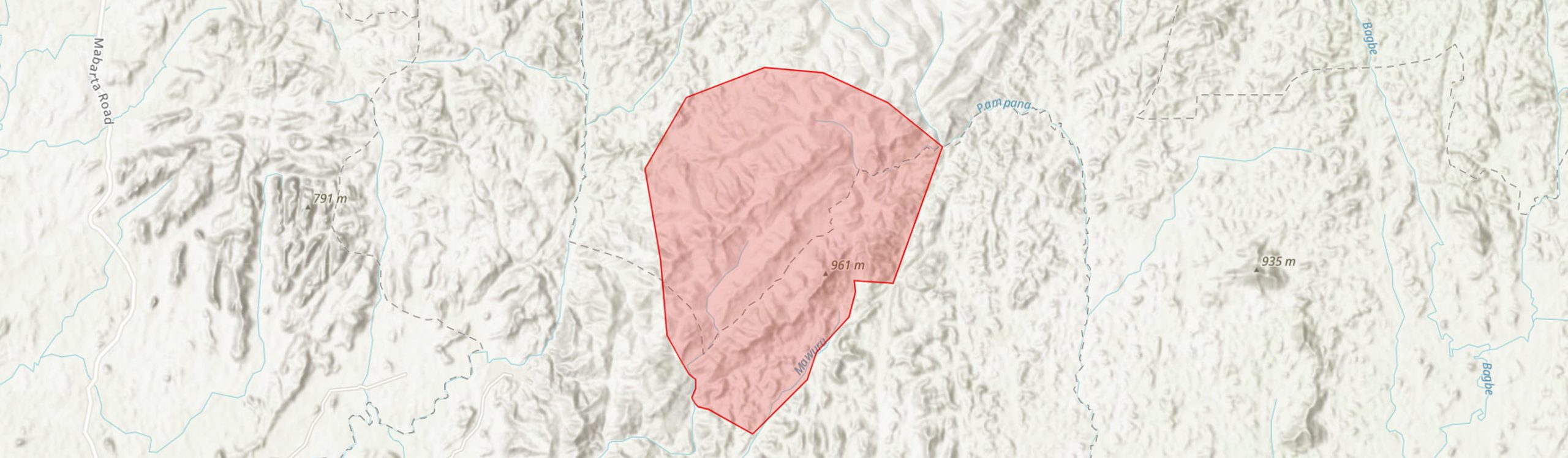
Country: Sierra Leone
Administrative region: Northern (Province)
Central co-ordinates: 9.20000 N, 11.55 W
Area: 236.7km²
Qualifying IPA Criteria
A(i)Site contains one or more globally threatened species, C(iii)Site contains nationally threatened or restricted habitat or vegetation types, AND/OR habitats that have severely declined in extent nationally
IPA assessment rationale
xxx
Site description
The Sula Mountains Grassland IPA is located in the northern section of the Sula Mountains, spanning Koinadugu and Tonkolili Districts in the Northern Province of Sierra Leone. The site lies north of the Farangbaya Forest Reserve, much of which currently falls within the active Tonkolili mining license area (GoSL 2024).
The Sula Mountains Grassland IPA contains several villages that have been there for many years, for example Kasafoni and Darakuru, each consisting of a few dozen family houses. The inhabitants of these villages utilize the area for agriculture. Swampy areas in valleys are utilized to grow wetland rice, sweet potatoes, groundnuts, etc. Forest on slopes are also used to grow rice, of varieties adapted to well-drained soils. The rice grows mixed with several other crops, such as maize, millet, Capsicum pepper and sesame. Oil palm trees are always left standing and used for palm oil production. These farmlands on slopes are left fallow for several years, before taken into cultivation again by slashing and burning the shrubby vegetation that has developed since the last farming. Small amounts of timber, as well as non-timber forest products, are collected mainly for use by the villagers themselves.
Artisanal gold digging has been practiced on a small scale by the villagers for some time, at times of the year when there was less farming work, and the water levels in the streams were low enough for gold digging. In recent years, many artisanal gold diggers have moved into the Sula Mountains. They practice gold digging year-round and on a larger scale, using water pumps to extract gold from sediment. They search for gold in sediment deposits near streams. The digging is done by hand, and they do not have machinery to crush hard rocks. The gold diggers created several new villages near the gold deposits, that contain numerous small huts which appear to be temporary. Their activity is well visible on Google Earth.
The hills of the Sula Mountains contains considerable iron ore deposits. A railway line was build to transport iron ore from the Sula Mountains to a port site near Pepel and since 2012 iron ore is being exported. The iron ore is currently extracted by open-pit mining, from three hills in the southern Sula Mountains: Simbili, Marampon and Numbara Hill. Of these three hills, only Numbara Hill is mainly grassland vegetation; the other two hills contain mainly forest vegetation. All sites of Pseudovigna sulaensis (VU) on Numbara Hill are destroyed because of open-pit mining, but the species still occurs on many other hills in the Sula Mountains, as well as on the Mts Béro in Guinea. Several hills in the central Sula Mountains have been surveyed for the presence of iron ore, but these hills are not yet mined. On Google Earth, old roads and test drilling platforms are visible.
Botanical significance
The Sula Mountains Grassland IPA has been designated to safeguard the high-altitude grassland habitats characteristic of the central and northern Sula Mountains, from the hills around Sakasakala village to the hills around Lake Sonfon. The IPA supports a suite of plant species of conservation concern, occurring in these high-altitude grasslands. The surrounding buffer zone also includes critical habitats for plant species of conservation importance, especially the river bed and gallery forest of the Tonkolili River.
Eriocaulon petraeum (CR) is endemic to the Sula Mountains and occurs in riverine habitats within the IPA. Eriocaulon sulanum was assessed as CR because the species was thought to be endemic to a short section of the Tonkolili River; however, the species has now been found in several places in Guinea. Pseudovigna sulaensis (VU) is near-endemic to the high-altitude grasslands of the Sula Mountains; recent fieldwork recorded the species at Mt Béro in Guinea. It remains unprotected across its range. Habenaria jaegeri (EN) has been recorded on well-drained grassland soils on Mt Kasafoni, while Habenaria jacobii (EN) was found common in high-altitude wet grasslands within this IPA. Both species occur outside of formally protected areas. Utricularia macrocheilos (VU), which inhabits similar high-altitude wet grasslands, has also been recorded. Additional threatened species present include Bryaspis humularioides (EN), Schizachyrium lomaense (VU), Aeschynomene deightonii (NT) in low-altitude grasslands, and Droogmansia scaettaiana (NT). Although not yet collected within the IPA, there is suitable habitat for Eriosema arenicola (VU) and Raphionacme caerulea (EN). These records reflect the unique botanical value of the site and its importance in safeguarding range-restricted and habitat-specific species, particularly those associated with high-altitude grassland and rocky, seasonally inundated substrates.
Habitat and geology
The Sula Mountains are characterised by rolling hills. The Sula grassland is part of the supracrustal belt dominated by metasedimentary rocks including banded iron formations (MacFarlane et al., 1981).
MACFARLANE, A, CROW, M J, ARTHURS, J W, WILKINSON, A F, AND AUCOTT, J W. 1981. The geology
and mineral resources of Northern Sierra Leone.Overseas Mem. Inst. Geol. Sci. No. 7.
Goodenough, K. M., Jones, D., & Ford, J. (2018). Geological mapping of Sierra Leone: baseline assessment and next steps. Nottingham, UK, British Geological Survey, 19pp. (OR/18/004) (Unpublished)
Conservation issues
Data on the extent and impact of these land and vegetation uses are lacking. Currently, there is no management plan for this area, nor are there actions in place to incorporate and monitor plant diversity at the site (FAO 2023).
The upper areas of the hills are lightly impacted due to challenging topography and absence of roads. In contrast, the lowland regions have experienced significant tree cover loss over the past 20 years (Global Forest Watch 2024) and continue to face threats from human activities, including land clearing for agriculture and fire. Anthropogenic fires linked to slash-and-burn agricultural practices particularly threaten native vegetation not adapted to high-frequency fire. Consequently, lowland areas have degraded, shifting in composition from rain forest species to secondary forest species (Cole 1967).
Ecosystem services
The grasslands are less used by the villagers. The grasslands on the hills in the Sula Mountains are used by people of the Fulani ethnic group, to raise their cattle. They usually settle in an area after obtaining permission from the village chief. The herdsmen live with their families in temporary villages with several round huts and round cattle corrals. They move around in a region in an annual cycle, to find the best grass for their cattle. The herdsmen often set fire to the grasslands to promote the growth of new grass to feed their cattle.
Site assessor(s)
Assessed by:
Gabriella Hoban, Royal Botanic Gardens, Kew
Fanny Massally, Royal Botanic Gardens, Kew
Date of first assessment: 8th Aug 2025
Reviewed by:Xander van der Burgt, The Royal Botanic Gardens Kew
IPA criterion A species
| Species | Qualifying sub-criterion | ≥ 1% of global population | ≥ 5% of national population | 1 of 5 best sites nationally | Entire global population | Socio-economically important | Abundance at site |
|---|---|---|---|---|---|---|---|
| Pseudovigna sulaensis R.Clark & Burgt | A(i) |  |
|
|
 |
|
Abundant |
| Eriocaulon petraeum S.M.Phillips & Burgt | A(i) | |
|
|
|
|
Abundant |
| Habenaria jaegeri Summerh. | A(i) | |
|
|
|
|
Occasional |
| Habenaria jacobii Summerh. | A(i) | |
|
|
|
|
Common |
| Afzelia africana Sm. ex Pers. | A(i) | |
|
|
|
|
|
| Anubias gracilis A.Chev. ex Hutch. | A(i) | |
|
|
|
|
|
| Raphionacme caerulea E.A.Bruce | A(i) | |
|
|
|
|
|
| Brachystegia leonensis Hutch. & Burtt Davy | A(i) | |
|
|
|
|
|
| Neolemonniera clitandrifolia A.Chev. | A(i) | |
|
|
|
|
|
| Cryptosepalum tetraphyllum (Hook.f.) Benth. | A(i) | |
|
|
|
|
|
| Monocymbium lanceolatum C.E.Hubb. | A(i) | |
|
|
|
|
Frequent |
| Schizachyrium lomaense A.Camus | A(i) | |
|
|
|
|
Frequent |
| Sericanthe trilocularis (Scott Elliot) Robbr. | A(i) | |
|
|
|
|
Frequent |
| Bryaspis humularioides Gledhill | A(i) | |
|
|
|
|
Pseudovigna sulaensis R.Clark & Burgt
Qualifying sub-criterion:
A(i)
≥ 1% of global population:
≥ 5% of national population:
1 of 5 best sites nationally:
Entire global population:
Socio-economically important:
Abundance at site:
Abundant
Eriocaulon petraeum S.M.Phillips & Burgt
Qualifying sub-criterion:
A(i)
≥ 1% of global population:
≥ 5% of national population:
1 of 5 best sites nationally:
Entire global population:
Socio-economically important:
Abundance at site:
Abundant
Habenaria jaegeri Summerh.
Qualifying sub-criterion:
A(i)
≥ 1% of global population:
≥ 5% of national population:
1 of 5 best sites nationally:
Entire global population:
Socio-economically important:
Abundance at site:
Occasional
Habenaria jacobii Summerh.
Qualifying sub-criterion:
A(i)
≥ 1% of global population:
≥ 5% of national population:
1 of 5 best sites nationally:
Entire global population:
Socio-economically important:
Abundance at site:
Common
Afzelia africana Sm. ex Pers.
Qualifying sub-criterion:
A(i)
≥ 1% of global population:
≥ 5% of national population:
1 of 5 best sites nationally:
Entire global population:
Socio-economically important:
Abundance at site:
Anubias gracilis A.Chev. ex Hutch.
Qualifying sub-criterion:
A(i)
≥ 1% of global population:
≥ 5% of national population:
1 of 5 best sites nationally:
Entire global population:
Socio-economically important:
Abundance at site:
Raphionacme caerulea E.A.Bruce
Qualifying sub-criterion:
A(i)
≥ 1% of global population:
≥ 5% of national population:
1 of 5 best sites nationally:
Entire global population:
Socio-economically important:
Abundance at site:
Brachystegia leonensis Hutch. & Burtt Davy
Qualifying sub-criterion:
A(i)
≥ 1% of global population:
≥ 5% of national population:
1 of 5 best sites nationally:
Entire global population:
Socio-economically important:
Abundance at site:
Neolemonniera clitandrifolia A.Chev.
Qualifying sub-criterion:
A(i)
≥ 1% of global population:
≥ 5% of national population:
1 of 5 best sites nationally:
Entire global population:
Socio-economically important:
Abundance at site:
Cryptosepalum tetraphyllum (Hook.f.) Benth.
Qualifying sub-criterion:
A(i)
≥ 1% of global population:
≥ 5% of national population:
1 of 5 best sites nationally:
Entire global population:
Socio-economically important:
Abundance at site:
Monocymbium lanceolatum C.E.Hubb.
Qualifying sub-criterion:
A(i)
≥ 1% of global population:
≥ 5% of national population:
1 of 5 best sites nationally:
Entire global population:
Socio-economically important:
Abundance at site:
Frequent
Schizachyrium lomaense A.Camus
Qualifying sub-criterion:
A(i)
≥ 1% of global population:
≥ 5% of national population:
1 of 5 best sites nationally:
Entire global population:
Socio-economically important:
Abundance at site:
Frequent
Sericanthe trilocularis (Scott Elliot) Robbr.
Qualifying sub-criterion:
A(i)
≥ 1% of global population:
≥ 5% of national population:
1 of 5 best sites nationally:
Entire global population:
Socio-economically important:
Abundance at site:
Frequent
Bryaspis humularioides Gledhill
Qualifying sub-criterion:
A(i)
≥ 1% of global population:
≥ 5% of national population:
1 of 5 best sites nationally:
Entire global population:
Socio-economically important:
Abundance at site:
IPA criterion C qualifying habitats
| Habitat | Qualifying sub-criterion | ≥ 5% of national resource | ≥ 10% of national resource | 1 of 5 best sites nationally | Areal coverage at site |
|---|---|---|---|---|---|
| Submontane grassland | C(i) | |
|
|
Submontane grassland
Qualifying sub-criterion:
C(i)
≥ 5% of national resource:
≥ 10% of national resource:
Areal coverage at site:
General site habitats
| General site habitat | Percent coverage | Importance |
|---|---|---|
| Savanna - Moist Savanna | |
|
| Grassland - Subtropical/Tropical High Altitude Grassland | |
Savanna - Moist Savanna
Percent coverage:
Importance:
Grassland - Subtropical/Tropical High Altitude Grassland
Percent coverage:
Importance:
Land use types
| Land use type | Percent coverage | Importance |
|---|---|---|
| Agriculture (pastoral) | |
|
| Extractive industry | |
Agriculture (pastoral)
Percent coverage:
Importance:
Extractive industry
Percent coverage:
Importance:


Recommended citation
Gabriella Hoban, Fanny Massally (2026) Tropical Important Plant Areas Explorer: Sula Mountains Grassland (Sierra Leone). https://tipas.kew.org/site/sula-mountains-grassland/ (Accessed on 26/08/2026)