
Country: New Guinea
Administrative region: Papua (Province)
Central co-ordinates: 0.86311 S, 131.37627 E
Area: 86.3km²
Qualifying IPA Criteria
A(i)Site contains one or more globally threatened species
IPA assessment rationale
At this site there are several species which are site endemics, including Cyrtosperma prasinispathum, Benstonea eumekes, Dendrobium odoardi, Calamus interruptus (DD), Calamus maturbongsii (VU), Clymenia platypoda (VU) and Burckella magusum (DD). There are other Bird's Head endemics with wider distributions present including Syzygium sorongense, Hydriastele variabilis, Hibiscus pleijtei, Ixora doreensis, Tricospermum grewioides, Melicope exuta, Aristolochia manokwariensis (EN). These lowland forests close to Sorong city are a valuable resource for forest products for local people, as well as for recreation and education.
Site description
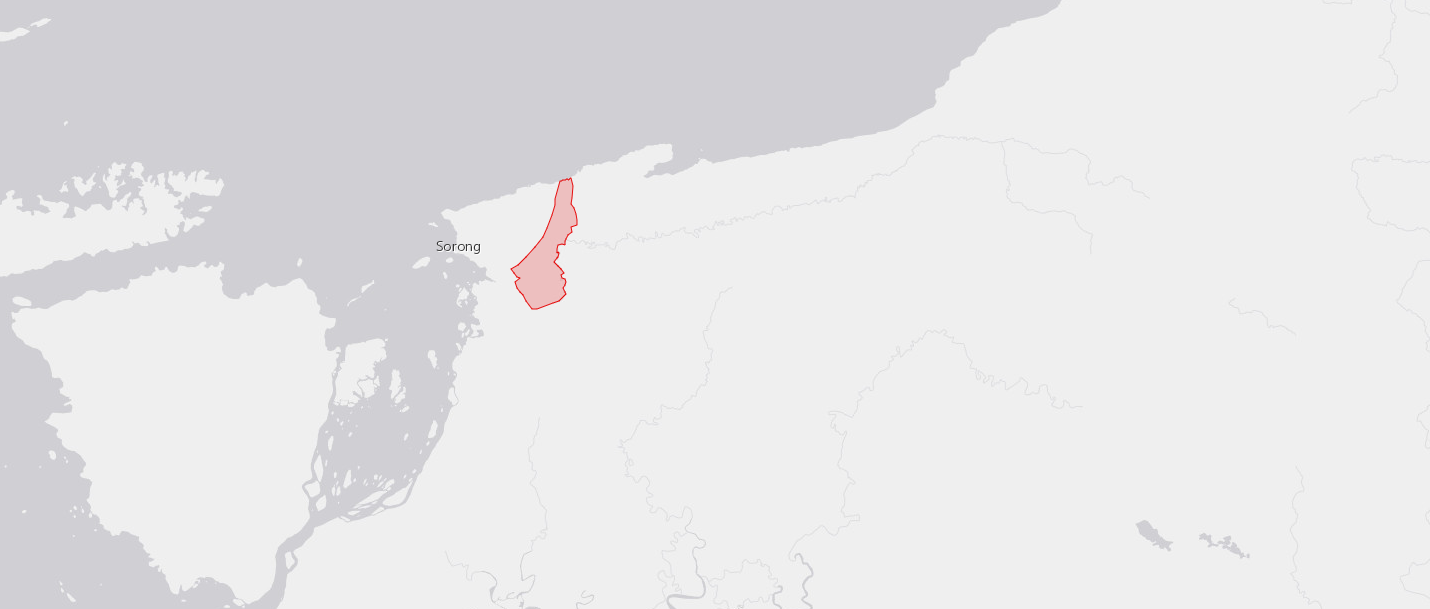
The area comprises lowland forest to the east and north of Sorong city, extending to the north coast of the Bird's Head and including part of the Warsamson river valley. The TIPA includes the protected area Taman Wisata Alam Sorong (Sorong Nature Tourism Park), close to the city of Sorong.
Botanical significance
Endemic plants in this area include Cyrtosperma prasinispathum, Benstonea eumekes, Syzygium
sorongense (VU), Dendrobium odoardi, Hydriastele variabilis, Calamus interruptus (DD), Hibiscus pleijtei, Ixora doreensis,
Tricospermum grewioides, Calamus maturbongsii (VU), Clymenia platypoda (VU), Burckella magusum (DD), Melicope exuta,
Aristolochia manokwariensis (EN). The vegetation in the Sorong forest is mostly merbau (Intsia bijuga), angsana (Pterocarpus indica), matoa (Pometia pinnata), and langsat (Lansium domesticum).
The local community uses timber in this area. The orchids Neuwiedia veratrifolia and Apostasia wallichii can be found in the Sorong forest. This includes a lowland forest ecosystem with a water catchment area. The most widely used species are Agathis labilardieri and Auracaria spp. resins.
Habitat and geology
This area comprises extensive lowland forests around the city of Sorong, on varying soil types. There are some coastal forests on the north coast, and riverine forests in the Warsamson river valley.
Habitat types include low foothills with varying steepness of slope. These include hard and dense sedimentary rocks with a soil surface of clay, sandstone, gravel, felsic to medium-plutonic limestone. The coastal plains do not have any flooding or inundation.
Conservation issues
Threats to the natural habitats in this area are utilization of forest land for residential development, utilization of timber and non-timber forest products, shifting cultivation activities, the creation of rice paddies for government food security programs and oil palm plantations, and infrastructure development that reduces the capacity of mining catchment areas, forest fires, and illegal hunting.
Ecosystem services
The diverse flora and fauna, camping grounds, bird watching, waterfalls, and several other tourist attractions make Sorong National Park a popular tourist destination. This tourist attraction is supported by the availability of other facilities, such as parking, trash cans, shelters, an animal observation tower, restrooms, and access roads, signposts, and footpaths.
Site assessor(s)
Assessed by:
Mutiara Ashia Zahra, Fauna & Flora
Ruth V. Duwiri, Fahutan UNIPA
Grant M. Teluwun, Fahutan UNIPA
Putra A.W. Sugino, Fahutan UNIPA
Wahyu A. Kurniawan, Fahutan UNIPA
Frans Karel Wambrauw, Fahutan UNIPA
Laura Jennings, Royal Botanic Garden Kew
Liam Trethowan, Royal Botanic Gardens, Kew
Jimmy Wanma, State University of Papua
Date of first assessment: 13th Oct 2025
IPA criterion A species
| Species | Qualifying sub-criterion | ≥ 1% of global population | ≥ 5% of national population | 1 of 5 best sites nationally | Entire global population | Socio-economically important | Abundance at site |
|---|---|---|---|---|---|---|---|
| Cyrtosperma prasinispathum A.S.D.Irsyam & M.R.Hariri | A(iii) |  |
|
 |
|
|
Unknown |
| Benstonea eumekes (H.St.John ex B.C.Stone) Callm. & Buerki | A(iii) | |
|
|
|
|
Unknown |
| Dendrobium odoardi Kraenzl. | A(iii) | |
|
|
|
|
Unknown |
| Clymenia platypoda B.C.Stone | A(i) | |
|
|
|
|
Unknown |
| Calamus maturbongsii W.J.Baker & J.Dransf. | A(i) | |
|
|
|
|
Unknown |
| Calamus interruptus Becc. | A(iii) | |
|
|
|
|
Unknown |
Cyrtosperma prasinispathum A.S.D.Irsyam & M.R.Hariri
Qualifying sub-criterion:
A(iii)
≥ 1% of global population:
≥ 5% of national population:
1 of 5 best sites nationally:
Entire global population:
Socio-economically important:
Abundance at site:
Unknown
Benstonea eumekes (H.St.John ex B.C.Stone) Callm. & Buerki
Qualifying sub-criterion:
A(iii)
≥ 1% of global population:
≥ 5% of national population:
1 of 5 best sites nationally:
Entire global population:
Socio-economically important:
Abundance at site:
Unknown
Dendrobium odoardi Kraenzl.
Qualifying sub-criterion:
A(iii)
≥ 1% of global population:
≥ 5% of national population:
1 of 5 best sites nationally:
Entire global population:
Socio-economically important:
Abundance at site:
Unknown
Clymenia platypoda B.C.Stone
Qualifying sub-criterion:
A(i)
≥ 1% of global population:
≥ 5% of national population:
1 of 5 best sites nationally:
Entire global population:
Socio-economically important:
Abundance at site:
Unknown
Calamus maturbongsii W.J.Baker & J.Dransf.
Qualifying sub-criterion:
A(i)
≥ 1% of global population:
≥ 5% of national population:
1 of 5 best sites nationally:
Entire global population:
Socio-economically important:
Abundance at site:
Unknown
Calamus interruptus Becc.
Qualifying sub-criterion:
A(iii)
≥ 1% of global population:
≥ 5% of national population:
1 of 5 best sites nationally:
Entire global population:
Socio-economically important:
Abundance at site:
Unknown
General site habitats
| General site habitat | Percent coverage | Importance |
|---|---|---|
| Forest - Subtropical/Tropical Moist Lowland Forest | |
Major |
| Wetlands (inland) - Permanent Rivers, Streams, Creeks [includes waterfalls] | |
Minor |
| Marine Intertidal - Rocky Shoreline | |
Minor |
Forest - Subtropical/Tropical Moist Lowland Forest
Percent coverage:
Importance:
Major
Wetlands (inland) - Permanent Rivers, Streams, Creeks [includes waterfalls]
Percent coverage:
Importance:
Minor
Marine Intertidal - Rocky Shoreline
Percent coverage:
Importance:
Minor


Recommended citation
Mutiara Ashia Zahra, Ruth V. Duwiri, Grant M. Teluwun, Putra A.W. Sugino, Wahyu A. Kurniawan, Frans Karel Wambrauw, Laura Jennings, Liam Trethowan, Jimmy Wanma (2026) Tropical Important Plant Areas Explorer: Sorong (New Guinea). https://tipas.kew.org/site/sorong/ (Accessed on 26/08/2026)