
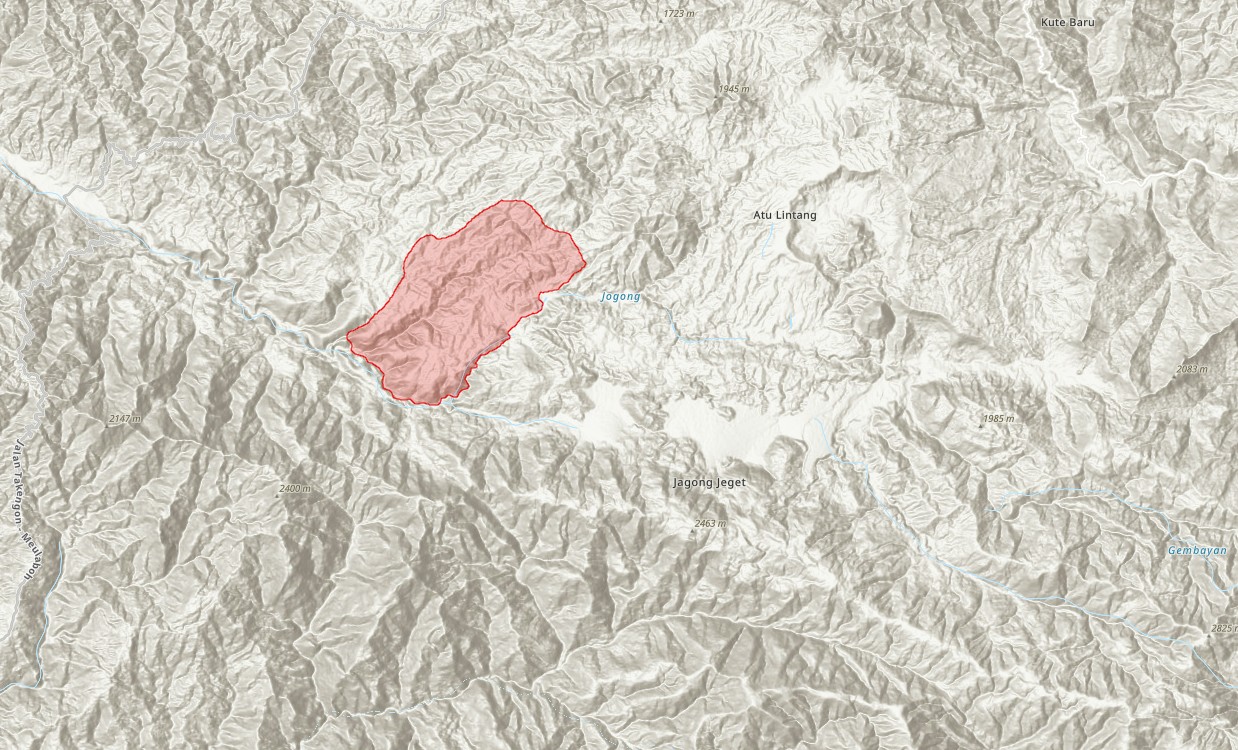
Country: Sumatera
Administrative region: Aceh (Province)
Central co-ordinates: 4.41262 N, 96.65739 E
Area: 36.7km²
Qualifying IPA Criteria
A(i)Site contains one or more globally threatened species
IPA assessment rationale
Berawang Baro is an important habitat for the globally threatened pitcher plant (Nepenthes lavicola), habitat to the entire global population of montane bogs endemic Coelogyne albomarginata, and significant populations of northern Gayo endemic Bulbophyllum wibowoajii as well as Nepenthes longiptera. The forest is highly threatened by ongoing forest conversion mainly from agriculture and related activities. Some highly ornamental species like orchids and pitcher plants are being harvested by illegal poachers and sold to the market, alongside the Spaghnum mosses growing on the forest floor.
Site description
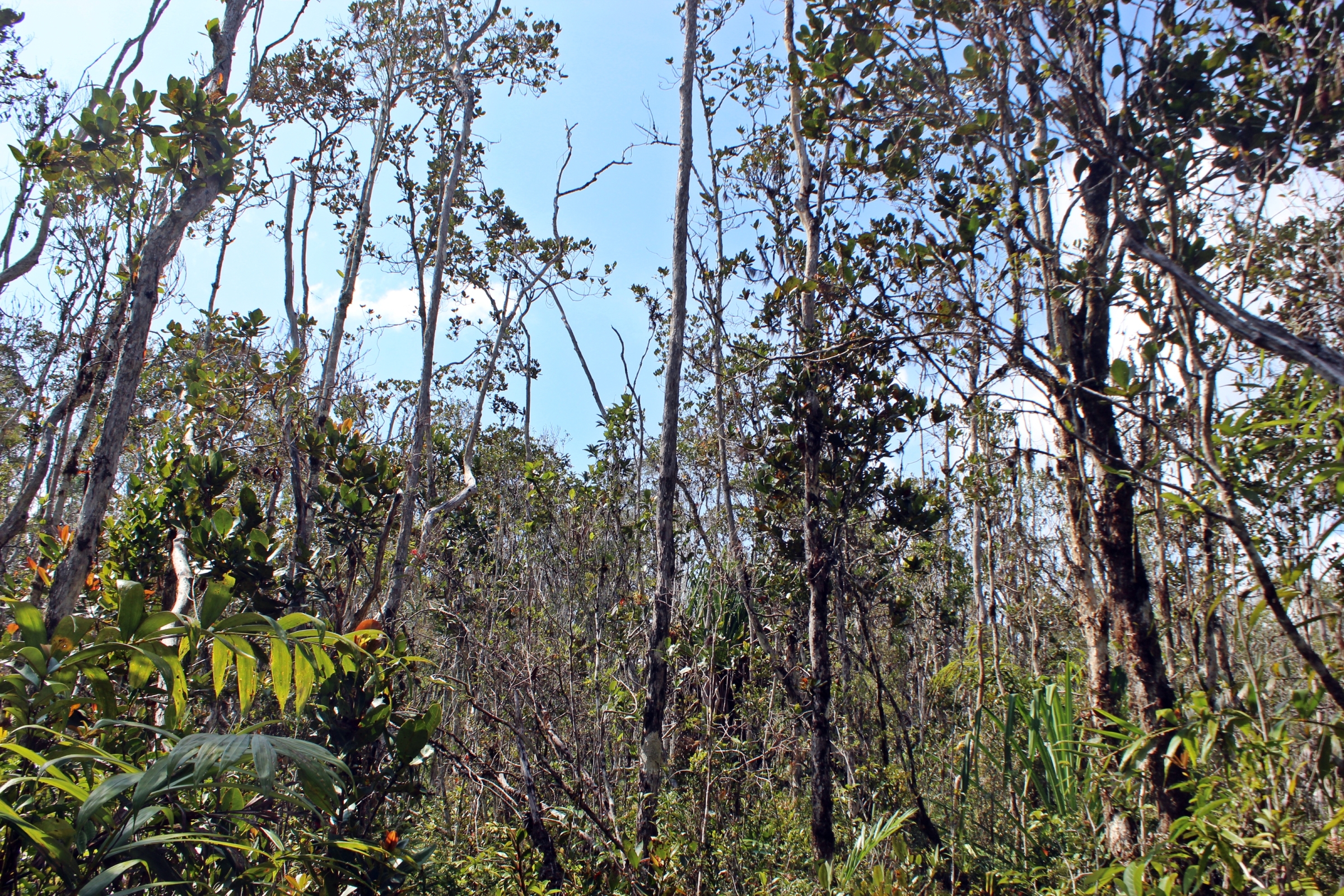
Berawang Baro is located in the western part of the Gayo Plateau in the Aceh Province. This area consists of submontane vegetation growing on undulating terrain with an elevation starting from 980 to around 1590 m. The forest grows on the uplifted Meulaboh formation (Muksin et al. 2023) and there are several montane bogs that exist in this area that act as water catchments. The montane bogs are special in having a unique composition of flora, marked by the presence of specialized, endemic, and threatened species. The landscape is a non-strictly protected forest, but practically not a conservation area, managed by the Ministry of Forestry.
Botanical significance
Berawang Baro harbours the most important population of the globally threatened Nepenthes lavicola (CR), the Berawang Baro endemic and heavily-poached Coelogyne albomarginata (Yudistira et al. 2024), the population of the potentially threatened northern Gayo endemic Nepenthes longiptera (Victoriano 2021), and a large portion of highly-poached Bulbophyllum wibowoajii. The forest stand consists of the Sumatra endemic tree, Magnolia sumatrae, a data deficient and potentially threatened species (Mustaqim pers. obs.). This forest is underexplored and there are some possible new species found in this area. Recently, a population of Corybas geminigibbus has just been recorded for Sumatra (Mustaqim et al. 2024). The bogs are a unique habitat, marked by an abundance amount of Sphagnum mosses, and the presence of carnivorous plants – besides N. lavicola and N. longiptera, there is also a Sumatra endemic Nepenthes tobaica.
Habitat and geology
Located mostly in the submontane zone of Sumatra montane ecoregions (Olson et al. 2001), this area is rich in plants. Forests in this area are categorized as submontane to transition to montane forests. Some scattered giant-sized trees of the Vulnerable Pinus merkusii also can be found. On poor soils, Ericaceae like Rhododendron and Vaccinium can easily be found. The unique habitat that exists in this area is montane bogs. The vegetation in this area consists of dwarfed forests but is rich in shrubs and herbs, particularly orchids. Berawang Baro occurs mostly in the Meulaboh rock formation, relatively isolated from the others which occur in the coastal area in the west, probably uplifted during the formation of the Barisan Mountain ranges (Muksin et al. 2023).
Conservation issues
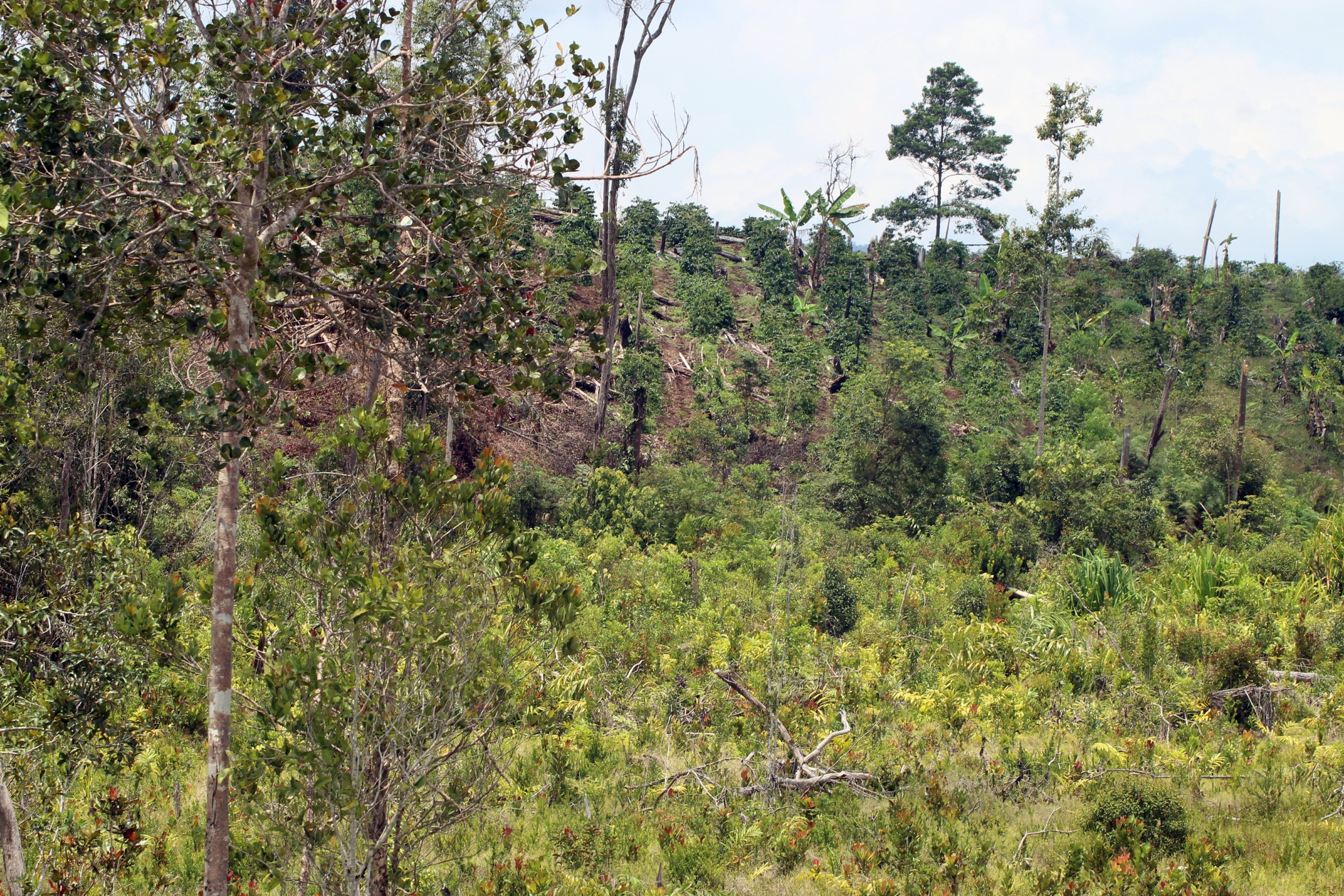
Habitat conversion for agriculture, settlements, and road facilities are the main threats to this habitat. The main commodity of the plantation is known as Gayo coffee. The plantation is in the marginal area of the vast total, nearly 100.000 hectares of coffee plantations in the northern Gayo Plateau (Gayo et al. 2018). Smaller trees in this area are chopped for temporary construction like huts built by the local farmers in their plantations. Plants, especially orchids and pitcher plants, are routinely harvested and sold to the market. Besides that, mosses growing on the forest floor of montane bogs are also harvested and sold as media for ornamental plants.
Ecosystem services
Small-scale harvesting of wood still occurs to be used in temporary buildings like huts. The montane bogs contain large amounts of freshwater and also organic material stored in the form of large underground biomass which is important for climate adaptation. The forest landscape is an important habitat for many species of birds and large mammals like the Malayan sun bear (Helarctos malayanus, VU) (Scotson et al. 2017).
Site assessor(s)
Assessed by:
Wendy Mustaqim, Universitas Samudra, Indonesia
Laura Jennings, Royal Botanic Garden Kew
Liam Trethowan, Royal Botanic Gardens, Kew
Date of first assessment: 2nd Jun 2025
IPA criterion A species
| Species | Qualifying sub-criterion | ≥ 1% of global population | ≥ 5% of national population | 1 of 5 best sites nationally | Entire global population | Socio-economically important | Abundance at site |
|---|---|---|---|---|---|---|---|
| Coelogyne albomarginata Yudistira, Schuit. & J.Champ. | A(iii) |  |
|
|
|
 |
Abundant |
| Bulbophyllum wibowoajii Jenny & R.Amsler | A(iii) | |
|
|
|
|
Abundant |
| Magnolia sumatrae (Dandy) Figlar & Noot. | A(i) | |
|
|
|
|
Occasional |
| Nepenthes lavicola Wistuba & Rischer | A(i) | |
|
|
|
|
Occasional |
| Nepenthes longiptera Victoriano | A(iii) | |
|
|
|
|
Scarce |
| Disepalum platypetalum Merr. | A(iv) | |
|
|
|
|
Occasional |
Coelogyne albomarginata Yudistira, Schuit. & J.Champ.
Qualifying sub-criterion:
A(iii)
≥ 1% of global population:
≥ 5% of national population:
1 of 5 best sites nationally:
Entire global population:
Socio-economically important:
Abundance at site:
Abundant
Bulbophyllum wibowoajii Jenny & R.Amsler
Qualifying sub-criterion:
A(iii)
≥ 1% of global population:
≥ 5% of national population:
1 of 5 best sites nationally:
Entire global population:
Socio-economically important:
Abundance at site:
Abundant
Magnolia sumatrae (Dandy) Figlar & Noot.
Qualifying sub-criterion:
A(i)
≥ 1% of global population:
≥ 5% of national population:
1 of 5 best sites nationally:
Entire global population:
Socio-economically important:
Abundance at site:
Occasional
Nepenthes lavicola Wistuba & Rischer
Qualifying sub-criterion:
A(i)
≥ 1% of global population:
≥ 5% of national population:
1 of 5 best sites nationally:
Entire global population:
Socio-economically important:
Abundance at site:
Occasional
Nepenthes longiptera Victoriano
Qualifying sub-criterion:
A(iii)
≥ 1% of global population:
≥ 5% of national population:
1 of 5 best sites nationally:
Entire global population:
Socio-economically important:
Abundance at site:
Scarce
Disepalum platypetalum Merr.
Qualifying sub-criterion:
A(iv)
≥ 1% of global population:
≥ 5% of national population:
1 of 5 best sites nationally:
Entire global population:
Socio-economically important:
Abundance at site:
Occasional
General site habitats
| General site habitat | Percent coverage | Importance |
|---|---|---|
| Forest - Subtropical/Tropical Moist Montane Forest | |
Major |
| Wetlands (inland) - Bogs, Marshes, Swamps, Fens, Peatlands [generally over 8 ha] | |
Minor |
Forest - Subtropical/Tropical Moist Montane Forest
Percent coverage:
Importance:
Major
Wetlands (inland) - Bogs, Marshes, Swamps, Fens, Peatlands [generally over 8 ha]
Percent coverage:
Importance:
Minor
Land use types
| Land use type | Percent coverage | Importance |
|---|---|---|
| Agriculture (arable) | |
Major |
| Harvesting of wild resources | |
Minor |
Agriculture (arable)
Percent coverage:
Importance:
Major
Harvesting of wild resources
Percent coverage:
Importance:
Minor
Threats
| Threat | Severity | Timing |
|---|---|---|
| Residential & commercial development - Housing & urban areas | Low | Ongoing - stable |
| Agriculture & aquaculture - Annual & perennial non-timber crops - Small-holder farming | High | Ongoing - increasing |
| Biological resource use - Gathering terrestrial plants - Intentional use (species being assessed is the target) | Low | Ongoing - stable |
Residential & commercial development - Housing & urban areas
Severity:
Low
Timing:
Ongoing - stable
Agriculture & aquaculture - Annual & perennial non-timber crops - Small-holder farming
Severity:
High
Timing:
Ongoing - increasing
Biological resource use - Gathering terrestrial plants - Intentional use (species being assessed is the target)
Severity:
Low
Timing:
Ongoing - stable
Bibliography
Terrestrial ecoregions of the world: a new map of life on earth
Bioscience, Vol 51, page(s) 3-938
Distribusi spasial lahan kopi eksisting berdasarkan ketinggian dan arahan fungsi kawasan di Kabupaten Aceh Tengah.
Jurnal Ilmiah Mahasiswa Pertanian UNSYIAH, Vol 3(4), page(s) 1-7
Secondary fault system in Northern Sumatra, evidenced by recent seismicity and geomorphic structure
Journal of Asian Earth Sciences, Vol 245, page(s) 105557
Corybas geminigibbus (Orchidaceae), a new addition to the orchid flora of Sumatra.
Lankesteriana, Vol 24(3), page(s) 239–244
Helarctos malayanus (errata version published in 2018).
The IUCN Red List of Threatened Species
A new species of Nepenthes (Nepenthaceae) and its natural hybrids from Aceh, Sumatra, Indonesia
Reinwardtia, Vol 20(1), page(s) 17-26
A new species of Coelogyne (Orchidaceae) from Aceh, Sumatra, Indonesia
Malesian Orchid Journal, Vol 27, page(s) 5–10


Recommended citation
Wendy Mustaqim, Laura Jennings, Liam Trethowan (2026) Tropical Important Plant Areas Explorer: Berawang Baro (Sumatera). https://tipas.kew.org/site/berawang-baro/ (Accessed on 26/08/2026)