
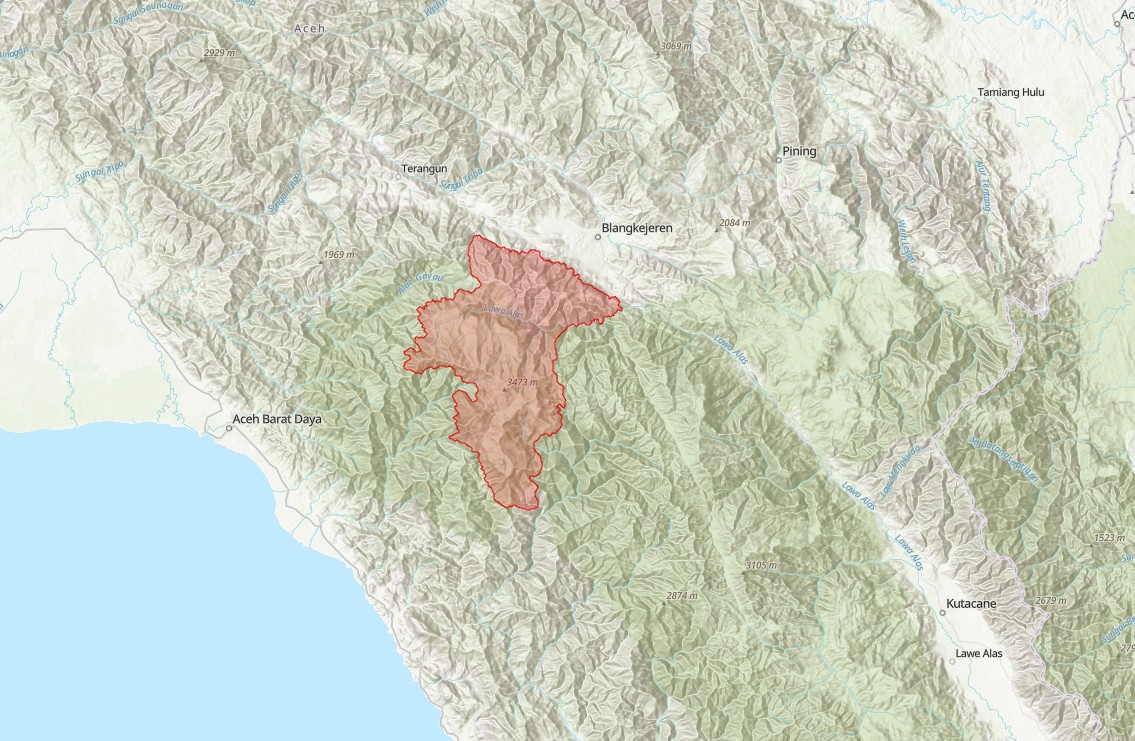
Country: Sumatera
Administrative region: Aceh (Province)
Central co-ordinates: 3.78947 N, 97.20762 E
Area: 631km²
Qualifying IPA Criteria
A(i)Site contains one or more globally threatened species, A(iii)Site contains one or more highly restricted endemic species that are potentially threatened, A(iv)Site contains one or more range restricted endemic species that are potentially threatened
IPA assessment rationale
Mount Leuser is an important habitat for five globally threatened plants, four Endangered and one Vulnerable. This includes the Endangered Quercus steenisii, a species where the entire global population are restricted to the subalpine zone of Mount Leuser. The other three EN species are Lithocarpus atjehensis, Elaeocarpus brigittae, and Daphniphyllum woodsonianum. One Vulnerable species is a remarkably important tree for the Gayonese people, the Merkus’ pine, Pinus merkusii. There are four narrow endemics that only can be found in Mount Leuser and populations for seven northern Sumatra endemics can be found here, mostly species restricted to the Gayo Plateau. There are studies on useful plants by the local Gayonese people in the surrounding areas but most of the species are usually widespread species and collected outside the assigned TIPA area.
Site description
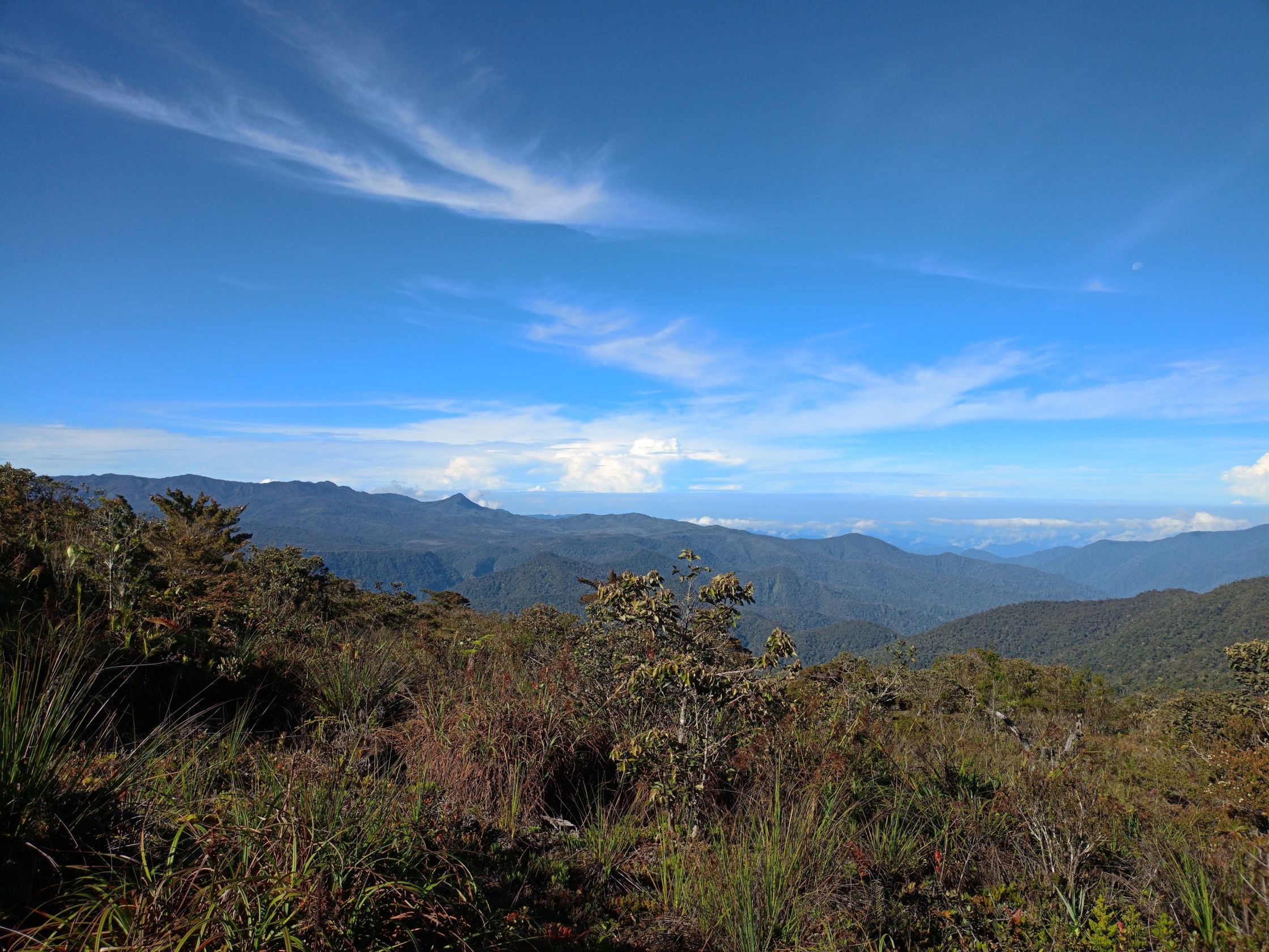
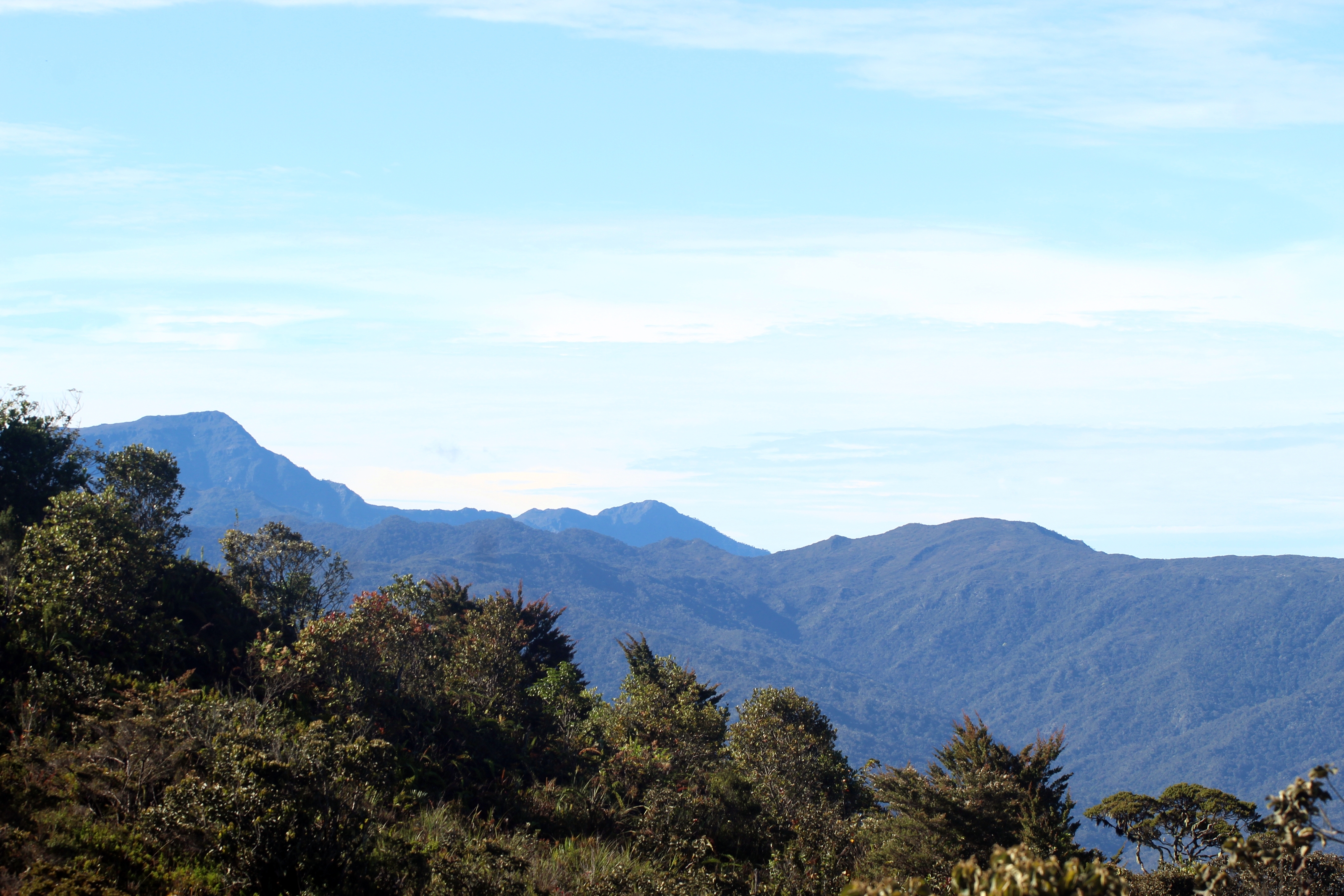
Mount Leuser is the second-highest summit in the Barisan Mountains range in Sumatra. The highest point reaches an elevation of around 3466 m asl. The Mount Leuser area belongs to the northern Sumatra mountain complex, characterised by undulating terrain with upper elevations, especially above 2400 m asl, consisting of subalpine vegetation, the highest vegetation type in Sumatra. This vegetation was partially burnt in the 1990s. In this zone, there is a unique type of vegetation named ‘Blang’, a grassland type vegetation, hosting the Leuser unique flora (De Wilde & Duyfjes 2001). The forest landscape are important habitat for larger mammals like the Sumatran tiger and deer. Most parts of Mount Leuser are protected by the government as part of the Gunung Leuser National Park. Mount Leuser is also a popular mountain climbing with a 51 km long trail from Penosan Sepakat as the nearest village to the westernmost summit.

Botanical significance
Mount Leuser harbours entire global population of endangered van Steenis’ oak (Quercus steenisii), the Leuser endemic and Data Deficient Eurya steenisii, two orchids (Coelogyne atjehensis and Coelogyne leuserensis), one wild balsam (Impatiens calendulina), and one grass (Garnotia spadicea). This is also the habitat of northern Sumatran endemic plants including two pitcher plants, i.e. Nepenthes angasanensis and Nepenthes densiflora. The exploration in the vast area of the subalpine areas is still limited, in particular the rock cliffs. Merkus’ Pine (Pinus merkusii) which occurs in some parts of the area is a valuable species for the locals as it is used in daily lives like lighting fires and minor timber source. Plants from Fagaceae, either Quercus or Lithocarpus, are used here as the source of timber called ‘gesing’ but the detailed information is lacking. Some species in the subalpine vegetation are also used by the local guides for firewood including gesing, ericaceous plants including the northern Sumatra endemic Rhododendron adinophyllum, and the common shrub or trees Leptospermum javanicum.
Habitat and geology
Vegetations growing in the TIPA area vary from submontane (1200-1500 m asl), montane (1500-2000 m asl), upper montane (2000-2400 m asl or slightly above), and subalpine (above 2400 m asl) (Laumonier 1997). Starting from an elevation around 2300 m asl, the trunk of most trees is covered by mosses. There is also a special vegetation called ‘Blang’ or ‘Mountain Blang’, appearing similar to heath vegetation (De Wilde & Duyfjes 2001). In the valley, on elevation below 2000 m asl, there is still quite an extensive Merkus pine forest. De Wilde & Duyfjes (2001) suggested that the subalpine zone of Mount Leuser is inhabited by a unique composition of plant species, including the presence of endemic species. The area included in TIPAs consists of four main bedrocks with the Loser formation as the largest component covering nearly 60 percent. It is a unique formation surrounded by the larger bedrock named Kluet Formation. In the northeast, where the mountain range is separated by the Alas River, the mountain ridge consists of two main bedrocks named Blangkejeren and Peutu formations (Muksin et al. 2023).
Conservation issues
Despite being a national park, forests in the lower elevation (about 2000 m asl) are threatened by the expansion of agricultural fields, including coffee, tobacco, and other minor commodities. This threatens the vegetation of the submontane to the montane forest. Once, there was also a forest fire happened in the eastern range, in the first peak named Pucuk Angkasan. There is a place called Burni Telong on the climbing trail, which means a mountain of fire, referring to the burnt mountain – a name given by the local people in the past. However, the fire seems already ceased for now. Minor threats from climbing activities are also happening, especially for firewood harvesting that includes the northern Sumatra endemic plant species and or threatened species like gesing (oak family). The landscape is also a habitat for the threatened large fauna like the Sumatran tiger (Panthera tigris sondaica), Sumatran orangutan (Pongo abelii), Malayan sun bear (Helarctos malayanus), muntjacs (Muntiacus muntjac), and Thomas’ langur (Presbytis thomasii).
Ecosystem services
Forest extraction in the form of illegal logging or NTFP extraction seems almost down to zero. The local people, however, use the freshwater as a source of drinking water and irrigation. Since a long time ago, Mount Leuser has been a popular destination for mountain climbing in Indonesia, one of them due to its status as the longest mountain climbing trail in the country. This activity provides the local people with income supporting their daily lives and the activity is indirectly helpful in suppressing the threats to the forest through the involvement of the local people.
Site assessor(s)
Assessed by:
Wendy Mustaqim, Universitas Samudra, Indonesia
Laura Jennings, Royal Botanic Garden Kew
Liam Trethowan, Royal Botanic Gardens, Kew
Date of first assessment: 2nd Jun 2025
IPA criterion A species
| Species | Qualifying sub-criterion | ≥ 1% of global population | ≥ 5% of national population | 1 of 5 best sites nationally | Entire global population | Socio-economically important | Abundance at site |
|---|---|---|---|---|---|---|---|
| Quercus steenisii Soepadmo | A(i) |  |
|
|
|
 |
Abundant |
| Lithocarpus atjehensis Hatus. ex Soepadmo | A(i) | |
|
|
|
|
Abundant |
| Elaeocarpus brigittae Coode | A(i) | |
|
|
|
|
Unknown |
| Daphniphyllum woodsonianum T.C.Huang | A(i) | |
|
|
|
|
Occasional |
| Pinus merkusii Jungh. & de Vriese | A(i) | |
|
|
|
|
Occasional |
| Eurya steenisii de Wit | A(iii) | |
|
|
|
|
Unknown |
| Coelogyne atjehensis (J.J.Sm.) M.W.Chase & Schuit. | A(iii) | |
|
|
|
|
Unknown |
| Coelogyne leuserensis (J.J.Wood & J.B.Comber) M.W.Chase & Schuit. | A(iii) | |
|
|
|
|
Unknown |
| Impatiens calendulina Grey-Wilson | A(iii) | |
|
|
|
|
Unknown |
| Garnotia spadicea Ohwi | A(iii) | |
|
|
|
|
Unknown |
| Calamagrostis atjehensis Ohwi | A(iii) | |
|
|
|
|
Unknown |
| Vaccinium korinchense Ridl. | A(iii) | |
|
|
|
|
Unknown |
| Nepenthes densiflora Danser | A(iii) | |
|
|
|
|
Occasional |
| Impatiens steenisii Grey-Wilson | A(iv) | |
|
|
|
|
Scarce |
| Gaultheria losirensis Sleumer | A(iii) | |
|
|
|
|
Unknown |
| Helictotrichon sumatrense Ohwi | A(iii) | |
|
|
|
|
Unknown |
| Nepenthes angasanensis Maulder, D.Schub., B.Salmon & B.Quinn | A(iv) | |
|
|
|
|
Occasional |
Quercus steenisii Soepadmo
Qualifying sub-criterion:
A(i)
≥ 1% of global population:
≥ 5% of national population:
1 of 5 best sites nationally:
Entire global population:
Socio-economically important:
Abundance at site:
Abundant
Lithocarpus atjehensis Hatus. ex Soepadmo
Qualifying sub-criterion:
A(i)
≥ 1% of global population:
≥ 5% of national population:
1 of 5 best sites nationally:
Entire global population:
Socio-economically important:
Abundance at site:
Abundant
Elaeocarpus brigittae Coode
Qualifying sub-criterion:
A(i)
≥ 1% of global population:
≥ 5% of national population:
1 of 5 best sites nationally:
Entire global population:
Socio-economically important:
Abundance at site:
Unknown
Daphniphyllum woodsonianum T.C.Huang
Qualifying sub-criterion:
A(i)
≥ 1% of global population:
≥ 5% of national population:
1 of 5 best sites nationally:
Entire global population:
Socio-economically important:
Abundance at site:
Occasional
Pinus merkusii Jungh. & de Vriese
Qualifying sub-criterion:
A(i)
≥ 1% of global population:
≥ 5% of national population:
1 of 5 best sites nationally:
Entire global population:
Socio-economically important:
Abundance at site:
Occasional
Eurya steenisii de Wit
Qualifying sub-criterion:
A(iii)
≥ 1% of global population:
≥ 5% of national population:
1 of 5 best sites nationally:
Entire global population:
Socio-economically important:
Abundance at site:
Unknown
Coelogyne atjehensis (J.J.Sm.) M.W.Chase & Schuit.
Qualifying sub-criterion:
A(iii)
≥ 1% of global population:
≥ 5% of national population:
1 of 5 best sites nationally:
Entire global population:
Socio-economically important:
Abundance at site:
Unknown
Coelogyne leuserensis (J.J.Wood & J.B.Comber) M.W.Chase & Schuit.
Qualifying sub-criterion:
A(iii)
≥ 1% of global population:
≥ 5% of national population:
1 of 5 best sites nationally:
Entire global population:
Socio-economically important:
Abundance at site:
Unknown
Impatiens calendulina Grey-Wilson
Qualifying sub-criterion:
A(iii)
≥ 1% of global population:
≥ 5% of national population:
1 of 5 best sites nationally:
Entire global population:
Socio-economically important:
Abundance at site:
Unknown
Garnotia spadicea Ohwi
Qualifying sub-criterion:
A(iii)
≥ 1% of global population:
≥ 5% of national population:
1 of 5 best sites nationally:
Entire global population:
Socio-economically important:
Abundance at site:
Unknown
Calamagrostis atjehensis Ohwi
Qualifying sub-criterion:
A(iii)
≥ 1% of global population:
≥ 5% of national population:
1 of 5 best sites nationally:
Entire global population:
Socio-economically important:
Abundance at site:
Unknown
Vaccinium korinchense Ridl.
Qualifying sub-criterion:
A(iii)
≥ 1% of global population:
≥ 5% of national population:
1 of 5 best sites nationally:
Entire global population:
Socio-economically important:
Abundance at site:
Unknown
Nepenthes densiflora Danser
Qualifying sub-criterion:
A(iii)
≥ 1% of global population:
≥ 5% of national population:
1 of 5 best sites nationally:
Entire global population:
Socio-economically important:
Abundance at site:
Occasional
Impatiens steenisii Grey-Wilson
Qualifying sub-criterion:
A(iv)
≥ 1% of global population:
≥ 5% of national population:
1 of 5 best sites nationally:
Entire global population:
Socio-economically important:
Abundance at site:
Scarce
Gaultheria losirensis Sleumer
Qualifying sub-criterion:
A(iii)
≥ 1% of global population:
≥ 5% of national population:
1 of 5 best sites nationally:
Entire global population:
Socio-economically important:
Abundance at site:
Unknown
Helictotrichon sumatrense Ohwi
Qualifying sub-criterion:
A(iii)
≥ 1% of global population:
≥ 5% of national population:
1 of 5 best sites nationally:
Entire global population:
Socio-economically important:
Abundance at site:
Unknown
Nepenthes angasanensis Maulder, D.Schub., B.Salmon & B.Quinn
Qualifying sub-criterion:
A(iv)
≥ 1% of global population:
≥ 5% of national population:
1 of 5 best sites nationally:
Entire global population:
Socio-economically important:
Abundance at site:
Occasional
General site habitats
| General site habitat | Percent coverage | Importance |
|---|---|---|
| Forest - Subtropical/Tropical Moist Montane Forest | |
Major |
| Wetlands (inland) - Bogs, Marshes, Swamps, Fens, Peatlands [generally over 8 ha] | |
Minor |
| Rocky Areas - Rocky Areas [e.g. inland cliffs, mountain peaks] | |
Minor |
Forest - Subtropical/Tropical Moist Montane Forest
Percent coverage:
Importance:
Major
Wetlands (inland) - Bogs, Marshes, Swamps, Fens, Peatlands [generally over 8 ha]
Percent coverage:
Importance:
Minor
Rocky Areas - Rocky Areas [e.g. inland cliffs, mountain peaks]
Percent coverage:
Importance:
Minor
Land use types
| Land use type | Percent coverage | Importance |
|---|---|---|
| Tourism / Recreation | |
Minor |
| Harvesting of wild resources | |
Minor |
| Nature conservation | |
Major |
Tourism / Recreation
Percent coverage:
Importance:
Minor
Harvesting of wild resources
Percent coverage:
Importance:
Minor
Nature conservation
Percent coverage:
Importance:
Major
Threats
| Threat | Severity | Timing |
|---|---|---|
| Residential & commercial development - Housing & urban areas | Low | Ongoing - stable |
| Biological resource use - Gathering terrestrial plants - Intentional use (species being assessed is the target) | Low | Ongoing - trend unknown |
Residential & commercial development - Housing & urban areas
Severity:
Low
Timing:
Ongoing - stable
Biological resource use - Gathering terrestrial plants - Intentional use (species being assessed is the target)
Severity:
Low
Timing:
Ongoing - trend unknown
Protected areas
| Protected area name | Protected area type | Relationship with IPA | Areal overlap |
|---|---|---|---|
| Gunung Leuser National Park | National Park | protected/conservation area encompasses IPA | |
Gunung Leuser National Park
Protected area type:
National Park
Relationship with IPA:
protected/conservation area encompasses IPA
Areal overlap:
Bibliography
On the special botanical character of the Leuser Park and vicinity, with emphasis on the high mountain blang vegetation of northern Sumatra.
Flora Malesiana Bulletin, Vol 12(7/8), page(s) 377-391
The Vegetation and Physiography of Sumatra
Secondary fault system in Northern Sumatra, evidenced by recent seismicity and geomorphic structure
Journal of Asian Earth Sciences, Vol 245, page(s) art. 105557


Recommended citation
Wendy Mustaqim, Laura Jennings, Liam Trethowan (2026) Tropical Important Plant Areas Explorer: Mount Leuser (Sumatera). https://tipas.kew.org/site/mount-leuser/ (Accessed on 25/08/2026)