
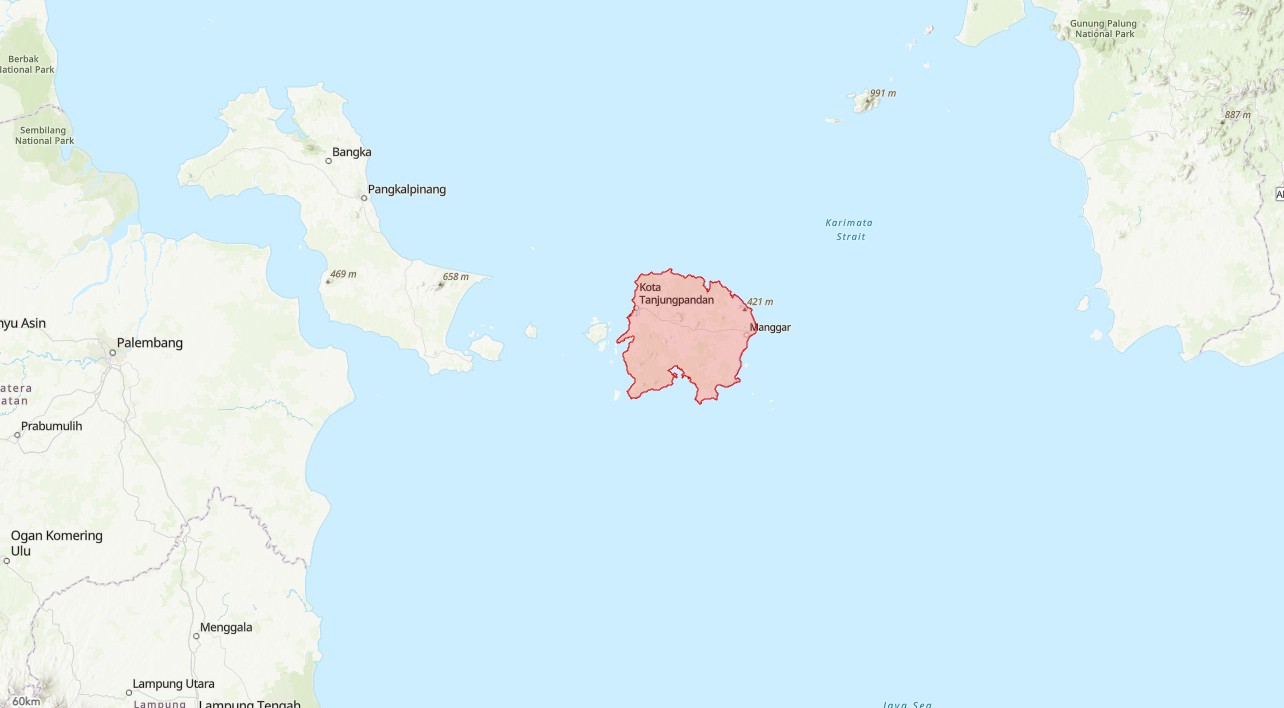
Country: Sumatera
Administrative region: Bangka Belitung (Province)
Central co-ordinates: 2.86083 S, 107.90036 E
Qualifying IPA Criteria
A(i)Site contains one or more globally threatened species
IPA assessment rationale
Belitung Island is an important habitat for globally threatened plants, one Critically Endangered and one Vulnerable. It is also the habitat for one narrow endemic species, Homalomena hypsiantha. Some species are targeted for poaching, like Nepenthes spp. and the endemic Homalomena hypsiantha. Culturally important occurs as there are two species used in the Belitung people's customary food named gangan, i.e. Dillenia suffruticosa and Trema orientale.
Site description
Belitung is an island dominated by lowland with many areas consisting of vegetation growing on podzols, and also the most important ecosystem in Indonesia, the lowland heath forest. Belitung has the highest point at 500 metres asl in Mount Tajam, and Belitung consists of undulating terrains in many parts. In this area, the heath forest can be found in many parts of the island. Belitung is threatened by some important factors, including urban and rural developments and tin mining happening in many parts of the island. The landscape is not protected by the government but has been designated as a Belitong UNESCO Global Geopark.
Botanical significance
Belitung harbour nearly the entire global population of the globally threatened tree Hopea bilitonensis. There is also a species endemic to the island: Homalomena hypsiantha. Besides that, there is also a highly valued and globally threatened tree, Eusideroxylon zwageri, spread in many parts of the island. Belitung is less rich than the forests of the larger islands like Sumatra or Borneo. However, this island is botanically important due to the presence of kerangas, or heath vegetation growing on quartz sand and podzolic soils, having a unique floristic composition such as the dominance of myrtle families, abundant occurrence of pitcher plants (Nepenthes), and unusual lowland vegetations dominated by Ericaceae species – Vaccinium bancanum and Vaccinium bracteatum.
Habitat and geology
Belitung is categorised as lowland tropical rainforest, and within the occurrence of Sundaland Heath Forest. The mixed forest area is characterised by the occurrence of large trees like Eusideroxylon, Hopea, and Ixonanthes reticulata. The forest on poor-nutrient soils is dominated by the myrtle family. In more open places, grassland and sedges are becoming predominant, mixed with small trees like Baeckea frutescens and several Syzygium species. On more inundated land, the habitat consists of mangrove and gelam formation (Melaleuca cajuputi). The Triassic granitic formation in Belitung Island originated around 230 to 220 mya (mean: 220 mya; Cobbing et al. 1986, Zhang et al. 2023). Before the last glacial maximum, the island was connected by land with all regions of Sundaland.
Conservation issues
None of the areas in Belitung has been assigned as a nationally protected area by the government. A degree of protection comes from the recently established Belitung Geopark, covering the majority of the island. The island is threatened by residential and commercial development, mining activities, urban and rural development, like transportation and service corridors, as well as recreational activities in many places, and also the biological resource uses in the form of logging and wood harvest, as well as illegal plant poaching. Despite minor, illegal plant collecting also happened for ornamental plants like Nepenthes and aroids, including the endemic Homalomena hypsiantha. Last, Belitung is home to many interesting animals, including the endemic Belitung tarsier (Tarsius bancanus saltator) (Yustian 2006), Belitung caecillian (Ichthyophis billitonensis) (Kusumah et al. 2023), and the fish Gymnochanda verae (Tan & Lim 2011).
Ecosystem services
Commercial timber seems no longer a valuable ecosystem service for Belitung. However, tree chopping for pole and or fishing tools seems to be still ongoing. The forest is important for the water catchment of a small island, not only for drinking water but also provides habitat for its endemic aquatic fauna. The forest is also habitat for endemic and threatened animals. Plants on this island also become a source of traditional medicine, and especially the customary/local food called gangan, unique to the people of Belitung, with the unique plants including Dillenia suffruticosa and Trema orientale (Sulistyaningsih et al. 2019).
Site assessor(s)
Assessed by:
Wendy Mustaqim, Universitas Samudra, Indonesia
Laura Jennings, Royal Botanic Garden Kew
Liam Trethowan, Royal Botanic Gardens, Kew
Date of first assessment: 2nd Jun 2025
IPA criterion A species
| Species | Qualifying sub-criterion | ≥ 1% of global population | ≥ 5% of national population | 1 of 5 best sites nationally | Entire global population | Socio-economically important | Abundance at site |
|---|---|---|---|---|---|---|---|
| Hopea bilitonensis P.S.Ashton | A(i) |  |
|
|
 |
|
Abundant |
| Homalomena hypsiantha P.C.Boyce & S.Y.Wong | A(iv) | |
|
|
|
|
Unknown |
| Eusideroxylon zwageri Teijsm. & Binn. | A(i) | |
|
|
|
|
Frequent |
Hopea bilitonensis P.S.Ashton
Qualifying sub-criterion:
A(i)
≥ 1% of global population:
≥ 5% of national population:
1 of 5 best sites nationally:
Entire global population:
Socio-economically important:
Abundance at site:
Abundant
Homalomena hypsiantha P.C.Boyce & S.Y.Wong
Qualifying sub-criterion:
A(iv)
≥ 1% of global population:
≥ 5% of national population:
1 of 5 best sites nationally:
Entire global population:
Socio-economically important:
Abundance at site:
Unknown
Eusideroxylon zwageri Teijsm. & Binn.
Qualifying sub-criterion:
A(i)
≥ 1% of global population:
≥ 5% of national population:
1 of 5 best sites nationally:
Entire global population:
Socio-economically important:
Abundance at site:
Frequent
General site habitats
| General site habitat | Percent coverage | Importance |
|---|---|---|
| Forest - Subtropical/Tropical Dry Forest | |
Major |
| Forest - Subtropical/Tropical Moist Lowland Forest | |
Major |
| Forest - Subtropical/Tropical Moist Montane Forest | |
Minor |
| Shrubland - Subtropical/Tropical Dry Shrubland | |
Minor |
| Wetlands (inland) - Permanent Rivers, Streams, Creeks [includes waterfalls] | |
Major |
| Wetlands (inland) - Bogs, Marshes, Swamps, Fens, Peatlands [generally over 8 ha] | |
Minor |
Forest - Subtropical/Tropical Dry Forest
Percent coverage:
Importance:
Major
Forest - Subtropical/Tropical Moist Lowland Forest
Percent coverage:
Importance:
Major
Forest - Subtropical/Tropical Moist Montane Forest
Percent coverage:
Importance:
Minor
Shrubland - Subtropical/Tropical Dry Shrubland
Percent coverage:
Importance:
Minor
Wetlands (inland) - Permanent Rivers, Streams, Creeks [includes waterfalls]
Percent coverage:
Importance:
Major
Wetlands (inland) - Bogs, Marshes, Swamps, Fens, Peatlands [generally over 8 ha]
Percent coverage:
Importance:
Minor
Land use types
| Land use type | Percent coverage | Importance |
|---|---|---|
| Tourism / Recreation | |
|
| Harvesting of wild resources | |
|
| Agriculture (arable) | |
Tourism / Recreation
Percent coverage:
Importance:
Harvesting of wild resources
Percent coverage:
Importance:
Agriculture (arable)
Percent coverage:
Importance:
Threats
| Threat | Severity | Timing |
|---|---|---|
| Residential & commercial development - Housing & urban areas | High | Ongoing - stable |
| Residential & commercial development - Commercial & industrial areas | Medium | Ongoing - trend unknown |
| Residential & commercial development - Tourism & recreation areas | Low | Ongoing - stable |
| Energy production & mining - Mining & quarrying | High | Ongoing - stable |
| Transportation & service corridors - Roads & railroads | Low | Ongoing - trend unknown |
| Biological resource use - Gathering terrestrial plants - Intentional use (species being assessed is the target) | Low | Ongoing - trend unknown |
| Biological resource use - Logging & wood harvesting - Intentional use: subsistence/small scale (species being assessed is the target) [harvest] | Low | Ongoing - stable |
| Human intrusions & disturbance - Recreational activities | Low | Ongoing - trend unknown |
Residential & commercial development - Housing & urban areas
Severity:
High
Timing:
Ongoing - stable
Residential & commercial development - Commercial & industrial areas
Severity:
Medium
Timing:
Ongoing - trend unknown
Residential & commercial development - Tourism & recreation areas
Severity:
Low
Timing:
Ongoing - stable
Energy production & mining - Mining & quarrying
Severity:
High
Timing:
Ongoing - stable
Transportation & service corridors - Roads & railroads
Severity:
Low
Timing:
Ongoing - trend unknown
Biological resource use - Gathering terrestrial plants - Intentional use (species being assessed is the target)
Severity:
Low
Timing:
Ongoing - trend unknown
Biological resource use - Logging & wood harvesting - Intentional use: subsistence/small scale (species being assessed is the target) [harvest]
Severity:
Low
Timing:
Ongoing - stable
Human intrusions & disturbance - Recreational activities
Severity:
Low
Timing:
Ongoing - trend unknown
Conservation designation
| Designation name | Protected area | Relationship with IPA | Areal overlap |
|---|---|---|---|
| Belitong Geopark | UNESCO Geopark | protected/conservation area matches IPA | |
Belitong Geopark
Protected area:
UNESCO Geopark
Relationship with IPA:
protected/conservation area matches IPA
Areal overlap:
Bibliography
Studies on Homalomeneae (Araceae) of Sumatera I: Homalomena hypsiantha, a distinctive new species of the Chamaecladon Supergroup
Webbia, Vol 67, page(s) 147-150
The granites of the Southeast Asian Tin Belt
Journal of the Geological Society, Vol 143(3), page(s) 537–550
Rediscovery of the Billiton Caecilian, Ichthyophis billitonensis Taylor, 1965, on Belitung Island, Indonesia, after more than five decades.
Herpetology Notes, Vol 16, page(s) 95-97
Heath forest and its biological diversity
A Field Guide to the Potential Plants of Belitung Islands
A new species of glass-perch from Belitung Island, Indonesia (Teleostei: Ambassidae: Gymnochanda). Gymnochanda verae Tan & Lim, 2011.
Zootaxa, Vol 3085, page(s) 55-62
Population density and the conservation status of belitung’s tarsier Tarsius bancanus saltator on Belitung Island, Indonesia
Reconstructing the East Palaeo-Tethyan assemblage boundary in west Indonesia: constraints from Triassic granitoids in the Bangka and Belitung islands.
Geological Society, London, Special Publications, Vol 531, page(s) 265-286


Recommended citation
Wendy Mustaqim, Laura Jennings, Liam Trethowan (2026) Tropical Important Plant Areas Explorer: Belitung Island (Sumatera). https://tipas.kew.org/site/belitung-island/ (Accessed on 23/08/2026)