
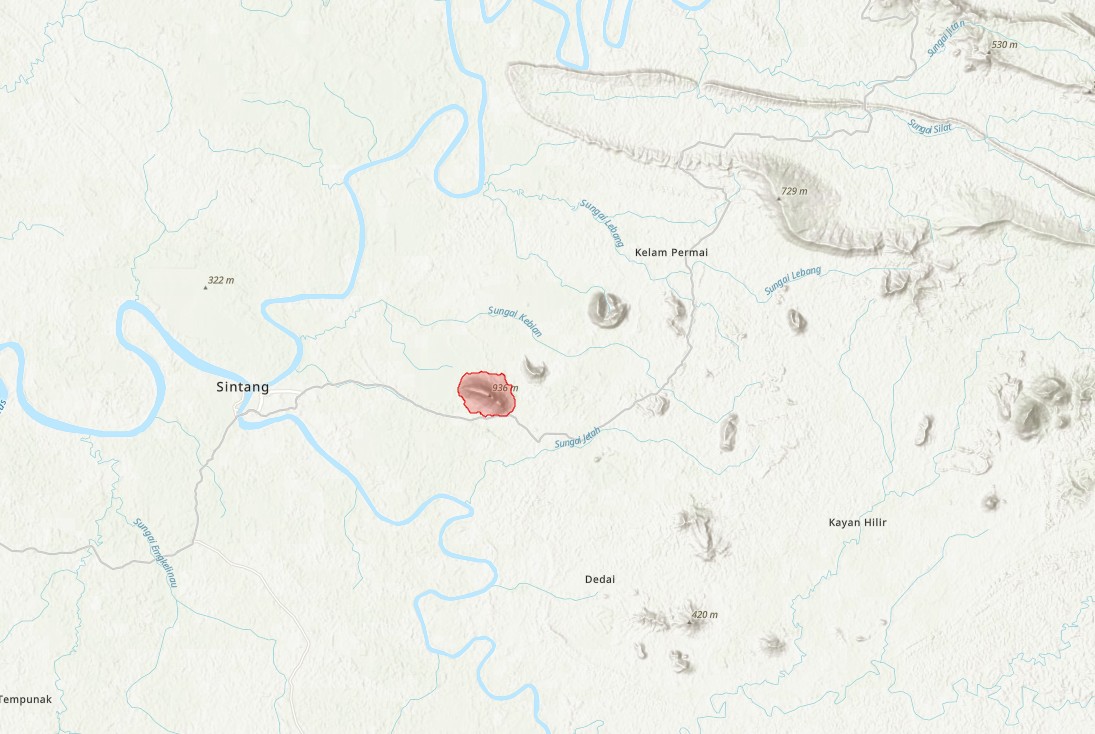
Country: Borneo
Administrative region: Kalimantan Berat (Province)
Central co-ordinates: 0.07740 N, 111.64262 E
Area: 11.6km²
Qualifying IPA Criteria
A(i)Site contains one or more globally threatened species
IPA assessment rationale
Bukit Kelam is an important habitat for globally threatened plants, with two Critically Endangered, one Endangered, and three Vulnerable species recorded at the site. Three species are so far been recorded only in Bukit Kelam, named Lithocarpus rufus (Strijk 2023), Nepenthes clipeata (Mansur et al. 2021) and Seorsus aequatorius (Sunarti et al. 2023). Some species in this site are targeted for poaching, i.e. Nepenthes clipeata, Nepenthes bicalcarata, and Paphiopedilum bullenianum, since they are popular ornamental plants sold in the Indonesian market. Studies on culturally important plants have been done a few times, but the results show that plants used in traditional medicines are neither endemic nor threatened.
Site description
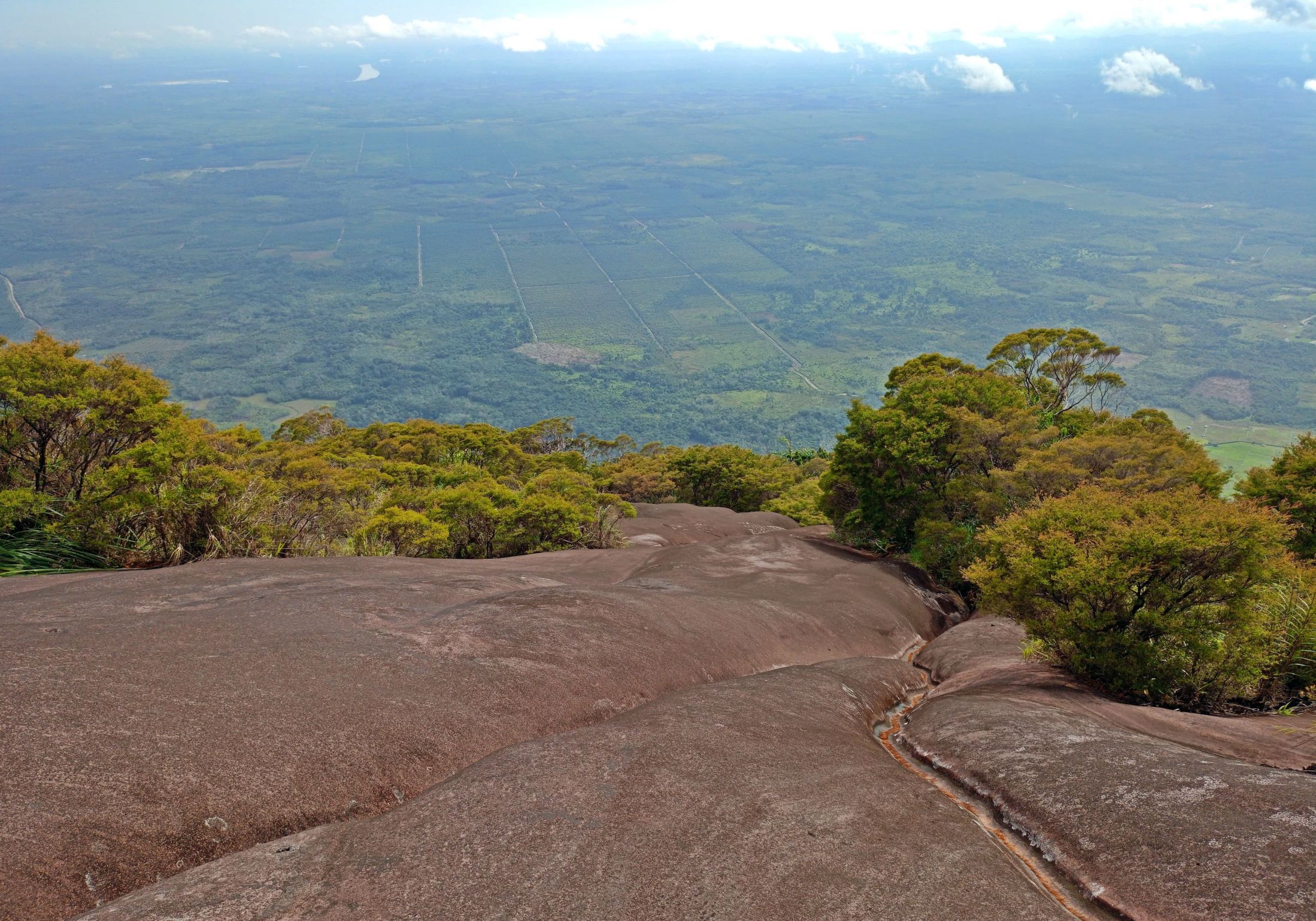
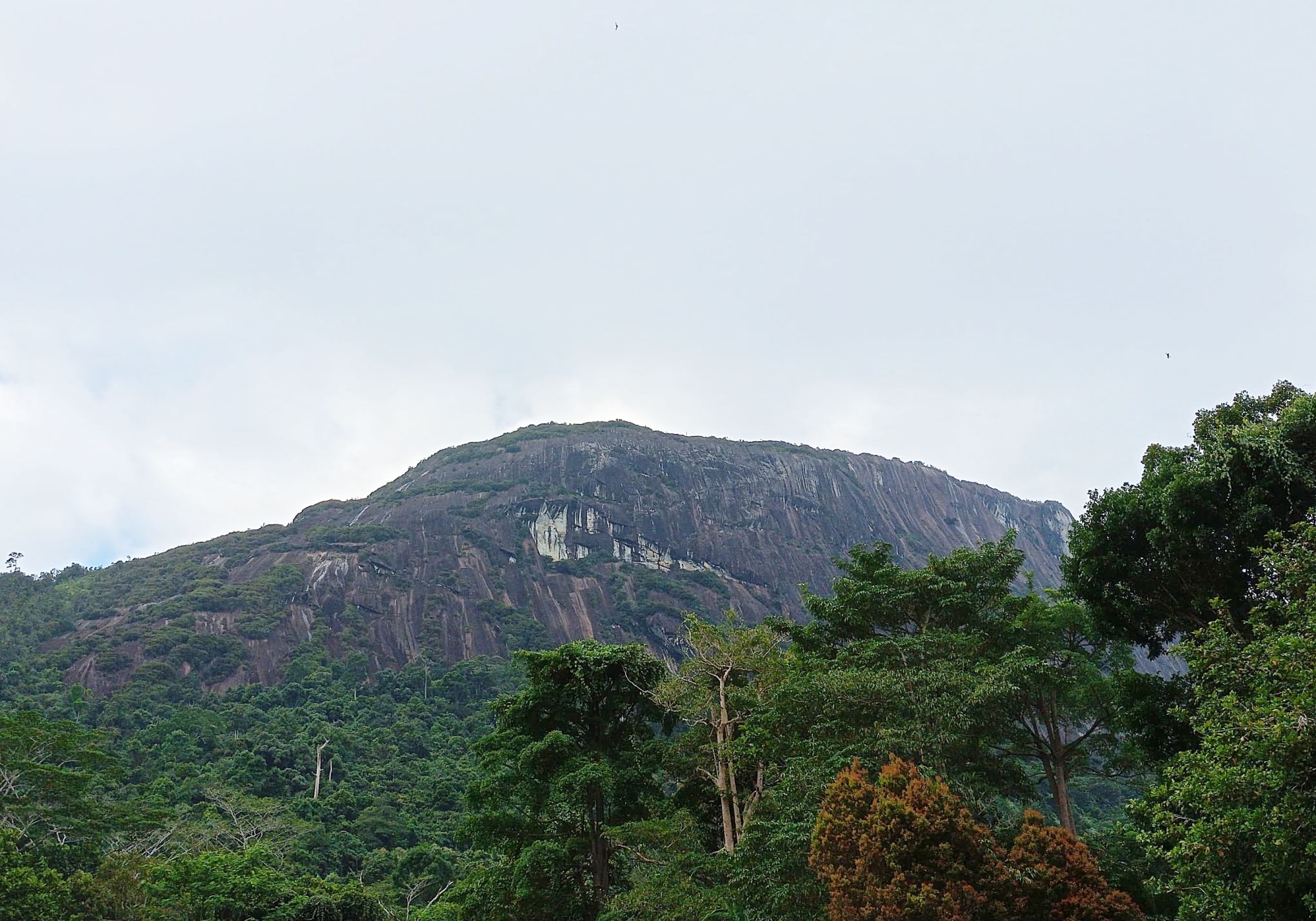
Bukit Kelam or Mount Kelam is a granitic dome in the western part of Indonesian Borneo. It has the highest point at 1002 metres above sea level (Phillips et al. 2008). The granite has a slightly crescent-shaped outline that stretches around 3.6 km long and 1 km wide. The upper nearly flat summit area is separated from the lowlands by steep slopes, except for the two ends, which have a relatively climbable degree. Below the cliff, the vegetation is lowland, but there is a montane forest above. In many parts, mosses cover rocks, and carnivorous plants are present. The landscape is protected under the governance of Bukit Kelam Nature Tourism Park, Kalimantan Barat Natural Resource and Conservation Agency.
Botanical significance
Bukit Kelam harbours the entire global populations of two globally threatened species, i.e. Nepenthes clipeata and Lithocarpus rufus. The cliff is now the only area where the Nepenthes clipeata can be found. Other threatened species recorded here include Paphiopedilum bullenianum and, Bornean endemic, Nepenthes bicalcarata. There is also another species endemic to Mount Kelam named Seorsus aequatorius, which is potentially threatened since it occurs in the trail and camp area. Bukit Kelam is unique since it is the largest monolith in the world, with some remarkable endemic species. Some potentially undescribed species also occur at this site, but the botanical knowledge seems still incomplete. The habitat is rich in carnivorous plants, including pitcher plants and the genus Utricularia.
Habitat and geology
With its unique geological history, the forest in Mount Kelam can be divided into two main types, i.e. the lowland tropical forest below the cliff and the submontane forest along the summit areas. The scattered shrub is the main habitat for the threatened species, Nepenthes clipeata and the Mount Kelam endemic Seorsus aequatorius. Meanwhile, the forested part is the main habitat for Lithocarpus rufus and with the Paphiopedilum bullenianum growing in the shaded forest floor. The monolithic granite of Mount Kelam, alongside Uluru in Australia, stands among the largest in the world (Mansur et al. 2021).
Conservation issues
With the existing protection from the Indonesian government, the vegetation of Mount Kelam is not considered threatened. However, forest fires were observed to occur during the El-Nino from 1997 to 1998 (Cantley et al. 2004). Current threats are considered minor, notably the small-scale non timber forest product (NTFP) extraction and tourism activities that consist of climbing, caving, and waterfall tourism. Bukit Kelam is a habitat for the endemic freshwater crab Lepidothelphusa menneri (Ng & Wowor 2024).
Ecosystem services
Timber extraction seems no longer active, but a small-scale harvest of NTFPs is still ongoing. This is in the form of wood chopping, but without information for its specific purposes. The monolith and forest create a good combination for the source of drinking water for the surroundings, and also as a green space for the vast amounts of nearby palm oil plantations. The drinking water comes from all sides due to the occurrence of bogs and other inundated sites caused by the accumulation of organic materials along the summit area.
Site assessor(s)
Assessed by:
Wendy Mustaqim, Universitas Samudra, Indonesia
Agusti Randi, Tumbuhan Asli Nusantara Foundation, Indonesia
Laura Jennings, Royal Botanic Garden Kew
Liam Trethowan, Royal Botanic Gardens, Kew
Date of first assessment: 19th May 2025
IPA criterion A species
| Species | Qualifying sub-criterion | ≥ 1% of global population | ≥ 5% of national population | 1 of 5 best sites nationally | Entire global population | Socio-economically important | Abundance at site |
|---|---|---|---|---|---|---|---|
| Nepenthes clipeata Danser | A(i) |  |
 |
|
|
|
Scarce |
| Coelogyne kelamensis J.J.Sm. | A(iv) | |
|
|
|
|
Occasional |
| Lithocarpus rufus (Seemen) A.Camus | A(i) | |
|
|
|
|
Unknown |
| Seorsus aequatorius Rye & Trudgen | A(iii) | |
|
|
|
|
Occasional |
| Nepenthes bicalcarata Hook.f. | A(i) | |
|
|
|
|
Scarce |
| Paphiopedilum bullenianum Pfitzer | A(i) | |
|
|
|
|
Unknown |
| Ficus subfulva Corner | A(i) | |
|
|
|
|
Unknown |
| Cinnamomum angustitepalum Kosterm. | A(i) | |
|
|
|
|
Unknown |
Nepenthes clipeata Danser
Qualifying sub-criterion:
A(i)
≥ 1% of global population:
≥ 5% of national population:
1 of 5 best sites nationally:
Entire global population:
Socio-economically important:
Abundance at site:
Scarce
Coelogyne kelamensis J.J.Sm.
Qualifying sub-criterion:
A(iv)
≥ 1% of global population:
≥ 5% of national population:
1 of 5 best sites nationally:
Entire global population:
Socio-economically important:
Abundance at site:
Occasional
Lithocarpus rufus (Seemen) A.Camus
Qualifying sub-criterion:
A(i)
≥ 1% of global population:
≥ 5% of national population:
1 of 5 best sites nationally:
Entire global population:
Socio-economically important:
Abundance at site:
Unknown
Seorsus aequatorius Rye & Trudgen
Qualifying sub-criterion:
A(iii)
≥ 1% of global population:
≥ 5% of national population:
1 of 5 best sites nationally:
Entire global population:
Socio-economically important:
Abundance at site:
Occasional
Nepenthes bicalcarata Hook.f.
Qualifying sub-criterion:
A(i)
≥ 1% of global population:
≥ 5% of national population:
1 of 5 best sites nationally:
Entire global population:
Socio-economically important:
Abundance at site:
Scarce
Paphiopedilum bullenianum Pfitzer
Qualifying sub-criterion:
A(i)
≥ 1% of global population:
≥ 5% of national population:
1 of 5 best sites nationally:
Entire global population:
Socio-economically important:
Abundance at site:
Unknown
Ficus subfulva Corner
Qualifying sub-criterion:
A(i)
≥ 1% of global population:
≥ 5% of national population:
1 of 5 best sites nationally:
Entire global population:
Socio-economically important:
Abundance at site:
Unknown
Cinnamomum angustitepalum Kosterm.
Qualifying sub-criterion:
A(i)
≥ 1% of global population:
≥ 5% of national population:
1 of 5 best sites nationally:
Entire global population:
Socio-economically important:
Abundance at site:
Unknown
General site habitats
| General site habitat | Percent coverage | Importance |
|---|---|---|
| Forest - Subtropical/Tropical Moist Lowland Forest | |
|
| Forest - Subtropical/Tropical Moist Montane Forest | |
|
| Wetlands (inland) - Bogs, Marshes, Swamps, Fens, Peatlands [generally over 8 ha] | |
|
| Rocky Areas - Rocky Areas [e.g. inland cliffs, mountain peaks] | |
Forest - Subtropical/Tropical Moist Lowland Forest
Percent coverage:
Importance:
Forest - Subtropical/Tropical Moist Montane Forest
Percent coverage:
Importance:
Wetlands (inland) - Bogs, Marshes, Swamps, Fens, Peatlands [generally over 8 ha]
Percent coverage:
Importance:
Rocky Areas - Rocky Areas [e.g. inland cliffs, mountain peaks]
Percent coverage:
Importance:
Land use types
| Land use type | Percent coverage | Importance |
|---|---|---|
| Tourism / Recreation | |
Minor |
| Harvesting of wild resources | |
Minor |
| Nature conservation | |
Major |
Tourism / Recreation
Percent coverage:
Importance:
Minor
Harvesting of wild resources
Percent coverage:
Importance:
Minor
Nature conservation
Percent coverage:
Importance:
Major
Threats
| Threat | Severity | Timing |
|---|---|---|
| Residential & commercial development - Tourism & recreation areas | Low | Ongoing - stable |
| Biological resource use - Gathering terrestrial plants - Intentional use (species being assessed is the target) | Low | Ongoing - trend unknown |
Residential & commercial development - Tourism & recreation areas
Severity:
Low
Timing:
Ongoing - stable
Biological resource use - Gathering terrestrial plants - Intentional use (species being assessed is the target)
Severity:
Low
Timing:
Ongoing - trend unknown
Protected areas
| Protected area name | Protected area type | Relationship with IPA | Areal overlap |
|---|---|---|---|
| Taman Wisata Alam Bukit Kelam | National Reserve | protected/conservation area matches IPA | |
Taman Wisata Alam Bukit Kelam
Protected area type:
National Reserve
Relationship with IPA:
protected/conservation area matches IPA
Areal overlap:
Management type
| Management type | Description | Year started | Year finished |
|---|---|---|---|
| Site management plan in place | Forest Tourism Management. This area is included within the Nature Tourism Park where all plants, and wildlife in the area are protected by the Indonesian government. | 1990 | |
Site management plan in place
Forest Tourism Management. This area is included within the Nature Tourism Park where all plants, and wildlife in the area are protected by the Indonesian government.
Year started:
1990
Year finished:
Bibliography
Pitcher Plants of Borneo (2nd ed.)
Nepenthes clipeata Survival Project
Redesign Taman Wisata Alam Gunung Kelam
Jurnal Online Mahasiswa Arsitektur Universitas Tanjungpura, Vol 7(1), page(s) 36-50
Seorsus aequatorius (Myrtaceae), a Borneon endemic, rediscovered after 129 years: Conservation implications.
Journal for Nature Conservation, Vol 81, page(s) 126699
Ecology of Nepenthes clipeata on Gunung Kelam, Indonesian Borneo
Plant Ecology & Diversity, Vol 14(3-4), page(s) 195–204
Inventarisasi jenis anggrek (Orchidaceae) terrestrial di Taman Wisata Alam Bukit Kelam Kabupaten Sintang
Protobiont, Vol 8(3), page(s) 46-52
Lepidothelphusa menneri n. sp. (Crustacea: Brachyura: Gecarcinucidae), first record of the genus from Kalimantan, Indonesia.
Zootaxa, Vol 5397(2), page(s) 218–224


Recommended citation
Wendy Mustaqim, Agusti Randi, Laura Jennings, Liam Trethowan (2026) Tropical Important Plant Areas Explorer: Bukit Kelam (Borneo). https://tipas.kew.org/site/bukit-kelam/ (Accessed on 26/08/2026)