
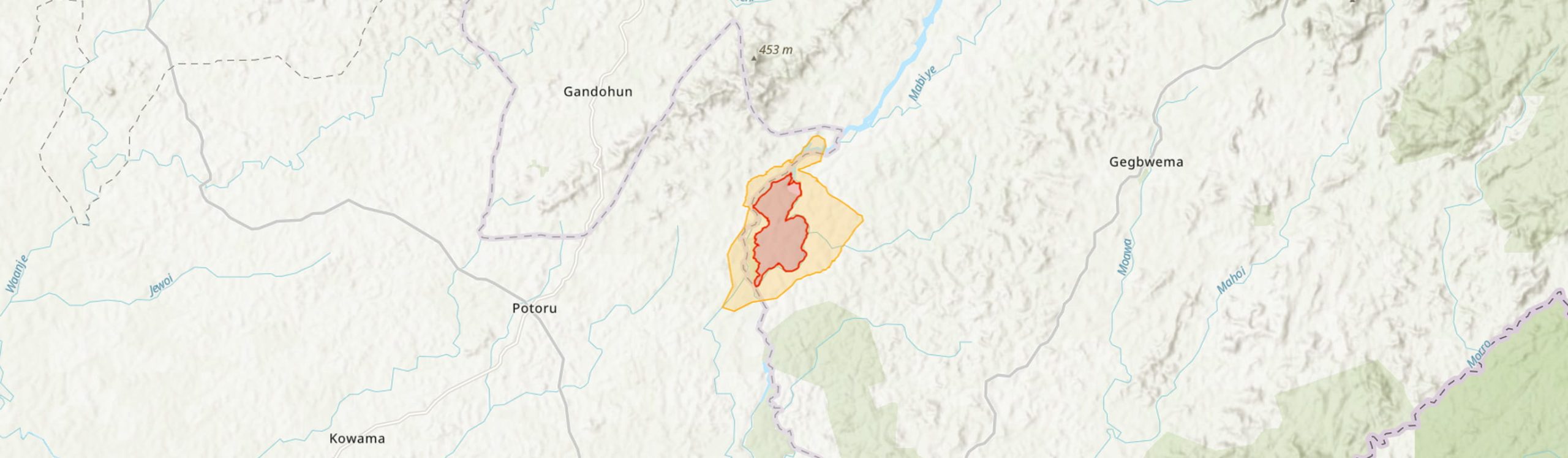
Country: Sierra Leone
Administrative region: Southern (Province)
Central co-ordinates: 7.54000 N, 11.35 W
Area: 30.6km²
Qualifying IPA Criteria
A(i)Site contains one or more globally threatened species, B(ii)Site contains an exceptional number of species of high conservation importance, C(iii)Site contains nationally threatened or restricted habitat or vegetation types, AND/OR habitats that have severely declined in extent nationally
IPA assessment rationale
The Tiwai Island IPA qualifies under the criteria A (i) as it contains twenty globally threatened species as well as B (ii) containing several species of significant conservation value. Additionally, the IPA qualifies under criteria C(iii). It is the largest inland island in the country and constitutes part of the intact remnant of the low moist tropical evergreen forest in Sierra Leone, a habitat that is nationally restricted. The region is a mosaic of gallery and swamp forest supporting high species diversity of over 700 plants, at least one of them, Millettia leonensis, is endemic to Sierra Leone.
Site description
The Tiwai Island Important Plant Area (IPA) contains a remnant of the West African Tropical Rainforest (Saidu et al., 2022). It is situated on the border between the Kenema District in the Eastern Province and the Pujehun District in the Southern Province of Sierra Leone (Google Earth, 2025). According to the Tiwai Island Wildlife Sanctuary (TIWS, n.d.), the island is surrounded by eight communities in two chiefdoms: Mapuma, Ngjema, and Segbema in Koya Chiefdom (Kenema District), and Kambama, Sahun, Naihun, Jenneh, and Boma in Barri Chiefdom (Pujehun District). This site is situated approximately 15 km southwest of Potoru, about 300 km southeast of Freetown, and roughly 35 km from the Liberian border (Fimbel, 1994, Google earth, 2026).
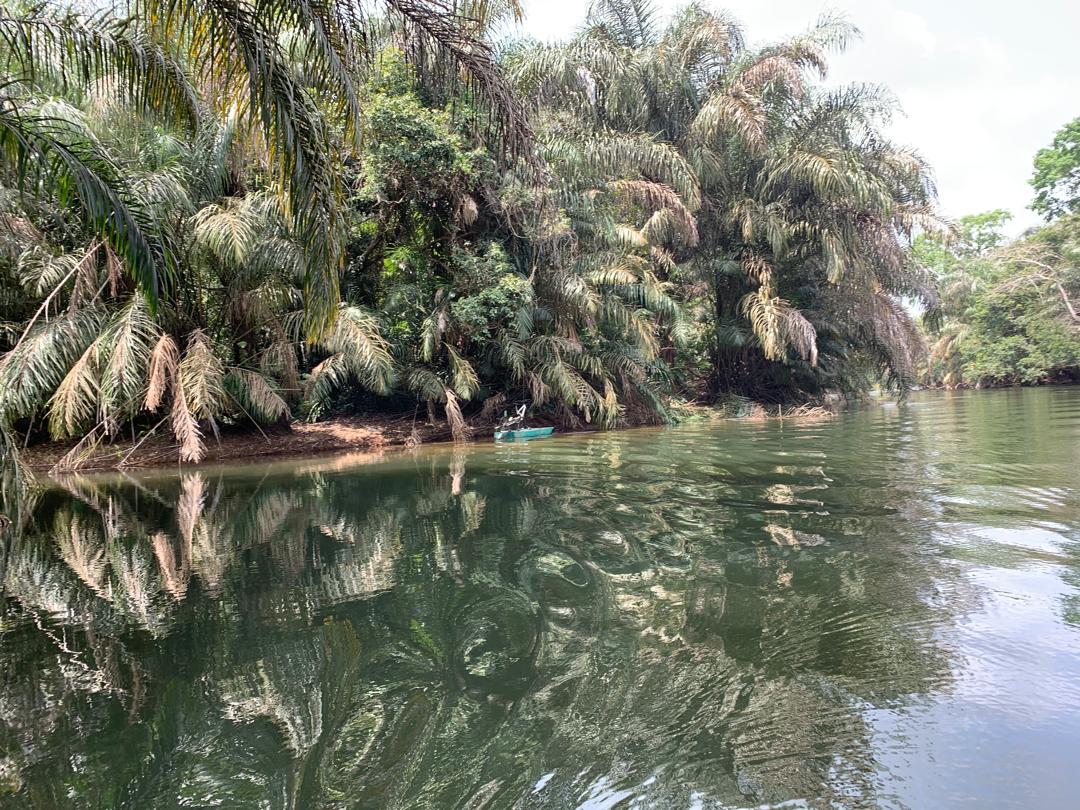
Tiwai Island, the largest inland rainforest island in Sierra Leone, is located within the Moa River, a few km northwest of Gola West (Oates et al., 1990), covering approximately 12 km² (1,200 hectares; Saidu et al., 2022). The name Tiwai means "large island" in the Mende language. It was recognized in the late 1970s as a critical habitat for wildlife protection, and ecological research and the first community-led conservation commenced on Tiwai Island in the early 1980s (Oates et al., 1990). The humid tropical lowland ecosystem gets up to 3,200 mm of rainfall annually and is home to unique group of fauna, including the Olive Colobus (Procolobus verus) and the Pygmy Hippo (Choeropsis liberiensis) (Oates et al., 1990).
The island's vegetation is classified as tropical moist evergreen forest with a mosaic of gallery forests, palm forests, and inland swamps (Holdridge 1947, Fimbel 1994). Tiwai lies within the Guinean Forests Biodiversity Hotspot, designated by Conservation International. Previous studies have estimated that the island hosts over 700 vascular plant species, approximately 20% of which are globally threatened, with several endemic to Sierra Leone (Oates, 1999). About 60% of the island consists of the mature forest (25 years old), while 30% is regenerating secondary forest as a result of historical anthropogenic agricultural operations that declined during the 1980s (Oates et al., 1990; Kolp et al., 2008).
Botanical significance
Tiwai Island represents one of the remaining sites of lowland evergreen forest in Sierra Leone, supporting more than 700 species of plants. A comprehensive botanical survey conducted in 2003 by the late Prof. Ake Assi and Prof. Aiah Lebbie documented 695 plant species, including 282 voucher specimen collections housed in the National Herbarium. The study identified 20 globally threatened species, 26 previously uncollected species in Sierra Leone, and 103 taxa yet to be assessed by the IUCN.
Notable globally threatened taxa include Dactyladenia smeathmannii (EN), Dactyladenia hirsuta (EN), Eugenia liberiana (EN), Millettia leonensis (EN), Hemandradenia chevalieri (EN), Milicia regia (VU), Okoubaka aubrevillei (EN), etc. The first Sierra Leonean records from Tiwai include Cyperus blepharoleptos, Ruthalicia longipes, Combretum aphanopetalum, Vernonia conferta, Culcasia seretii, and Raphia mannii. The rediscovery of Tiliacora dinklagei, last collected in 1944, further emphasizes the island’s urgent conservation and the need for continued research.
The island is dominated by widespread West African species such as Monanthotaxis mannii, Heterotis rotundifolia, Piptadeniastrum africanum, Parinari excelsa, and big lianas of Landolphia hirtusa of about 104 cm in diameter (Fanny Massally pers. obs.). Other common taxa include Xylopia aethiopica, Anthostema senegalense, Osodendron altissimum, Nauclea latifolia, Alchornea cordifolia, and Uapaca guineensis.
Habitat and geology
The dominant canopy tree species of the moist evergreen forest at Tiwai are Heritiera utilis, Brachystegia leonensis, and Parinari excelsa. Additional habitats include swamp forest, forest regrowth and secondary forest, and farm bush, which is often dominated by the invasive shrub Chromolaena odorata (Klop et al., 2010).
The island topology is at a low elevation of about 85 - 120 m above sea level with an average annual temperature of about 27°C. Annual rainfall average is about 3,000 mm, with a wet climate and a dry period lasting from December to March (Klop et al., 2010). In some specific habitats, rainfall can exceed 3,200 mm annually. The soils at Tiwai Island are highly sandy, strongly acidic, and have poor mineral nutrients (Oates et al., 1990), typical of the West African humid tropical lowland forest zone.
Conservation issues
All protected area management in Sierra Leone including Tiwai island are overseen by the National protected Area Authority, which is the main governmental agency for protected areas in Sierra Leone. The Tiwai Island Wildlife Sanctuary is locally managed by the Tiwai Island Administrative Committee (TIAC), including representatives from the eight surrounding communities, the Environmental Foundation Agency (EFA), government agencies, Njala University, and conservation bodies essential for its protection. The sanctuary forms part of the UNESCO World Heritage site, as the Gola-Tiwai Complex, and is currently classified under the IUCN Category IV (habitat/species management area).
Even though few studies have reported anthropogenic pressures, including poaching, forest fragmentation, swamp modification for rice cultivation, deforestation, and agricultural expansion, in addition to climate change in the past (Saidu et al., 2022, Fanny Massally pers. obs.), there is no forest cover loss has been detected inside the Tiwai Island sanctuary between May 2024 and April 2025 (WFP, 2025)
Recent analysis highlights an ongoing decline in forest cover linked to charcoal production and farmland conversion in the Southern Province, particularly around the sanctuary (Stevens et al. 2025). Historically, similar land-use anthropogenic pressures in the 1970s led to the clearing of 30% of Tiwai’s original forest. To prevent recurrence of land degradation, management must ensure robust protection with community-led efforts, to ensure Tiwai’s continued protection.
Ecosystem services
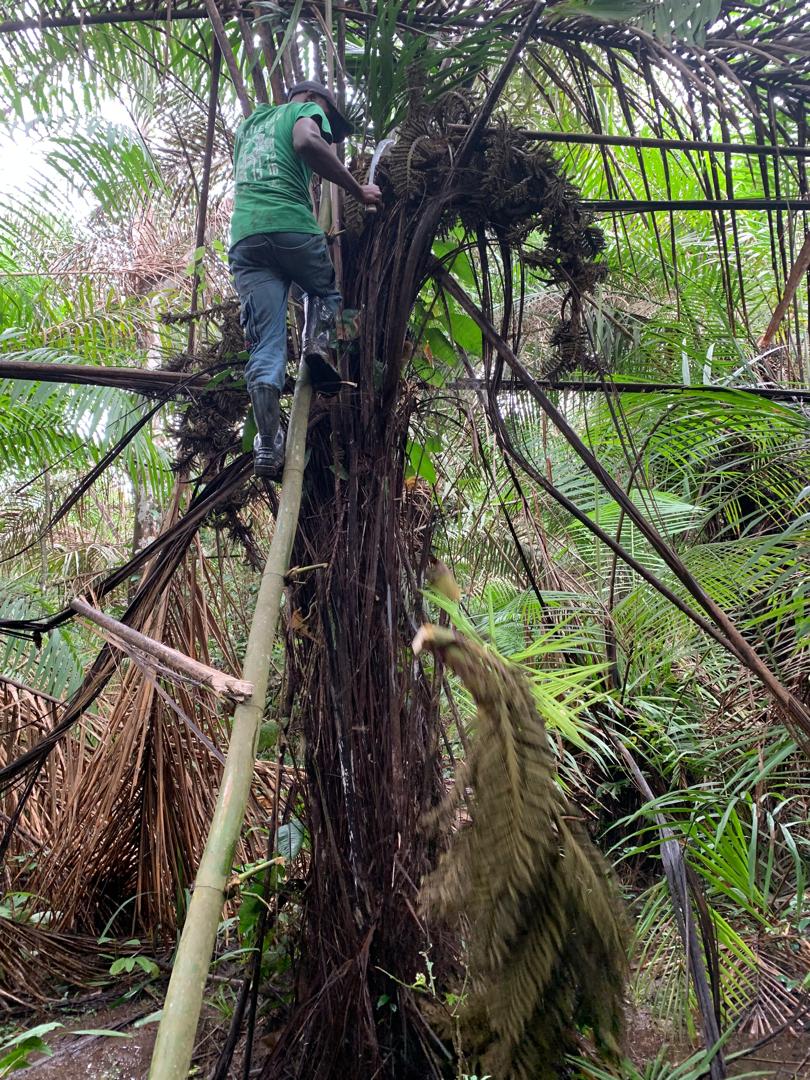
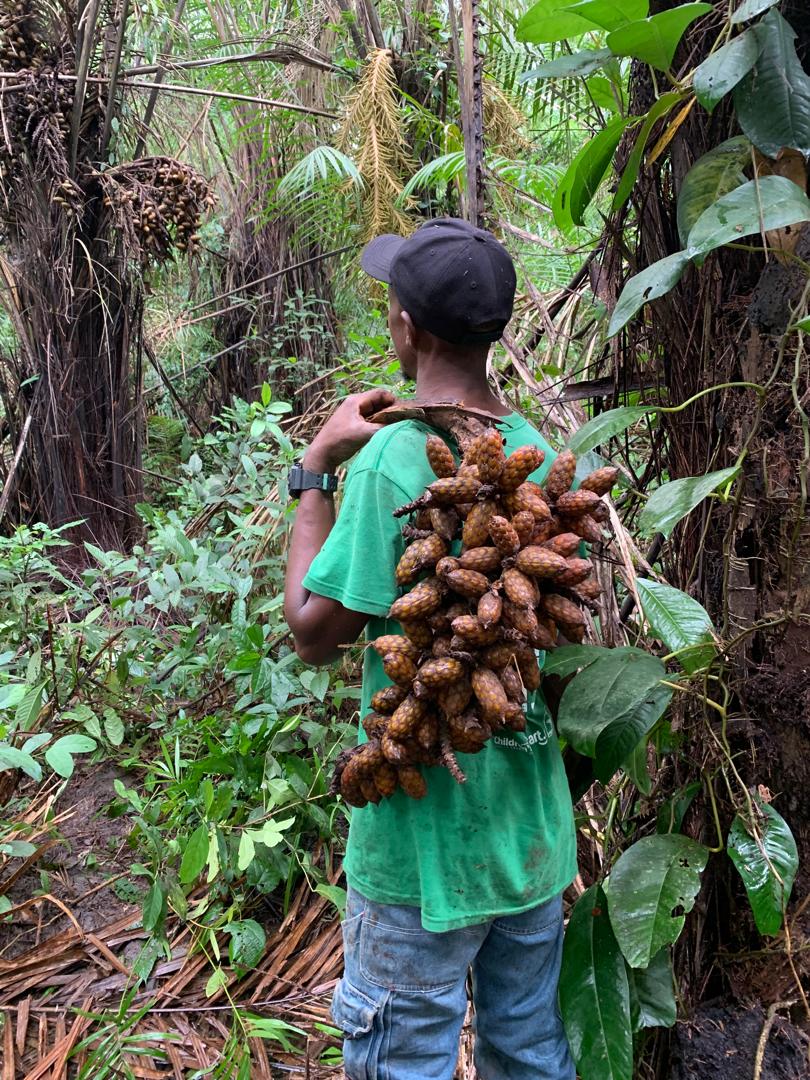
Tiwai Island provides a range of ecosystem services that sustain both wildlife and the local communities, including cultural, supporting, provisioning, and regulating services. Many of the plant species on the island provide direct benefit to the human communities; they are used for food, source of local traditional medicines, or as local materials.
The island mosaic of forest habitats offers support to diverse fauna communities, including Pygmy Hippos (Choeropsis liberiensis), several primate species, birds, and insects. The Pygmy Hippos, which are a globally threatened species, depends on the island's dense riparian vegetation for shelter and forage. A dietary study identified ten plant species consumed by this species, included Ipomoea alba, Ipomoea batatas, Theobroma cacao, Pteridium aquilinum, Cucurbita pepo, Urena sp., Digitaria eriantha, Hibiscus esculentus, Corchorus olitorius, and Geophila obvallata (Saidu et al., 2022). These include wild and cultivated taxa, highlighting the animals' use of natural and anthropogenic food sources. Frugivorous primates, like the western white-and-black colobus (Colobus polykomos), eat mostly fruits, seeds, and young leaves, especially from leguminous plants (Fabaceae). They play a critical ecological role by dispersing seeds and maintaining forest regeneration (Dalsilva, 1994).
Tiwai forest contributes to regulating services such as predator and prey regulation to maintain ecosystem balance, water retention, and microclimate regulation. The forest also holds high cultural significance and spiritual historic value to the Mende people who use plants from Tiwai in ceremonies and rituals.
Site assessor(s)
Assessed by:
Gabriella Hoban, Royal Botanic Gardens, Kew
Fanny Massally, Royal Botanic Gardens, Kew
Date of first assessment: 24th Apr 2025
Reviewed by:Xander van der Burgt, The Royal Botanic Gardens Kew
Mr. Tommy Garnett, Environmental Foundation for Africa
IPA criterion A species
| Species | Qualifying sub-criterion | ≥ 1% of global population | ≥ 5% of national population | 1 of 5 best sites nationally | Entire global population | Socio-economically important | Abundance at site |
|---|---|---|---|---|---|---|---|
| Dactyladenia hirsuta | A(i) |  |
|
|
 |
|
Scarce |
| Anopyxis klaineana (Pierre) Engl. | A(i) | |
|
|
|
|
Unknown |
| Berlinia occidentalis Keay | A(i) | |
|
|
|
|
Frequent |
| Cola simiarum Sprague ex Brenan & Keay | A(i) | |
|
|
|
|
Frequent |
| Didelotia afzelii Taub. | A(i) | |
|
|
|
|
Frequent |
| Gilbertiodendron bilineatum (Hutch. & Dalziel) J.Léonard | A(i) | |
|
|
|
|
Scarce |
| Hemandradenia chevalieri | A(i) | |
|
|
|
|
Scarce |
| Milicia regia (A.Chev.) C.C.Berg | A(i) | |
|
|
|
|
Frequent |
| Millettia leonensis Hepper | A(i) | |
|
|
|
|
Scarce |
| Millettia warneckei Harms | A(i) | |
|
|
|
|
Scarce |
| Okoubaka aubrevillei Pellegr. & Normand | A(i) | |
|
|
|
|
Scarce |
| Placodiscus oblongifolius | A(i) | |
|
|
|
|
Scarce |
| Terminalia ivorensis A.Chev. | A(i) | |
|
|
|
|
Frequent |
| Tristemma involucratum Benth. | A(i) | |
|
|
|
|
Frequent |
| Uvariodendron angustifolium | A(i) | |
|
|
|
|
Scarce |
| Aulacocalyx divergens (Hutch. & Dalziel) Keay | A(i) | |
|
|
|
|
Unknown |
| Dactyladenia smeathmannii (Baill.) Prance & White | A(i) | |
|
|
|
|
Unknown |
| Eugenia liberiana Amshoff | A(i) | |
|
|
|
|
Unknown |
| Tessmannia baikiaeoides | A(i) | |
|
|
|
|
Scarce |
| Aulacocalyx divergens (Hutch. & Dalziel) Keay | A(i) | |
|
|
|
|
Unknown |
Dactyladenia hirsuta
Qualifying sub-criterion:
A(i)
≥ 1% of global population:
≥ 5% of national population:
1 of 5 best sites nationally:
Entire global population:
Socio-economically important:
Abundance at site:
Scarce
Anopyxis klaineana (Pierre) Engl.
Qualifying sub-criterion:
A(i)
≥ 1% of global population:
≥ 5% of national population:
1 of 5 best sites nationally:
Entire global population:
Socio-economically important:
Abundance at site:
Unknown
Berlinia occidentalis Keay
Qualifying sub-criterion:
A(i)
≥ 1% of global population:
≥ 5% of national population:
1 of 5 best sites nationally:
Entire global population:
Socio-economically important:
Abundance at site:
Frequent
Cola simiarum Sprague ex Brenan & Keay
Qualifying sub-criterion:
A(i)
≥ 1% of global population:
≥ 5% of national population:
1 of 5 best sites nationally:
Entire global population:
Socio-economically important:
Abundance at site:
Frequent
Didelotia afzelii Taub.
Qualifying sub-criterion:
A(i)
≥ 1% of global population:
≥ 5% of national population:
1 of 5 best sites nationally:
Entire global population:
Socio-economically important:
Abundance at site:
Frequent
Gilbertiodendron bilineatum (Hutch. & Dalziel) J.Léonard
Qualifying sub-criterion:
A(i)
≥ 1% of global population:
≥ 5% of national population:
1 of 5 best sites nationally:
Entire global population:
Socio-economically important:
Abundance at site:
Scarce
Hemandradenia chevalieri
Qualifying sub-criterion:
A(i)
≥ 1% of global population:
≥ 5% of national population:
1 of 5 best sites nationally:
Entire global population:
Socio-economically important:
Abundance at site:
Scarce
Milicia regia (A.Chev.) C.C.Berg
Qualifying sub-criterion:
A(i)
≥ 1% of global population:
≥ 5% of national population:
1 of 5 best sites nationally:
Entire global population:
Socio-economically important:
Abundance at site:
Frequent
Millettia leonensis Hepper
Qualifying sub-criterion:
A(i)
≥ 1% of global population:
≥ 5% of national population:
1 of 5 best sites nationally:
Entire global population:
Socio-economically important:
Abundance at site:
Scarce
Millettia warneckei Harms
Qualifying sub-criterion:
A(i)
≥ 1% of global population:
≥ 5% of national population:
1 of 5 best sites nationally:
Entire global population:
Socio-economically important:
Abundance at site:
Scarce
Okoubaka aubrevillei Pellegr. & Normand
Qualifying sub-criterion:
A(i)
≥ 1% of global population:
≥ 5% of national population:
1 of 5 best sites nationally:
Entire global population:
Socio-economically important:
Abundance at site:
Scarce
Placodiscus oblongifolius
Qualifying sub-criterion:
A(i)
≥ 1% of global population:
≥ 5% of national population:
1 of 5 best sites nationally:
Entire global population:
Socio-economically important:
Abundance at site:
Scarce
Terminalia ivorensis A.Chev.
Qualifying sub-criterion:
A(i)
≥ 1% of global population:
≥ 5% of national population:
1 of 5 best sites nationally:
Entire global population:
Socio-economically important:
Abundance at site:
Frequent
Tristemma involucratum Benth.
Qualifying sub-criterion:
A(i)
≥ 1% of global population:
≥ 5% of national population:
1 of 5 best sites nationally:
Entire global population:
Socio-economically important:
Abundance at site:
Frequent
Uvariodendron angustifolium
Qualifying sub-criterion:
A(i)
≥ 1% of global population:
≥ 5% of national population:
1 of 5 best sites nationally:
Entire global population:
Socio-economically important:
Abundance at site:
Scarce
Aulacocalyx divergens (Hutch. & Dalziel) Keay
Qualifying sub-criterion:
A(i)
≥ 1% of global population:
≥ 5% of national population:
1 of 5 best sites nationally:
Entire global population:
Socio-economically important:
Abundance at site:
Unknown
Dactyladenia smeathmannii (Baill.) Prance & White
Qualifying sub-criterion:
A(i)
≥ 1% of global population:
≥ 5% of national population:
1 of 5 best sites nationally:
Entire global population:
Socio-economically important:
Abundance at site:
Unknown
Eugenia liberiana Amshoff
Qualifying sub-criterion:
A(i)
≥ 1% of global population:
≥ 5% of national population:
1 of 5 best sites nationally:
Entire global population:
Socio-economically important:
Abundance at site:
Unknown
Tessmannia baikiaeoides
Qualifying sub-criterion:
A(i)
≥ 1% of global population:
≥ 5% of national population:
1 of 5 best sites nationally:
Entire global population:
Socio-economically important:
Abundance at site:
Scarce
Aulacocalyx divergens (Hutch. & Dalziel) Keay
Qualifying sub-criterion:
A(i)
≥ 1% of global population:
≥ 5% of national population:
1 of 5 best sites nationally:
Entire global population:
Socio-economically important:
Abundance at site:
Unknown
IPA criterion C qualifying habitats
| Habitat | Qualifying sub-criterion | ≥ 5% of national resource | ≥ 10% of national resource | 1 of 5 best sites nationally | Areal coverage at site |
|---|---|---|---|---|---|
| Lowland Evergreen Forest | C(iii) | |
|
|
Lowland Evergreen Forest
Qualifying sub-criterion:
C(iii)
≥ 5% of national resource:
≥ 10% of national resource:
Areal coverage at site:
General site habitats
| General site habitat | Percent coverage | Importance |
|---|---|---|
| Forest - Subtropical/Tropical Moist Lowland Forest | |
Major |
| Forest - Subtropical/Tropical Swamp Forest | |
Minor |
| Wetlands (inland) - Bogs, Marshes, Swamps, Fens, Peatlands [generally over 8 ha] | |
Minor |
| Wetlands (inland) - Permanent Rivers, Streams, Creeks [includes waterfalls] | |
Unknown |
Forest - Subtropical/Tropical Moist Lowland Forest
Percent coverage:
Importance:
Major
Forest - Subtropical/Tropical Swamp Forest
Percent coverage:
Importance:
Minor
Wetlands (inland) - Bogs, Marshes, Swamps, Fens, Peatlands [generally over 8 ha]
Percent coverage:
Importance:
Minor
Wetlands (inland) - Permanent Rivers, Streams, Creeks [includes waterfalls]
Percent coverage:
Importance:
Unknown
Land use types
| Land use type | Percent coverage | Importance |
|---|---|---|
| Nature conservation | |
Major |
| Tourism / Recreation | |
Major |
| Harvesting of wild resources | |
Minor |
| Agriculture (aquatic) | |
Major |
| Agriculture (arable) | |
Minor |
Nature conservation
Percent coverage:
Importance:
Major
Tourism / Recreation
Percent coverage:
Importance:
Major
Harvesting of wild resources
Percent coverage:
Importance:
Minor
Agriculture (aquatic)
Percent coverage:
Importance:
Major
Agriculture (arable)
Percent coverage:
Importance:
Minor
Threats
| Threat | Severity | Timing |
|---|---|---|
| Agriculture & aquaculture - Annual & perennial non-timber crops - Small-holder farming | Low | Ongoing - stable |
| Agriculture & aquaculture - Livestock farming & ranching - Small-holder grazing, ranching or farming | Low | Ongoing - stable |
| Biological resource use - Hunting & collecting terrestrial animals - Motivation Unknown/Unrecorded | Low | Ongoing - stable |
| Biological resource use - Fishing & harvesting aquatic resources - Intentional use: subsistence/small scale (species being assessed is the target) [harvest] | Low | Ongoing - stable |
| Agriculture & aquaculture - Annual & perennial non-timber crops - Small-holder farming | Low | Ongoing - stable |
| Agriculture & aquaculture - Livestock farming & ranching - Small-holder grazing, ranching or farming | Low | Ongoing - stable |
| Biological resource use - Hunting & collecting terrestrial animals - Motivation Unknown/Unrecorded | Low | Ongoing - stable |
| Biological resource use - Fishing & harvesting aquatic resources - Intentional use: subsistence/small scale (species being assessed is the target) [harvest] | Low | Ongoing - stable |
Agriculture & aquaculture - Annual & perennial non-timber crops - Small-holder farming
Severity:
Low
Timing:
Ongoing - stable
Agriculture & aquaculture - Livestock farming & ranching - Small-holder grazing, ranching or farming
Severity:
Low
Timing:
Ongoing - stable
Biological resource use - Hunting & collecting terrestrial animals - Motivation Unknown/Unrecorded
Severity:
Low
Timing:
Ongoing - stable
Biological resource use - Fishing & harvesting aquatic resources - Intentional use: subsistence/small scale (species being assessed is the target) [harvest]
Severity:
Low
Timing:
Ongoing - stable
Agriculture & aquaculture - Annual & perennial non-timber crops - Small-holder farming
Severity:
Low
Timing:
Ongoing - stable
Agriculture & aquaculture - Livestock farming & ranching - Small-holder grazing, ranching or farming
Severity:
Low
Timing:
Ongoing - stable
Biological resource use - Hunting & collecting terrestrial animals - Motivation Unknown/Unrecorded
Severity:
Low
Timing:
Ongoing - stable
Biological resource use - Fishing & harvesting aquatic resources - Intentional use: subsistence/small scale (species being assessed is the target) [harvest]
Severity:
Low
Timing:
Ongoing - stable
Protected areas
| Protected area name | Protected area type | Relationship with IPA | Areal overlap |
|---|---|---|---|
| Tiwai Island Wildlife Sanctuary | Wildlife Sanctuary | protected/conservation area overlaps with IPA | |
| Gola-Tiwai Complex | UNESCO World Heritage Site | protected/conservation area overlaps with IPA | |
Tiwai Island Wildlife Sanctuary
Protected area type:
Wildlife Sanctuary
Relationship with IPA:
protected/conservation area overlaps with IPA
Areal overlap:
Gola-Tiwai Complex
Protected area type:
UNESCO World Heritage Site
Relationship with IPA:
protected/conservation area overlaps with IPA
Areal overlap:
Management type
| Management type | Description | Year started | Year finished |
|---|---|---|---|
| Site management plan in place | |
|
|
| Protected Area management plan in place | |
|
Site management plan in place
Year started:
Year finished:
Protected Area management plan in place
Year started:
Year finished:
Bibliography
Tiwai Island Wildlife Sanctuary Communities
Determinants of variation in tropical forest primate biomass: new evidence from West Africa
Ecology, Vol 71(1), page(s) 328-343
The birds of Gola Forest and Tiwai Island, Sierra Leone
Malimbus, Vol 32, page(s) 33-58
The relative use of abandoned farm clearings and old forest habitats by primates and a forest antelope at Tiwai, Sierra Leone, West Africa
Biological Conservation, Vol 70(3), page(s) 277-286
Biodiversity of Gola Forest, Sierra Leone.
Royal Society for the Protection of Birds, Conservation Society of Sierra Leone, Government of Sierra Leone
Threats and Conservation Strategies of Pygmy Hippopotamus (Choeropsis liberiensis) in Tiwai Island, Sierra Leone
Direct Research Journal of Agriculture and Food Science, Vol 10(5), page(s) 119-125
Diet of Colobus polykomos on Tiwai Island: selection of food in relation to its seasonal abundance and nutritional quality
International Journal of Primatology, Vol 15(5), page(s) 655-680
Determination of world plant formations from simple climatic data
Science, Vol 105(2727), page(s) 367-368.
Asset Impact monitoring from space, Sierra Leone forest cover loss analysis 2025


Recommended citation
Gabriella Hoban, Fanny Massally (2026) Tropical Important Plant Areas Explorer: Tiwai Island (Sierra Leone). https://tipas.kew.org/site/tiwai/ (Accessed on 24/08/2026)