
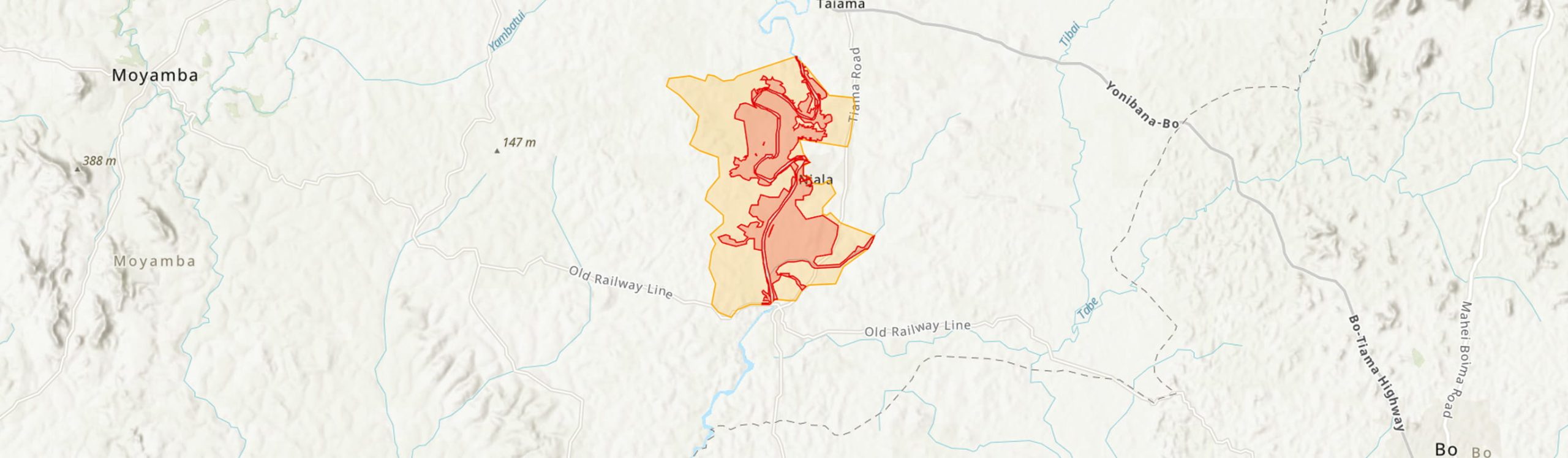
Country: Sierra Leone
Administrative region: Southern (Province)
Central co-ordinates: 8.11000 N, 12.1 W
Area: 102.8km²
Qualifying IPA Criteria
A(i)Site contains one or more globally threatened species, B(ii)Site contains an exceptional number of species of high conservation importance
IPA assessment rationale
This is a globally significant site, as it contains the entire known population of Ayenia guinensis, as well as an additional 9 threatened species that quality under criterion A(i). It also triggers criterion B(ii) as it is among the 15 richest sites nationally containing species of high conservation importance.
Site description
The Njala IPA is located along the Taia River, near Njala in the Moyamba District in the Southern Province of Sierra Leone. This township hosts the Njala University campus and the National Herbarium of Sierra Leone. The university has facilitated a substantial scientific research output and alteration of the natural environments, with much of its focus on agricultural studies in the vicinity. This IPA is situated on the inland plain near the escarpment region and encapsulates habitat along the banks of the Taia River. The name "Njala" translates to "bank of the river" in the Mende language (Poppel 2014). While the original vegetation in this region has largely been replaced by university facilities and agricultural land, some intact riparian vegetation persists along the river. Extensive botanical survey at this site is still required. Until then, this IPA boundary remains preliminary.
Botanical significance
This site is the collecting locality of many significant historical collections of gallery forest species, including nine threatened taxa. Among these are national endemics such as Cassipourea paludosa (Rhizophoraceae), Leptoderris trifoliolata (Papilionoideae), Newtonia elliotii (Mimosoideae), Millettia leonensis (Papilionoideae) and the site-endemic Ayenia guineensis (Malvaceae). Conservation important species Cynometra leonensis, L. trifoliolata, N. elliotii and Placodiscus riparius were re-recorded in recent surveys.
Notably, this IPA supports a globally important population of the endemic scrambling shrub Ayenia guineensis (or Byttneria guineensis, CR). This species is only known from the locality of Njala (Deighton #5030), where it was collected in 1949, and has not been observed since. While suitable gallery forest habitat persists, extensive targeted survey is needed to assess its current status.
Gallery forests in the IPA contain the climber Leptoderris trifoliolata (EN), the liana Millettia leonensis (EN), and rare trees such as Dialium pobeguinii (VU), Didelotia afzelii (VU) and Placodiscus riparius (VU). The herb Stylochaeton pilosus (EN) occurs in gallery forests or secondary habitats, while the shrub Sericanthe trilocularis (EN) is found on rocks on riversides. The endemic mangrove Cassipourea paludosa (EN), a species from freshwater river edges and swamps, has recently been recorded in disturbed agricultural habitats in the Northern Province of Sierra Leone (Lovell 2021), indicating strong potential for its persistence at this site.
Rheophytic species have been documented and studied at this site by Lebbie in Cheek et al. (2016), in which the new genus Karima scarciesii (Euphorbiaceae) was first described. It is assessed as NT (Cheek et al. 2016, Cheek 2017). Additionally Inversodicraea mortonii was collected downstream near Mano (Harris #12), thus targeted surveys are recommended in suitable water-rapid habitat within this IPA.
Furthermore, modelling the distribution of conservation important species at the site is recommended to address the collection bias imposed due to the proximity of this site to the herbarium.
Habitat and geology
The vegetation at the Njala IPA has been highly modified (Global Forest Watch 2024). Despite this, some natural habitats persist, including lowland gallery forest; a threatened habitat in West Africa (Couch et al. 2019). The site also contains swamp and riverine grasslands which have evaded reclamation activities (Poppel 2014, FAO 2023). On the flats further from drainage lines, the original forest cover has been cleared and forest at various successional stages now occurs; ranging from ‘farmbush’ to thicket and secondary forest. Anthropogenic habitats, such as extensive oil palm plantations and upland crop fields (e.g. rice, cassava, sweet potato) now dominate the flats.
The geology of Njala is characterised by ancient Precambrian granitic basement rocks, with significant alluvial deposits concentrated along river valleys and low-lying areas (Amara et al. 2022).
Conservation issues
The Njala IPA faces significant conservation challenges, driven by a long history of human interaction and land use change. The establishment of the agricultural college in the 1920s began to transform the landscape into an area primarily for agricultural experimentation and training. This laid the foundations for what would later become the Njala University College (Poppel 2014). Since 1939, large-scale reclamation of freshwater inland swamps occurred (Poppel 2014). Clearing and agricultural expansion have continued to the present day, further degrading native vegetation and reducing habitat integrity (Global Forest Watch 2024). The Moyamba District, where Njala is situated, has experienced a 45% loss in tree cover over the past two decades, with most remaining vegetation consisting of degraded farm bush resulting from shifting cultivation and frequent burning (Global Forest Watch 2024). The critical habitat, gallery forest, that may support species of high conservation importance, is also threatened by activities like sand mining from the river (Sokpo, pers. obs. 2022), with the felling of trees for charcoal burning. The Njala IPA requires conservation effort to mitigate the continuing decline in habitat area and quality, particularly the persistent sand and gold mining activities up river.
Ecosystem services
The Njala IPA acts as a watershed for nearby populations, and other communities downstream. Riparian vegetation at the site protects water quality, and provides soil stabilisation and erosion control services. Remaining vegetation also contributes to carbon sequestration. The site offers provisioning services, such as timber, fuelwood, and non-timber forest products, which are essential for the livelihoods of surrounding communities (Agbeja 2012). Importantly, this site contains important biodiversity and globally significant populations of threatened species. Cultural services include Njala’s role as a historically significant educational and scientific research facilities, including the National Herbarium of Sierra Leone.
Site assessor(s)
Assessed by:
Gabriella Hoban, Royal Botanic Gardens, Kew
Date of first assessment: 13th Dec 2024
Reviewed by:Xander van der Burgt, The Royal Botanic Gardens Kew
Martin Cheek, The Royal Botanic Gardens Kew
Aiah Lebbie, The University of Sierra Leone
IPA criterion A species
| Species | Qualifying sub-criterion | ≥ 1% of global population | ≥ 5% of national population | 1 of 5 best sites nationally | Entire global population | Socio-economically important | Abundance at site |
|---|---|---|---|---|---|---|---|
| Ayenia guineensis (Keay & Milne-Redh.) Christenh. & Byng | A(i) |  |
|
|
|
 |
Unknown |
| Cassipourea paludosa Hutch. & Dalziel ex Jacq.-Fél. | A(i) | |
|
|
|
|
Unknown |
| Dialium pobeguinii Pellegr. | A(i) | |
|
|
|
|
Unknown |
| Didelotia afzelii Taub. | A(i) | |
|
|
|
|
Unknown |
| Leptoderris trifoliolata Hepper | A(i) | |
|
|
|
|
Scarce |
| Millettia leonensis Hepper | A(i) | |
|
|
|
|
Unknown |
| Placodiscus riparius Keay | A(i) | |
|
|
|
|
Occasional |
| Sericanthe trilocularis (Scott Elliot) Robbr. | A(i) | |
|
|
|
|
Unknown |
| Stylochaeton pilosum Bogner | A(i) | |
|
|
|
|
Unknown |
| Newtonia elliotii (Harms) Keay | A(i) | |
|
|
|
|
Scarce |
| Inversodicraea mortonii (C.Cusset) Cheek | A(i) | |
|
|
|
|
Unknown |
Ayenia guineensis (Keay & Milne-Redh.) Christenh. & Byng
Qualifying sub-criterion:
A(i)
≥ 1% of global population:
≥ 5% of national population:
1 of 5 best sites nationally:
Entire global population:
Socio-economically important:
Abundance at site:
Unknown
Cassipourea paludosa Hutch. & Dalziel ex Jacq.-Fél.
Qualifying sub-criterion:
A(i)
≥ 1% of global population:
≥ 5% of national population:
1 of 5 best sites nationally:
Entire global population:
Socio-economically important:
Abundance at site:
Unknown
Dialium pobeguinii Pellegr.
Qualifying sub-criterion:
A(i)
≥ 1% of global population:
≥ 5% of national population:
1 of 5 best sites nationally:
Entire global population:
Socio-economically important:
Abundance at site:
Unknown
Didelotia afzelii Taub.
Qualifying sub-criterion:
A(i)
≥ 1% of global population:
≥ 5% of national population:
1 of 5 best sites nationally:
Entire global population:
Socio-economically important:
Abundance at site:
Unknown
Leptoderris trifoliolata Hepper
Qualifying sub-criterion:
A(i)
≥ 1% of global population:
≥ 5% of national population:
1 of 5 best sites nationally:
Entire global population:
Socio-economically important:
Abundance at site:
Scarce
Millettia leonensis Hepper
Qualifying sub-criterion:
A(i)
≥ 1% of global population:
≥ 5% of national population:
1 of 5 best sites nationally:
Entire global population:
Socio-economically important:
Abundance at site:
Unknown
Placodiscus riparius Keay
Qualifying sub-criterion:
A(i)
≥ 1% of global population:
≥ 5% of national population:
1 of 5 best sites nationally:
Entire global population:
Socio-economically important:
Abundance at site:
Occasional
Sericanthe trilocularis (Scott Elliot) Robbr.
Qualifying sub-criterion:
A(i)
≥ 1% of global population:
≥ 5% of national population:
1 of 5 best sites nationally:
Entire global population:
Socio-economically important:
Abundance at site:
Unknown
Stylochaeton pilosum Bogner
Qualifying sub-criterion:
A(i)
≥ 1% of global population:
≥ 5% of national population:
1 of 5 best sites nationally:
Entire global population:
Socio-economically important:
Abundance at site:
Unknown
Newtonia elliotii (Harms) Keay
Qualifying sub-criterion:
A(i)
≥ 1% of global population:
≥ 5% of national population:
1 of 5 best sites nationally:
Entire global population:
Socio-economically important:
Abundance at site:
Scarce
Inversodicraea mortonii (C.Cusset) Cheek
Qualifying sub-criterion:
A(i)
≥ 1% of global population:
≥ 5% of national population:
1 of 5 best sites nationally:
Entire global population:
Socio-economically important:
Abundance at site:
Unknown
General site habitats
| General site habitat | Percent coverage | Importance |
|---|---|---|
| Forest - Subtropical/Tropical Moist Lowland Forest | |
|
| Forest - Subtropical/Tropical Swamp Forest | |
|
| Grassland - Subtropical/Tropical Seasonally Wet/Flooded Lowland Grassland | |
|
| Wetlands (inland) - Permanent Rivers, Streams, Creeks [includes waterfalls] | |
|
| Artificial - Terrestrial - Arable Land | |
|
| Artificial - Terrestrial - Urban Areas | |
Forest - Subtropical/Tropical Moist Lowland Forest
Percent coverage:
Importance:
Forest - Subtropical/Tropical Swamp Forest
Percent coverage:
Importance:
Grassland - Subtropical/Tropical Seasonally Wet/Flooded Lowland Grassland
Percent coverage:
Importance:
Wetlands (inland) - Permanent Rivers, Streams, Creeks [includes waterfalls]
Percent coverage:
Importance:
Artificial - Terrestrial - Arable Land
Percent coverage:
Importance:
Artificial - Terrestrial - Urban Areas
Percent coverage:
Importance:
Land use types
| Land use type | Percent coverage | Importance |
|---|---|---|
| Agriculture (arable) | |
|
| Residential / urban development | |
Agriculture (arable)
Percent coverage:
Importance:
Residential / urban development
Percent coverage:
Importance:
Management type
| Management type | Description | Year started | Year finished |
|---|---|---|---|
| No management plan in place | |
|
No management plan in place
Year started:
Year finished:
Bibliography
Global Forest Watch
The Vegetation of Sierra Leone
Threatened Habitats and Tropical Important Plant Areas of Guinea, West Africa
Legal Study on Forests in Sierra Leone: Strengthening the forestry legal framework to address transboundary challenges and degradation trends in the Upper Guinean forest ecosystem
Cassipourea paludosa
The IUCN Red List of Threatened Species
From the soil up: Sierra Leone and the rural university in the wake of empire (dissertation thesis)
Effects of land use on Soil Organic Carbon fractions in soils of Njala Landscape in Sierra Leone
International Journal of Environment, Agriculture and Biotechnology, Vol 1(4)
Effect of land uses on soil erodibility in the Njala Area of Southern Sierra Leone
Open Journal of Soil Science, Vol 12(10), page(s) 475-489
Community perceptions on socio-economic incentives for rehabilitation of tree species on Njala University Campus, Sierra Leone
Arboricultural Journal, Vol 33(3), page(s) pp.189-201
Discovering Karima (Euphorbiaceae), a New Crotonoid Genus from West Tropical Africa Long Hidden within Croton
PLoS ONE, Vol 11, page(s) 4
Karima scarciesii
The IUCN Red List of Threatened Species


Recommended citation
Gabriella Hoban (2026) Tropical Important Plant Areas Explorer: Njala (Sierra Leone). https://tipas.kew.org/site/njala/ (Accessed on 26/08/2026)