
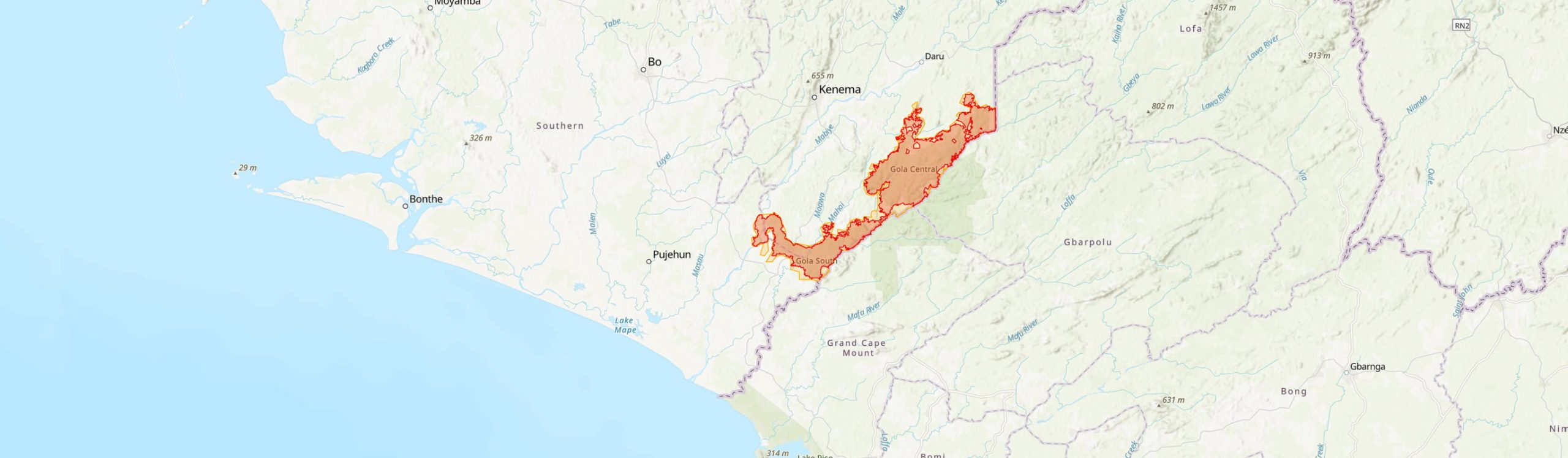
Country: Sierra Leone
Administrative region: Eastern (Province)
Central co-ordinates: 7.60000 N, 10.9 W
Area: 1307.9km²
Qualifying IPA Criteria
A(i)Site contains one or more globally threatened species, B(i)Site contains a high number of species within defined habitat or vegetation types, C(i)Site contains globally threatened or restricted habitat or vegetation types
IPA assessment rationale
This IPA qualifies under criteria A(i) as it contains globally significant populations of fifty-one threatened species, as well as A(iii) as it contains the entire known population of a highly range restricted species, Tricalysia parva. Additionally this site qualifies under criterion C(i), containing the largest remnant nationally of primary moist closed forest and gallery forest, a threatened habitat type in the region.
Site description
The Gola IPA is located in southeastern Sierra Leone, along the border with Liberia. This IPA is part of the Gola Rainforest National Park (GRNP), a transboundary protected area that represents one of the largest remaining tracts of Upper Guinean Forest in West Africa. Additionally, the area comprises the largest remaining area of intact, lowland rainforest anywhere in Sierra Leone. While this IPA treats the boundary of the Gola Rainforest as one polygon, the area of the GRNP has been divided into two areas referred to as the 'northern' and 'southern' areas. Effective protection and management of this area is essential to prevent the complete loss of the country's main area of primary evergreen forest.
Botanical significance
Gola has a high diversity in many taxa including a good representation of the threatened and endemic species of the Upper Guinea forests. Many of these species have their westernmost occurrence in Gola.
While a complete botanical checklist for Gola is a work in progress, a total of 665 dicots, 175 monocots and 32 species of ferns (excluding exotics) have thus far been recorded at the site (Klop et al. 2008, Hawthorne 2010, Ake Assi 2016, van der Burgt & Lopez-Poveda 2018). Of the species recorded in the IPA there are at least twenty-two threatened taxa and one species globally endemic to Gola, Tricalysia parva (NE). Eight of these 22 species are unique to this IPA including Gilbertiodendron splendidum, Isolona deightonii and Vepris fer. Many other species found in this IPA are endemic to the Upper Guinean forests, such as Brachystegia leonensis, Cola baldwinii, Diospyros thomasii, Leptonychia occidentalis and Memecylon ramosum. Further studies will result in new records of rare species within the IPA.
Habitat and geology
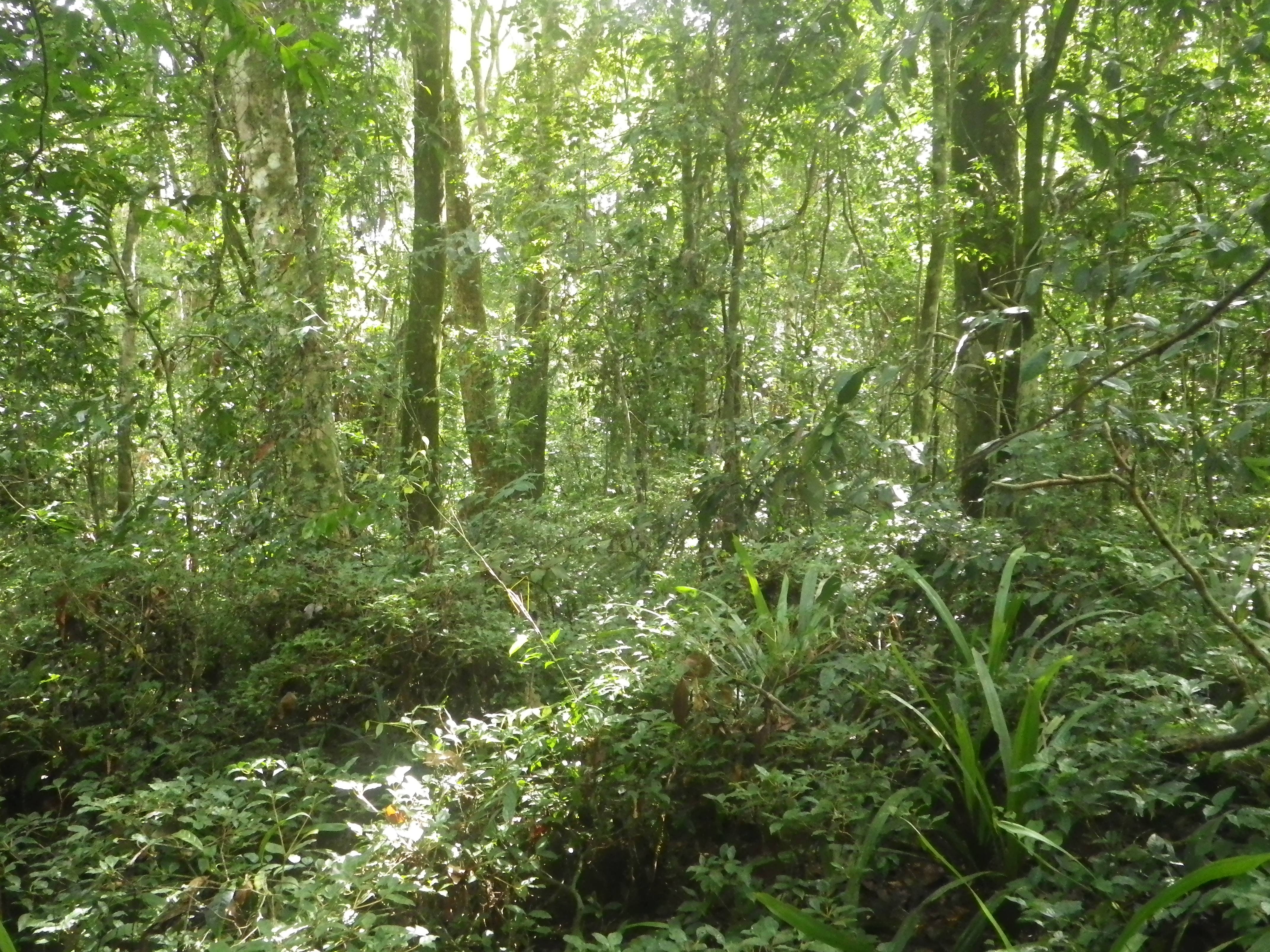
Gola Forest lies within the Upper Guinean Forest ecoregion (Olson et al. 2001) and is characterised by evergreen and semi-deciduous forest, as well as gallery forest along drainage lines. Geologically, the area features ancient Precambrian rocks, which are overlayed iron and magnesium-rich metamorphic rocks of the by the granite-greenstone complex. The predominant soils in Gola are derived from granite, thus are characterized by freely draining sands and gravels, mixed with varying proportions of lateritic gravel. The area supports lush vegetation due to annual rainfall exceeding 2000 mm. Gola is characterized as moist evergreen forest (White 1972), however some parts of the southern and western portions are better classified as moist semi-deciduous forest with inland swamp forest (Klop et al 2008). Evergreen forest is characterised by Heritieria utilis, Brachystegia leonensis, Calpocalyx aubrevillei and Sacoglottis gabonensis. Moist semi-deciduous forest is dominated by Cynometra leonensis, Parinari excelsa, Parkia bicolor and Piptadeniastrum africanum. In swamo forest Raphia palms often dominate alongside characteristic tree species Uapaca spp. and Nauclea diderrichii. Where forest has been cleared, vegetation at various successional stages occurs, ranging from farmbush to secondary forest, evident in the higher abundance of trees Carapa procera, Macaranga barteri and Musanga cecropioides (Cole 1968).
Conservation issues
Despite its protected status, Gola continues to face significant threats that jeopardise its ecological integrity. These issues are targeted by the not-for-profit 'Gola Rainforest Conservation, which has been active at site since 2014 (although their inception in 2015; Malan et al. 2022). This organisation is formed as a partnership between the Government of Sierra Leone, the Conservation Society of Sierra Leone (CSSL), the Royal Society for the Protection of Birds (RSPB) and the people of the seven Gola Chiefdoms (Ashpole 2023). Gola Rainforest Conservation coordinates research and conservation efforts in the area through various initiatives, including the REDD+ programme (Ashpole 2023). Despite sustained conservation attention on Gola National Park, the area remains a hotspot of forest loss from 2002 to 2023, as identified using the Harris et al. (2017) deforestation hotspot methodology available via Global Forest Watch (accessed 2025). A study from 2014-2018 found that the REDD+ programme reduced but not reversed deforestation in Gola NP (Malan et al. 2022), however analysis shows that forest loss in Gola is vastly less of an issue at Gola in comparison to the rest of Sierra Leone (White, unpublished, 2024). Agricultural encroachment into forest, particularly slash-and-burn farming, continues to expand into forest edges, reducing habitat connectivity. The Gola REDD+ project was designed to incentivize communities to shift away from traditional to more sustainable agricultural practices such such as cocoa (Malan et al. 2022), however while these practices negatively impact plant diversity. Disturbance also facilitates the incursion of species, such as the invasive shrub Chromolaena odorata (Klop et al. 2008). Illegal logging and artisanal mining are primary drivers of deforestation and habitat degradation, often facilitated by weak enforcement of the national park (Klop et al. 2008). Hunting and the bushmeat trade also pose risks to the forest’s fauna, indirectly affecting plant populations that rely on animal-mediated seed dispersal, such as the elephant dispersed endangered tree Tieghemella heckelii. Effective conservation of this IPA requires strengthening community-based forest management and addressing socio-economic drivers of deforestation.
Ecosystem services
Gola Forest provides an array of critical ecosystem services. It’s diverse forests holds globally important habitat, including for threatened wildlife such as the Pygmy Hippopotamus, African Forest Elephant, Zebra Duiker, Chimpanzee, Diana Monkey, and Western Red Colobus (UNESCO 2024). The forest also hosts approximately 313 bird species, of which at least eighteen are of global conservation concern, notably the White-necked Picathartes (Klop et al. 2010). Provisioning services from Gola include valuable non-timber forest products (NTFPs), such as medicinal plants, fruits, and honey, which are integral to local community well-being. Additionally, Gola Forest plays an essential role in carbon sequestration as a natural carbon sink, and also regulates regional hydrology and maintains water sources crucial for agriculture and downstream livelihoods. The forest is a nationally significant ecotourism destination, hosting between 500 and 800 tourists annually (UNESCO 2024); providing local communities with an important source of income.
Site assessor(s)
Assessed by:
Reviewed by:
Gabriella Hoban, Royal Botanic Gardens, Kew
Xander van der Burgt, Royal Botanic Gardens, Kew
Fanny Massally, Royal Botanic Gardens, Kew
Date of first assessment: 1st Oct 2024
Date of latest reassessment: 27th Apr 2026
Reviewed by:
Martin Cheek, The Royal Botanic Gardens Kew
IPA criterion A species
| Species | Qualifying sub-criterion | ≥ 1% of global population | ≥ 5% of national population | 1 of 5 best sites nationally | Entire global population | Socio-economically important | Abundance at site |
|---|---|---|---|---|---|---|---|
| Dactyladenia globosa Jongkind | A(i) |  |
|
|
 |
|
|
| Berlinia occidentalis Keay | A(i) | |
|
|
|
|
|
| Brachystegia leonensis Hutch. & Burtt Davy | A(i) | |
|
|
|
|
|
| Cola baldwinii Jongkind | A(i) | |
|
|
|
|
|
| Gilbertiodendron splendidum (A.Chev. ex Hutch. & Dalziel) J.Léonard | A(i) | |
|
|
|
|
|
| Isolona deightonii Keay | A(i) | |
|
|
|
|
|
| Leptonychia occidentalis Keay | A(i) | |
|
|
|
|
|
| Memecylon ramosum Jacq.-Fél. | A(i) | |
|
|
|
|
|
| Vepris fer Cheek | A(i) | |
|
|
|
|
|
| Anubias gracilis A.Chev. ex Hutch. | A(i) | |
|
|
|
|
|
| Cryptosepalum tetraphyllum (Hook.f.) Benth. | A(i) | |
|
|
|
|
|
| Didelotia afzelii Taub. | A(i) | |
|
|
|
|
|
| Gilbertiodendron aylmeri (Hutch. & Dalziel) J.Léonard | A(i) | |
|
|
|
|
|
| Gilbertiodendron bilineatum (Hutch. & Dalziel) J.Léonard | A(i) | |
|
|
|
|
|
| Guibourtia leonensis J. L�onard | A(i) | |
|
|
|
|
|
| Tessmannia baikieaoides Hutch. & Dalziel | A(i) | |
|
|
|
|
|
| Entandrophragma candollei Harms | A(i) | |
|
|
|
|
|
| Campylospermum amplectens (Stapf) Farron | A(i) | |
|
|
|
|
|
| Drypetes afzelii (Pax) Hutch. | A(i) | |
|
|
|
|
|
| Sericanthe adamii (N.Hallé) Robbr. | A(i) | |
|
|
|
|
|
| Monocyclanthus vignei Keay | A(i) | |
|
|
|
|
|
| Afzelia africana Sm. ex Pers. | A(i) | |
|
|
|
|
|
| Albizia ferruginea (Guill. & Perr.) Benth. | A(i) | |
|
|
|
|
|
| Amanoa bracteosa Planch. | A(i) | |
|
|
|
|
|
| Anopyxis klaineana (Pierre) Engl. | A(i) | |
|
|
|
|
|
| Antrocaryon micraster A.Chev. & Guillaumin | A(i) | |
|
|
|
|
|
| Cola reticulata A.Chev. | A(i) | |
|
|
|
|
|
| Copaifera salikounda Heckel | A(i) | |
|
|
|
|
|
| Cordia platythyrsa Baker | A(i) | |
|
|
|
|
|
| Deinbollia maxima Gilg ex Engl. | A(i) | |
|
|
|
|
|
| Entandrophragma utile (Dawe & Sprague) Sprague | A(i) | |
|
|
|
|
|
| Entandrophragma cylindricum (Sprague) Sprague | A(i) | |
|
|
|
|
|
| Entandrophragma angolense (Welw.) C.DC. | A(i) | |
|
|
|
|
|
| Garcinia afzelii Engl. | A(i) | |
|
|
|
|
|
| Garcinia kola Heckel | A(i) | |
|
|
|
|
|
| Homalium smythei Hutch. & Dalziel | A(i) | |
|
|
|
|
|
| Lophira alata Banks ex Gaertn.f. | A(i) | |
|
|
|
|
|
| Milicia regia (A.Chev.) C.C.Berg | A(i) | |
|
|
|
|
|
| Millettia warneckei Harms | A(i) | |
|
|
|
|
|
| Nauclea diderrichii (De Wild. & T.Durand) Merrill | A(i) | |
|
|
|
|
|
| Neolemonniera clitandrifolia A.Chev. | A(i) | |
|
|
|
|
|
| Nesogordonia papaverifera (A.Chev.) Capuron ex N.Hallé | A(i) | |
|
|
|
|
|
| Phyllanthus profusus | A(i) | |
|
|
|
|
|
| Placodiscus oblongifolius | A(i) | |
|
|
|
|
|
| Shirakiopsis aubrevillei (Beille)Esser | A(i) | |
|
|
|
|
|
| Schumanniophyton problematicum | A(i) | |
|
|
|
|
|
| Terminalia ivorensis A.Chev. | A(i) | |
|
|
|
|
|
| Turraeanthus africana (Welw. ex C.DC.) Pellegr. | A(i) | |
|
|
|
|
|
| Warneckea memecyloides | A(i) | |
|
|
|
|
Dactyladenia globosa Jongkind
Qualifying sub-criterion:
A(i)
≥ 1% of global population:
≥ 5% of national population:
1 of 5 best sites nationally:
Entire global population:
Socio-economically important:
Abundance at site:
Berlinia occidentalis Keay
Qualifying sub-criterion:
A(i)
≥ 1% of global population:
≥ 5% of national population:
1 of 5 best sites nationally:
Entire global population:
Socio-economically important:
Abundance at site:
Brachystegia leonensis Hutch. & Burtt Davy
Qualifying sub-criterion:
A(i)
≥ 1% of global population:
≥ 5% of national population:
1 of 5 best sites nationally:
Entire global population:
Socio-economically important:
Abundance at site:
Cola baldwinii Jongkind
Qualifying sub-criterion:
A(i)
≥ 1% of global population:
≥ 5% of national population:
1 of 5 best sites nationally:
Entire global population:
Socio-economically important:
Abundance at site:
Gilbertiodendron splendidum (A.Chev. ex Hutch. & Dalziel) J.Léonard
Qualifying sub-criterion:
A(i)
≥ 1% of global population:
≥ 5% of national population:
1 of 5 best sites nationally:
Entire global population:
Socio-economically important:
Abundance at site:
Isolona deightonii Keay
Qualifying sub-criterion:
A(i)
≥ 1% of global population:
≥ 5% of national population:
1 of 5 best sites nationally:
Entire global population:
Socio-economically important:
Abundance at site:
Leptonychia occidentalis Keay
Qualifying sub-criterion:
A(i)
≥ 1% of global population:
≥ 5% of national population:
1 of 5 best sites nationally:
Entire global population:
Socio-economically important:
Abundance at site:
Memecylon ramosum Jacq.-Fél.
Qualifying sub-criterion:
A(i)
≥ 1% of global population:
≥ 5% of national population:
1 of 5 best sites nationally:
Entire global population:
Socio-economically important:
Abundance at site:
Vepris fer Cheek
Qualifying sub-criterion:
A(i)
≥ 1% of global population:
≥ 5% of national population:
1 of 5 best sites nationally:
Entire global population:
Socio-economically important:
Abundance at site:
Anubias gracilis A.Chev. ex Hutch.
Qualifying sub-criterion:
A(i)
≥ 1% of global population:
≥ 5% of national population:
1 of 5 best sites nationally:
Entire global population:
Socio-economically important:
Abundance at site:
Cryptosepalum tetraphyllum (Hook.f.) Benth.
Qualifying sub-criterion:
A(i)
≥ 1% of global population:
≥ 5% of national population:
1 of 5 best sites nationally:
Entire global population:
Socio-economically important:
Abundance at site:
Didelotia afzelii Taub.
Qualifying sub-criterion:
A(i)
≥ 1% of global population:
≥ 5% of national population:
1 of 5 best sites nationally:
Entire global population:
Socio-economically important:
Abundance at site:
Gilbertiodendron aylmeri (Hutch. & Dalziel) J.Léonard
Qualifying sub-criterion:
A(i)
≥ 1% of global population:
≥ 5% of national population:
1 of 5 best sites nationally:
Entire global population:
Socio-economically important:
Abundance at site:
Gilbertiodendron bilineatum (Hutch. & Dalziel) J.Léonard
Qualifying sub-criterion:
A(i)
≥ 1% of global population:
≥ 5% of national population:
1 of 5 best sites nationally:
Entire global population:
Socio-economically important:
Abundance at site:
Guibourtia leonensis J. L�onard
Qualifying sub-criterion:
A(i)
≥ 1% of global population:
≥ 5% of national population:
1 of 5 best sites nationally:
Entire global population:
Socio-economically important:
Abundance at site:
Tessmannia baikieaoides Hutch. & Dalziel
Qualifying sub-criterion:
A(i)
≥ 1% of global population:
≥ 5% of national population:
1 of 5 best sites nationally:
Entire global population:
Socio-economically important:
Abundance at site:
Entandrophragma candollei Harms
Qualifying sub-criterion:
A(i)
≥ 1% of global population:
≥ 5% of national population:
1 of 5 best sites nationally:
Entire global population:
Socio-economically important:
Abundance at site:
Campylospermum amplectens (Stapf) Farron
Qualifying sub-criterion:
A(i)
≥ 1% of global population:
≥ 5% of national population:
1 of 5 best sites nationally:
Entire global population:
Socio-economically important:
Abundance at site:
Drypetes afzelii (Pax) Hutch.
Qualifying sub-criterion:
A(i)
≥ 1% of global population:
≥ 5% of national population:
1 of 5 best sites nationally:
Entire global population:
Socio-economically important:
Abundance at site:
Sericanthe adamii (N.Hallé) Robbr.
Qualifying sub-criterion:
A(i)
≥ 1% of global population:
≥ 5% of national population:
1 of 5 best sites nationally:
Entire global population:
Socio-economically important:
Abundance at site:
Monocyclanthus vignei Keay
Qualifying sub-criterion:
A(i)
≥ 1% of global population:
≥ 5% of national population:
1 of 5 best sites nationally:
Entire global population:
Socio-economically important:
Abundance at site:
Afzelia africana Sm. ex Pers.
Qualifying sub-criterion:
A(i)
≥ 1% of global population:
≥ 5% of national population:
1 of 5 best sites nationally:
Entire global population:
Socio-economically important:
Abundance at site:
Albizia ferruginea (Guill. & Perr.) Benth.
Qualifying sub-criterion:
A(i)
≥ 1% of global population:
≥ 5% of national population:
1 of 5 best sites nationally:
Entire global population:
Socio-economically important:
Abundance at site:
Amanoa bracteosa Planch.
Qualifying sub-criterion:
A(i)
≥ 1% of global population:
≥ 5% of national population:
1 of 5 best sites nationally:
Entire global population:
Socio-economically important:
Abundance at site:
Anopyxis klaineana (Pierre) Engl.
Qualifying sub-criterion:
A(i)
≥ 1% of global population:
≥ 5% of national population:
1 of 5 best sites nationally:
Entire global population:
Socio-economically important:
Abundance at site:
Antrocaryon micraster A.Chev. & Guillaumin
Qualifying sub-criterion:
A(i)
≥ 1% of global population:
≥ 5% of national population:
1 of 5 best sites nationally:
Entire global population:
Socio-economically important:
Abundance at site:
Cola reticulata A.Chev.
Qualifying sub-criterion:
A(i)
≥ 1% of global population:
≥ 5% of national population:
1 of 5 best sites nationally:
Entire global population:
Socio-economically important:
Abundance at site:
Copaifera salikounda Heckel
Qualifying sub-criterion:
A(i)
≥ 1% of global population:
≥ 5% of national population:
1 of 5 best sites nationally:
Entire global population:
Socio-economically important:
Abundance at site:
Cordia platythyrsa Baker
Qualifying sub-criterion:
A(i)
≥ 1% of global population:
≥ 5% of national population:
1 of 5 best sites nationally:
Entire global population:
Socio-economically important:
Abundance at site:
Deinbollia maxima Gilg ex Engl.
Qualifying sub-criterion:
A(i)
≥ 1% of global population:
≥ 5% of national population:
1 of 5 best sites nationally:
Entire global population:
Socio-economically important:
Abundance at site:
Entandrophragma utile (Dawe & Sprague) Sprague
Qualifying sub-criterion:
A(i)
≥ 1% of global population:
≥ 5% of national population:
1 of 5 best sites nationally:
Entire global population:
Socio-economically important:
Abundance at site:
Entandrophragma cylindricum (Sprague) Sprague
Qualifying sub-criterion:
A(i)
≥ 1% of global population:
≥ 5% of national population:
1 of 5 best sites nationally:
Entire global population:
Socio-economically important:
Abundance at site:
Entandrophragma angolense (Welw.) C.DC.
Qualifying sub-criterion:
A(i)
≥ 1% of global population:
≥ 5% of national population:
1 of 5 best sites nationally:
Entire global population:
Socio-economically important:
Abundance at site:
Garcinia afzelii Engl.
Qualifying sub-criterion:
A(i)
≥ 1% of global population:
≥ 5% of national population:
1 of 5 best sites nationally:
Entire global population:
Socio-economically important:
Abundance at site:
Garcinia kola Heckel
Qualifying sub-criterion:
A(i)
≥ 1% of global population:
≥ 5% of national population:
1 of 5 best sites nationally:
Entire global population:
Socio-economically important:
Abundance at site:
Homalium smythei Hutch. & Dalziel
Qualifying sub-criterion:
A(i)
≥ 1% of global population:
≥ 5% of national population:
1 of 5 best sites nationally:
Entire global population:
Socio-economically important:
Abundance at site:
Lophira alata Banks ex Gaertn.f.
Qualifying sub-criterion:
A(i)
≥ 1% of global population:
≥ 5% of national population:
1 of 5 best sites nationally:
Entire global population:
Socio-economically important:
Abundance at site:
Milicia regia (A.Chev.) C.C.Berg
Qualifying sub-criterion:
A(i)
≥ 1% of global population:
≥ 5% of national population:
1 of 5 best sites nationally:
Entire global population:
Socio-economically important:
Abundance at site:
Millettia warneckei Harms
Qualifying sub-criterion:
A(i)
≥ 1% of global population:
≥ 5% of national population:
1 of 5 best sites nationally:
Entire global population:
Socio-economically important:
Abundance at site:
Nauclea diderrichii (De Wild. & T.Durand) Merrill
Qualifying sub-criterion:
A(i)
≥ 1% of global population:
≥ 5% of national population:
1 of 5 best sites nationally:
Entire global population:
Socio-economically important:
Abundance at site:
Neolemonniera clitandrifolia A.Chev.
Qualifying sub-criterion:
A(i)
≥ 1% of global population:
≥ 5% of national population:
1 of 5 best sites nationally:
Entire global population:
Socio-economically important:
Abundance at site:
Nesogordonia papaverifera (A.Chev.) Capuron ex N.Hallé
Qualifying sub-criterion:
A(i)
≥ 1% of global population:
≥ 5% of national population:
1 of 5 best sites nationally:
Entire global population:
Socio-economically important:
Abundance at site:
Phyllanthus profusus
Qualifying sub-criterion:
A(i)
≥ 1% of global population:
≥ 5% of national population:
1 of 5 best sites nationally:
Entire global population:
Socio-economically important:
Abundance at site:
Placodiscus oblongifolius
Qualifying sub-criterion:
A(i)
≥ 1% of global population:
≥ 5% of national population:
1 of 5 best sites nationally:
Entire global population:
Socio-economically important:
Abundance at site:
Shirakiopsis aubrevillei (Beille)Esser
Qualifying sub-criterion:
A(i)
≥ 1% of global population:
≥ 5% of national population:
1 of 5 best sites nationally:
Entire global population:
Socio-economically important:
Abundance at site:
Schumanniophyton problematicum
Qualifying sub-criterion:
A(i)
≥ 1% of global population:
≥ 5% of national population:
1 of 5 best sites nationally:
Entire global population:
Socio-economically important:
Abundance at site:
Terminalia ivorensis A.Chev.
Qualifying sub-criterion:
A(i)
≥ 1% of global population:
≥ 5% of national population:
1 of 5 best sites nationally:
Entire global population:
Socio-economically important:
Abundance at site:
Turraeanthus africana (Welw. ex C.DC.) Pellegr.
Qualifying sub-criterion:
A(i)
≥ 1% of global population:
≥ 5% of national population:
1 of 5 best sites nationally:
Entire global population:
Socio-economically important:
Abundance at site:
Warneckea memecyloides
Qualifying sub-criterion:
A(i)
≥ 1% of global population:
≥ 5% of national population:
1 of 5 best sites nationally:
Entire global population:
Socio-economically important:
Abundance at site:
IPA criterion C qualifying habitats
| Habitat | Qualifying sub-criterion | ≥ 5% of national resource | ≥ 10% of national resource | 1 of 5 best sites nationally | Areal coverage at site |
|---|---|---|---|---|---|
| Low-altitude evergreen forest and gallery forest | C(i) | |
|
|
Low-altitude evergreen forest and gallery forest
Qualifying sub-criterion:
C(i)
≥ 5% of national resource:
≥ 10% of national resource:
Areal coverage at site:
General site habitats
| General site habitat | Percent coverage | Importance |
|---|---|---|
| Forest - Subtropical/Tropical Moist Lowland Forest | |
Forest - Subtropical/Tropical Moist Lowland Forest
Percent coverage:
Importance:
Land use types
| Land use type | Percent coverage | Importance |
|---|---|---|
| Nature conservation | |
|
| Agriculture (arable) | |
|
| Agriculture (pastoral) | |
|
| Harvesting of wild resources | |
Nature conservation
Percent coverage:
Importance:
Agriculture (arable)
Percent coverage:
Importance:
Agriculture (pastoral)
Percent coverage:
Importance:
Harvesting of wild resources
Percent coverage:
Importance:
Protected areas
| Protected area name | Protected area type | Relationship with IPA | Areal overlap |
|---|---|---|---|
| Gola Rainforest National Park | National Park | IPA encompasses protected/conservation area | 100 |
| Sahun | National Reserve | protected/conservation area overlaps with IPA | 80 |
Gola Rainforest National Park
Protected area type:
National Park
Relationship with IPA:
IPA encompasses protected/conservation area
Areal overlap:
100
Sahun
Protected area type:
National Reserve
Relationship with IPA:
protected/conservation area overlaps with IPA
Areal overlap:
80
Bibliography
Terrestrial ecoregions of the world: a new map of life on earth
Bioscience, Vol 51, page(s) 3-938
The Vegetation of Sierra Leone
Botanical Training and Investigation of a Botanical Survey in Gola for Gola Forest Project/RSPB
Gola National Park Expedition Report
Floristic association in the Gola rain forests: a proposed biosphere reserve
Journal of Pure and Applied Science, Vol 2, page(s) 35-50
Forest inventory of the Gola Forest reserves
Report to the Government of Sierra Leone, FAO, Rome
Biodiversity of Gola Forest, Sierra Leone
Technical Report
Protecting Gola: 10 years of the REDD+ conservation project in Sierra Leone’s Gola Rainforest
The birds of Gola Forest and Tiwai Island, Sierra Leone
Malimbus, Vol 32, page(s) 33-58
Gola-Tiwai complex
Evaluating the impacts of a large-scale voluntary REDD+ project in Sierra Leone
nature sustainability, Vol 7, page(s) 120-129
THE COMPENDIUM OF RARE AND THREATENED FOREST FLORA IN SIERRA LEONE
ENVIRONMENTAL PROTECTION AGENCY-SIERRA LEONE Available online


Recommended citation
Gabriella Hoban, Xander van der Burgt, Fanny Massally (2026) Tropical Important Plant Areas Explorer: Gola (Sierra Leone). https://tipas.kew.org/site/gola/ (Accessed on 26/08/2026)