
Country: Uganda
Administrative region: Northern (Region)
Central co-ordinates: 3.70412 N, 31.14941 E
Area: 517km²
Qualifying IPA Criteria
A(i)Site contains one or more globally threatened species, C(iii)Site contains nationally threatened or restricted habitat or vegetation types, AND/OR habitats that have severely declined in extent nationally
IPA assessment rationale
Mount Kei and Midigo qualifies as an IPA under criterion A(i), as this area supports a globally important population of Sansevieria (Dracaena) yumbiensis (VU) and nationally important populations of the threatened useful tree species Afzelia africana (VU), Cordyla richardii (VU), Khaya senegalensis (VU) and Vitellaria paradoxa (VU). This site further qualifies under criterion C(iii) as being one of the five best sites in Uganda for the nationally Endangered habitat of Vitellaria (Butyrospermum) wooded grassland, encompassing 3.4% of the national resource.
Site description
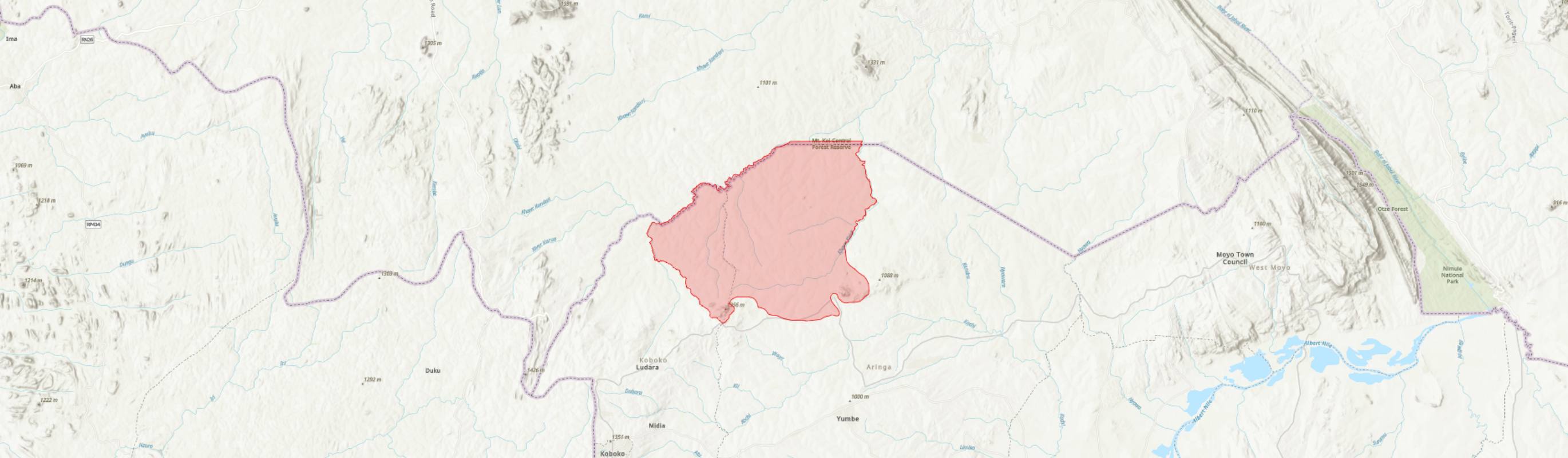
The Mount Kei and Midigo IPA lies within Koboko and Yumbe Districts in the West Nile region of northwest Uganda and encompasses the 416 km2 Mount Kei Central Forest Reserve / Wildlife Sanctuary (CFR; formerly the Mount Kei White Rhino Sanctuary) plus adjacent areas of unprotected land to the south of the reserve and around the small town of Midigo. The reserve is bounded on its northern side by the international border with South Sudan, where it follows a significant stretch of the Kaya River. To the east is the Kechi River and to the south are the settlements of Kai, Lobe and Midigo. The site is rather remote, with the nearest sizeable population centres being Koboko, ca. 25 km to the SW, Yumbe ca. 20 km to the SSE and Moyo ca. 55 km to the east. It is an area of undulating terrain dominated by savanna vegetation. The highest point of Mount Kei itself (1,332 m) is in the southwest of the site.
Botanical significance
Mount Kei CFR is of high botanical significance primarily for its large extent of Vitellaria (formerly Butyrospermum) wooded grassland, a nationally Endangered habitat in Uganda (Richards et al. in press). Whilst this is now degraded in large parts of the reserve, this site still represents one of the most extensive and intact examples of the habitat remaining in Uganda, with the site comprising over 3% of the national resource. Mount Kei is also a critical national site for the globally threatened shea butter tree, Vitellaria (Butyrospermum) paradoxa (VU), which is a socio-economically important species, and one of the dominant trees in this habitat. Three globally Vulnerable timber species, Afzelia africana, Khaya grandifoliola and K. senegalensis, were also recorded during surveys of the woody species in 1993 – 1994 for the Mount Kei CFR biodiversity report, with K. senegalensis being the most frequently encountered (Lwanga 1996). All three of these timber species are also listed as nationally Endangered in Uganda (WCS 2016). Afzelia africana is known to be targeted for logging at this site (see Conservation issues section).
The southern boundary of the IPA extends beyond the reserve to incorporate important populations of two other globally threatened plant species. The first is Sansevieria (Dracaena) yumbiensis (VU), an endemic species of Uganda that is known only from the Yumbe, Midigo and Moyo areas in the northwest of the country. This species grows in wooded grassland, where it is able to persist in degraded areas where small areas of intact habitat remain, e.g. around termite mounds (Forrest & Cole 2022). This species is nevertheless highly threatened by a range of anthropogenic factors, primarily through habitat destruction linked to the growth of the local population and influx of South Sudanese refugees within its range (Forrest & Cole 2022). This IPA includes several of the known subpopulations from south of Mount Kei CFR and is believed to contain >10% of the global population, although its full range is incompletely documented. It is also likely to occur within the reserve but has not yet been recorded from there. The second threatened species in the southern part of the IPA is Cordyla richardii (VU), a range-restricted species of northern Uganda and South Sudan which has been recorded from the vicinity of Midigo (A.S. Thomas #4075, 1941). There are no recent records from the IPA, and this species was not recorded in the survey of woody plants in 1993 – 1994 for the Mount Kei CFR biodiversity report (Lwanga 1996). However, from satellite imagery, the rocky hills to the east of Midigo appear to be suitable for this species and with intact habitat, and similar areas within Mount Kei CFR are also likely to feature this species, hence the lack of recent records is most likely due to highly limited botanical surveys in the site.
Lwanga (1996) recorded 217 species of trees and shrubs within the reserve with 12 additional species being noted from the only previous (pilot) survey. These included a number of nationally scarce species such as Morinda titanophylla (not yet evaluated on the Red List), although none are unique to this site within Uganda. Whilst Mount Kei did not feature within the top 20 forest reserves in Uganda for species richness based on survey data for birds, mammals, lepidoptera and trees, it was ranked 13th for rarity value (Howard et al. 2000), due to the presence of a number of rare and range-restricted species (Davenport & Howard 1996). The site remains highly under-explored botanically, particularly for non-woody species, and it is likely that further species of conservation concern will be revealed by future survey efforts.
Habitat and geology
Mount Kei CFR and the surrounding areas fall within the Sudanian phytogeographical region (White 1983) and East Sudanian savanna ecoregion (Olson et al. 2001). The area is classified as supporting primarily Vitellaria (Butyrospermum) savanna woodland with Hyperthelia dissoluta dominant in the grass layer, with a small area of Combretum-Terminalia-Loudetia savanna in the southwest and southeast of the site (Langdale-Brown et al. 1964). Commonly encountered savanna tree and shrub species include Vitellaria paradoxa, Annona senegalensis, Bridelia scleroneura, Grewia mollis, Gymnosporia heterophylla (recorded as Maytenus buxifolia), G. senegalensis, Lannea spp., Piliostigma thonningii, Pseudocedrela kotschyi, Searsia (Rhus) natalensis, Vangueria apiculata and several species of Acacia (Vachellia) such as A. hockii and A. sieberiana. Patches of forest are confined to riverine fringes, where trees such as Cynometra alexandri, Diospyros mespiliformis, Khaya spp., Ficus spp. and Syzygium guineense are recorded (Lwanga 1996; B. Kirunda, pers. comm. 2024).
Conservation issues
The Mount Kei CFR was gazetted in 1938; it was originally designated as a Rhino Sanctuary to support the local population of northern white rhino (Ceratotherium simum cottoni) but these were hunted to extinction by the mid-1970s (Edroma 1982), together with many of the other large mammals that occurred here. In 2018, the reserve was designated as a Wildlife Sanctuary. It is recognised as an Important Bird Area based on its support of several biome-restricted species including several that are known only from this area in Uganda, though without any globally threatened birds (Birdlife International 2024). However, it did not qualify as a Key Biodiversity Area in the recent national KBA assessment (Plumptre et al. 2019).
At the time of the Important Bird Area assessment in 2001 (Birdlife International 2024), threats were considered to be low as the human population in this part of Uganda was sparse, and extensive areas of wooded grassland within the reserve were intact. Some agricultural encroachment was noted on the southern side of the reserve and some other small-scale activities such as gathering wood for charcoal and construction were recorded. However, since this time the threats have increased drastically due to the rapidly growing human population in this region, in part fueled by the influx of refugees from neighbouring South Sudan during the recent political instability and in part by immigration of cattle grazers from surrounding districts (Cheptoris 2020). By 2017, an estimated 40% of the reserve had been encroached, with rapid increases in charcoal production, illegal timber harvesting (including Afzelia africana), cultivation and cattle grazing (Cheptoris 2020). Extensive areas of agriculture and settlement are now evident from satellite imagery throughout much of the reserve (Google Earth 2025), and the widespread use of burning to clear land is reported. The unprotected areas in the south of the IPA are highly degraded but still support pockets of natural habitat e.g. on rock outcrops and around termite mounds (Forrest & Cole 2022).
Given these intense threats, the National Forestry Authority decided in 2018-2020 to remove the settlers, estimated at ca. 2,000 residents. Community sensitisation efforts were made to promote the voluntary vacation of the reserve and by early 2020 approx. half of the settler community had left voluntarily (Cheptoris 2020). However, illegal logging of Afzelia africana continues to be a problem here (UTS 2023), as does logging and charcoal production using Vitellaria paradoxa, particularly from South Sudanese communities (A.S.M. Mutegeki, pers. comm. 2024).
Starting in 2023, the Equatoria Forestry Company, Form International and Hummingbirds, a Nature-based Solutions NGO, have instigated the Mount Kei Forest Restoration project in close collaboration with local communities in and around the reserve (Form International 2024; Hummingbirds 2024). The project has two components: (a) to establish 18,000 ha of teak (Tectona grandis) plantation as a sustainable and quick-growing wood source for local communities, and (b) to restore 20,000 ha of “native forest” in degraded areas. The scheme also plans to safeguard the remaining gallery forests in the reserve. This plan will place local communities at the heart of the restoration efforts and will establish local economic benefits to promote long-term sustainable “forest” management. However, the project plan is not yet available, such that it is not known which trees have been selected for inclusion in the restoration scheme.
Ecosystem services
The reserve serves as an important water catchment area, which was one reason for its retention as a protected area following the loss of the rhino population. It is also important for a range of provisioning services including fuelwood, wood for construction, medicinal plants and honey (Birdlife International 2024). The shea butter tree offers some commercial potential if harvested sustainably, but the harvesting of this species at Mount Kei CFR is not well documented. Ecotourism potential is rather low given the remoteness of the site and the loss of its megafauna to poaching.
Site assessor(s)
Assessed by:
Iain Darbyshire, Royal Botanic Gardens, Kew
Sophie Richards, Royal Botanic Gardens, Kew
James Kalema, Makerere University Herbarium
Samuel Ojelel, Makerere University Herbarium
Date of first assessment: 27th Sep 2024
Reviewed by:Ben Kirunda, Total Energies
IPA criterion A species
| Species | Qualifying sub-criterion | ≥ 1% of global population | ≥ 5% of national population | 1 of 5 best sites nationally | Entire global population | Socio-economically important | Abundance at site |
|---|---|---|---|---|---|---|---|
| Vitellaria paradoxa C.F.Gaertn. | A(i) |  |
 |
|
|
|
Common |
| Cordyla richardii Planch. ex Milne-Redh. | A(i) | |
|
|
|
|
Scarce |
| Sansevieria yumbiensis T.G.Forrest & T.C.Cole | A(i) | |
|
|
|
|
Occasional |
| Afzelia africana Sm. ex Pers. | A(i) | |
|
|
|
|
Occasional |
| Khaya grandifoliola C.DC. | A(i) | |
|
|
|
|
Scarce |
| Khaya senegalensis (Desv.) A.Juss. | A(i) | |
|
|
|
|
Occasional |
Vitellaria paradoxa C.F.Gaertn.
Qualifying sub-criterion:
A(i)
≥ 1% of global population:
≥ 5% of national population:
1 of 5 best sites nationally:
Entire global population:
Socio-economically important:
Abundance at site:
Common
Cordyla richardii Planch. ex Milne-Redh.
Qualifying sub-criterion:
A(i)
≥ 1% of global population:
≥ 5% of national population:
1 of 5 best sites nationally:
Entire global population:
Socio-economically important:
Abundance at site:
Scarce
Sansevieria yumbiensis T.G.Forrest & T.C.Cole
Qualifying sub-criterion:
A(i)
≥ 1% of global population:
≥ 5% of national population:
1 of 5 best sites nationally:
Entire global population:
Socio-economically important:
Abundance at site:
Occasional
Afzelia africana Sm. ex Pers.
Qualifying sub-criterion:
A(i)
≥ 1% of global population:
≥ 5% of national population:
1 of 5 best sites nationally:
Entire global population:
Socio-economically important:
Abundance at site:
Occasional
Khaya grandifoliola C.DC.
Qualifying sub-criterion:
A(i)
≥ 1% of global population:
≥ 5% of national population:
1 of 5 best sites nationally:
Entire global population:
Socio-economically important:
Abundance at site:
Scarce
Khaya senegalensis (Desv.) A.Juss.
Qualifying sub-criterion:
A(i)
≥ 1% of global population:
≥ 5% of national population:
1 of 5 best sites nationally:
Entire global population:
Socio-economically important:
Abundance at site:
Occasional
IPA criterion C qualifying habitats
| Habitat | Qualifying sub-criterion | ≥ 5% of national resource | ≥ 10% of national resource | 1 of 5 best sites nationally | Areal coverage at site |
|---|---|---|---|---|---|
| Vitellaria (Butyrospermum) wooded grassland (EN) | C(iii) | |
|
|
252.4 |
| Dry Combretum wooded grassland (VU) | C(iii) | |
|
|
3.56 |
Vitellaria (Butyrospermum) wooded grassland (EN)
Qualifying sub-criterion:
C(iii)
≥ 5% of national resource:
≥ 10% of national resource:
Areal coverage at site:
252.4
Dry Combretum wooded grassland (VU)
Qualifying sub-criterion:
C(iii)
≥ 5% of national resource:
≥ 10% of national resource:
Areal coverage at site:
3.56
General site habitats
| General site habitat | Percent coverage | Importance |
|---|---|---|
| Savanna - Dry Savanna | |
Major |
| Savanna - Moist Savanna | |
Major |
| Forest - Subtropical/Tropical Moist Lowland Forest | |
Minor |
| Shrubland - Subtropical/Tropical Dry Shrubland | |
Major |
| Rocky Areas - Rocky Areas [e.g. inland cliffs, mountain peaks] | |
Minor |
| Artificial - Terrestrial - Subtropical/Tropical Heavily Degraded Former Forest | |
Major |
Savanna - Dry Savanna
Percent coverage:
Importance:
Major
Savanna - Moist Savanna
Percent coverage:
Importance:
Major
Forest - Subtropical/Tropical Moist Lowland Forest
Percent coverage:
Importance:
Minor
Shrubland - Subtropical/Tropical Dry Shrubland
Percent coverage:
Importance:
Major
Rocky Areas - Rocky Areas [e.g. inland cliffs, mountain peaks]
Percent coverage:
Importance:
Minor
Artificial - Terrestrial - Subtropical/Tropical Heavily Degraded Former Forest
Percent coverage:
Importance:
Major
Land use types
| Land use type | Percent coverage | Importance |
|---|---|---|
| Nature conservation | |
Major |
| Agriculture (arable) | |
Major |
| Harvesting of wild resources | |
Unknown |
| Agriculture (pastoral) | |
Unknown |
Nature conservation
Percent coverage:
Importance:
Major
Agriculture (arable)
Percent coverage:
Importance:
Major
Harvesting of wild resources
Percent coverage:
Importance:
Unknown
Agriculture (pastoral)
Percent coverage:
Importance:
Unknown
Threats
| Threat | Severity | Timing |
|---|---|---|
| Agriculture & aquaculture - Annual & perennial non-timber crops - Small-holder farming | High | Ongoing - increasing |
| Agriculture & aquaculture - Livestock farming & ranching - Small-holder grazing, ranching or farming | Unknown | Ongoing - trend unknown |
| Biological resource use - Gathering terrestrial plants | Low | Ongoing - increasing |
| Biological resource use - Logging & wood harvesting | Medium | Ongoing - increasing |
| Natural system modifications - Fire & fire suppression - Increase in fire frequency/intensity | High | Ongoing - increasing |
| Human intrusions & disturbance - War, civil unrest & military exercises | Medium | Ongoing - trend unknown |
Agriculture & aquaculture - Annual & perennial non-timber crops - Small-holder farming
Severity:
High
Timing:
Ongoing - increasing
Agriculture & aquaculture - Livestock farming & ranching - Small-holder grazing, ranching or farming
Severity:
Unknown
Timing:
Ongoing - trend unknown
Biological resource use - Gathering terrestrial plants
Severity:
Low
Timing:
Ongoing - increasing
Biological resource use - Logging & wood harvesting
Severity:
Medium
Timing:
Ongoing - increasing
Natural system modifications - Fire & fire suppression - Increase in fire frequency/intensity
Severity:
High
Timing:
Ongoing - increasing
Human intrusions & disturbance - War, civil unrest & military exercises
Severity:
Medium
Timing:
Ongoing - trend unknown
Protected areas
| Protected area name | Protected area type | Relationship with IPA | Areal overlap |
|---|---|---|---|
| Mount Kei Central Forest Reserve | Forest Reserve (conservation) | IPA encompasses protected/conservation area | 415 |
| Mount Kei Wildlife Sanctuary | Wildlife Sanctuary | IPA encompasses protected/conservation area | 415 |
Mount Kei Central Forest Reserve
Protected area type:
Forest Reserve (conservation)
Relationship with IPA:
IPA encompasses protected/conservation area
Areal overlap:
415
Mount Kei Wildlife Sanctuary
Protected area type:
Wildlife Sanctuary
Relationship with IPA:
IPA encompasses protected/conservation area
Areal overlap:
415
Conservation designation
| Designation name | Protected area | Relationship with IPA | Areal overlap |
|---|---|---|---|
| Mount Kei Forest Reserve | Important Bird Area | IPA encompasses protected/conservation area | 384 |
| Mount Kei Forest Reserve | Key Biodiversity Area | IPA encompasses protected/conservation area | |
Mount Kei Forest Reserve
Protected area:
Important Bird Area
Relationship with IPA:
IPA encompasses protected/conservation area
Areal overlap:
384
Mount Kei Forest Reserve
Protected area:
Key Biodiversity Area
Relationship with IPA:
IPA encompasses protected/conservation area
Areal overlap:
Management type
| Management type | Description | Year started | Year finished |
|---|---|---|---|
| Sustainable Forestry management in place | Management plan under development as part of Mount Kei Forest Restoration project, led by Equatoria Forestry Company, Form International and Hummingbirds. | 2023 | |
Sustainable Forestry management in place
Management plan under development as part of Mount Kei Forest Restoration project, led by Equatoria Forestry Company, Form International and Hummingbirds.
Year started:
2023
Year finished:
Bibliography
The vegetation of Africa. A descriptive memoir to accompany the UNESCO/AETFAT/UNSO vegetation map of Africa
Conservation of vertebrates and plants in Uganda: Identifying Key Biodiversity Areas and other sites of national importance
Conservation Science and Practice, Vol 1, page(s) e7 Available online
The Vegetation of Uganda and its Bearing on Land-Use
Protected area planning in the tropics: Uganda's national system of Forest Nature Reserves.
Conservation Biology, Vol 14, page(s) 858 – 875
Improving the application of Important Plant Areas to conserve threatened habitats: A case study of Uganda
Conservation Science and Practice, page(s) e13246
Terrestrial Ecoregions of the World: A New Map of Life on Earth: A new global map of terrestrial ecoregions provides an innovative tool for conserving biodiversity
BioScience, Vol 51, page(s) 933-938
Nationally Threatened Species for Uganda: National Red List for Uganda for the following Taxa: Mammals, Birds, Reptiles, Amphibians, Butterflies, Dragonflies and Vascular Plants
Important Bird Area factsheet: Mount Kei Forest Reserve.
Response to the impending evictions of encroachers from Mt. Kei Central Forest Reserve (CFR) raised by Hon. Driwaru Zaitun, Woman Member of Parliament, Moyo District. Parliamentary Transcript, Ministry of Water and Environment, Republic of Uganda.
Mount Kei Forest Reserve Biodiversity Report.
White rhino extinct in Uganda.
Oryx, Vol 16, page(s) 352-357
Partnership for forest restoration and conservation: Mount Kei in Uganda.
Sansevieria yumbiensis: A new species in Northwest Uganda.
Sansevieria, Vol 48, page(s) 12-15
Project Mount Kei Reforestation. Plantation and forest restoration in a Central Forest Reserve in Uganda.
Trees and Shrubs. In: Davenport, T. & Howard, P. (eds), Mount Kei Forest Reserve Biodiversity Report.
Leaders accuse security over fresh illegal logging in Mt Kei Forest.
Uganda


Recommended citation
Iain Darbyshire, Sophie Richards, James Kalema, Samuel Ojelel (2026) Tropical Important Plant Areas Explorer: Mount Kei and Midigo (Uganda). https://tipas.kew.org/site/mount-kei-and-midigo/ (Accessed on 26/08/2026)