
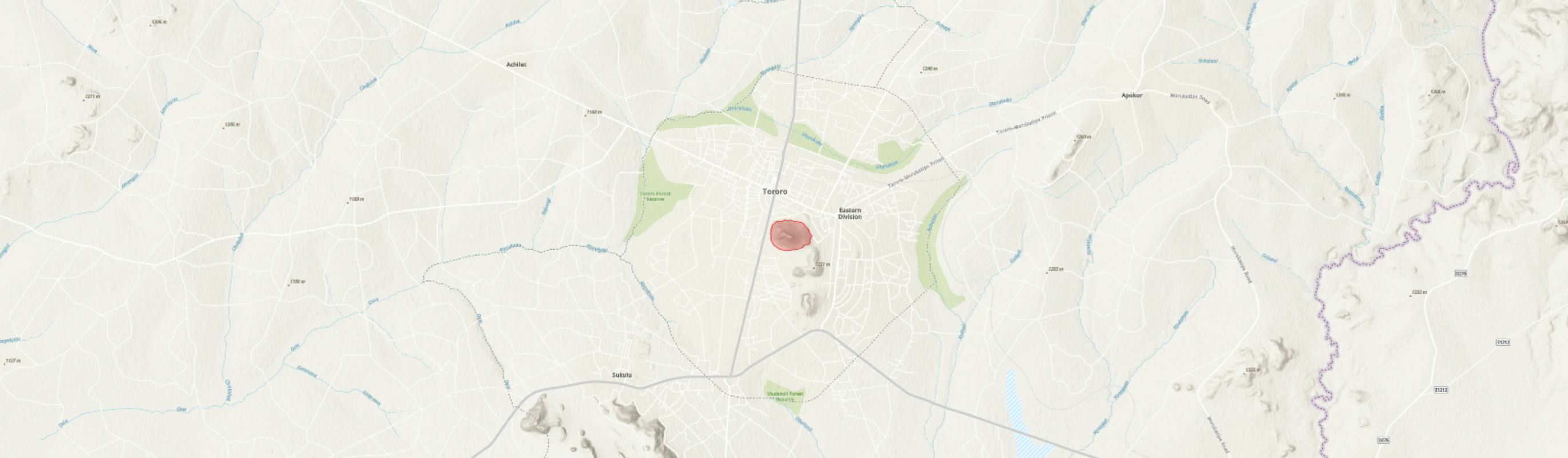
Country: Uganda
Administrative region: Eastern (Region)
Central co-ordinates: 0.68518 N, 34.18311 E
Area: 0.38km²
Qualifying IPA Criteria
A(i)Site contains one or more globally threatened species
IPA assessment rationale
Tororo Rock qualifies as an IPA under criterion A(i) as it contains a major portion of the global population of Aloe tororoana, a species currently assessed on the IUCN Red List as Vulnerable.
Site description
Tororo Rock is a prominent volcanic peak situated within Tororo District of Eastern region, Uganda, within 10 km of the Kenya border. It falls within the Tororo municipality, rising precipitously ca. 280 m above the surrounding town to a maximum height of 1,479 m. The slopes of the mountain support intact bushland, and extensive areas of exposed rock with a lithophytic flora on the steeper slopes.
Botanical significance
Tororo Rock is of global botanical importance for holding the largest and most secure wild population of the Ugandan endemic aloe, Aloe tororoana. Here, A. tororoana grows plentifully on steep and often inaccessible slopes and cliffs in areas without dense vegetation (Carter et al. 2011; Andima et al. 2014; Cole & Forrest 2017). It is currently assessed on the IUCN Red List as Vulnerable under criterion D2 (IUCN SSC East African Plants Red List Authority 2013), but given ongoing threats to some of its subpopulations, this assessment should be upgraded to Endangered under criterion B. Away from Tororo Rock, it is known only from the Osukuru (Sukulu) Hills to the southwest of Tororo, which are subject to ongoing and planned industrial activity through the Osukuru Industrial Complex, including phosphorite and iron ore deposits. A record of this species from the Toror Hills in the Northern region of Uganda (based on H.C. Dawkins #636, MO), mentioned in the Red List assessment, is believed to be in error as this site is a long way out of the range for this species.
The Tororo Rock IPA also contains a population of Pennisetum procerum growing in rock crevices. Although not an IPA trigger species, P. procerum is a crop wild relative to Pearl Millet, and hence a potential source of novel genes for crop resilience such as tolerance to drought, which may be important for diversification of the genetic base of this crop which is grown in eastern Uganda. In Uganda, P. procerum is only known from Karamoja region, Sipi and Tororo Rock (Kalema et al. 2016).
Habitat and geology
Tororo Rock is a volcanic plug comprising carbonatite (high-carbonate alkaline igneous rock) of Middle Eocene age (ca. 40 Ma), as an intrusion within Pre-Cambrian syenites (Williams 1952; HiTech AlkCarb 2022). Other lower lying carbonatite outcrops occur immediately to the south of the rock, but these are not included in the IPA because they have been extensively denuded of vegetation. The Tororo Rock IPA is surrounded by urban development, but as the slopes steepen, natural bushland vegetation remains intact. The bushland communities are mostly composed of species of Combretum, Bridelia, Acacia, Euclea, Rhus, Allophylus, Ficus, Olea and Capparis. On the steeper slopes there are areas of bare rock with pockets of shallow soil that support a succulent flora including Aloe tororoana and Euphorbia magnicapsula, both frequent here. There are also limited patches of Themeda triandra grassland on the upper slopes, often lightly wooded with Acacia hockii and E. magnicapsula (J. Kalema, pers. obs.).
Tororo experiences a humid climate with average annual rainfall of over 2,000 mm. The main wet season peaks in April and May, with a shorter wet season in November-December. The months with the lowest amounts of rainfall are February and July.
Conservation issues
Tororo Rock is included in Uganda’s Key Biodiversity Areas network based on the population of Aloe tororoana (Plumptre et al. 2017). While the site has been afforded some protection by the local community and authorities, currently Tororo Rock is not formally protected, and faces a number of threats, partially driven by its proximity to Tororo town. Encroachment for settlement and agriculture, cattle grazing, uncontrolled burning and harvesting of firewood and poles continue to degrade the vegetation, particularly on the lower slopes (P. Nyadoi, pers. comm. 2022). Past extraction of the carbonatite rock for local construction and road building has occurred, but community protests have led to these activities being halted (IUCN SSC East African Plants Red List Authority 2013). However, the lower-lying extrusions of carbonatite immediately to the south of Tororo Rock, outside of the IPA boundary, are mined for cement. There is thus a potential risk of habitat degradation arising from this mining activity in the neighbourhood, should it ever expand to the hill (Kalema et al. 2016). The erection of a series of telecommunication masts at the summit of the rock with associated power lines resulted in localised clearance of vegetation (IUCN SSC East African Plants Red List Authority 2013). Tourist footfall at the site is significant, with ladders having been erected to allow easy access to the summit, but the tourist route is clearly defined, and most of the populations of the Aloe are on inaccessible parts of the cliff. Rock climbing by mountaineers may, however, cause some erosion of the species’ fragile habitats. There are also some concerns over the unsustainable harvesting of the Aloe for its medicinal uses (see Key Ecosystem Services below), and there was evidence of reduction of the accessible populations of this species during a site visit in March 2025, attributed in part to harvesting. Other threats noted during the same visit included the spread of invasive species including Chromolaena odorata and Lantana camara, and - of particular concern - an extensive recent fire on the upper slopes that had impacted much of the bushland and some of the Aloe populations, this having apparently being set accidentally by visitors (I. Darbyshire et al., pers. obs. 2025).
Between 2014 and 2018, Uganda Wildlife Society implemented a conservation initiative at this site, which included replanting of some indigenous species and collaborating with Tororo District council and local communities to promote the protection of the fragile habitats and to develop an ordinance for the site. However, the funded project ended before completion of the ordinance, and some recommendations were not implemented, including the formal demarcation of the site boundary (P. Nyadoi, pers. comm. 2022). In 2023, however, the UN-Uganda National World Wildlife Day Celebration was hosted by Tororo District, and the Ministry of Tourism committed to support gazettement of the Rock as one of Uganda’s important tourism and conservation areas. This builds on the earlier efforts by UWS and the local government towards securing the Rock and protecting it from all forms of encroachment. Assigning the rock as an IPA will help facilitate the process and elicit stakeholder investments towards conservation and sustainability of its biodiversity and tourism values (P. Nyadoi, pers. comm. 2024).
Ecosystem services
Tororo Rock is an important site for tourism in eastern Uganda, and the 1–2-hour hike to the summit for the panoramic view over the Uganda-Kenya border region is a popular attraction, alongside rock climbing. The presence of ancestral caves is of cultural importance to the Jopadhola and Iteso peoples and adds to the tourist appeal (Uganda Tourism Center 2022; P. Nyadoi, pers. comm. 2024). This tourism provides a source of income for local businesses and tourist guides (Mukade 2018). Signage to indicate the presence of the aloe species and other interesting flora may promote ecotourism here in the future.
Aloe tororoana itself provides some provisioning services. It is used in traditional medicine for a number of ailments, including stomach pains, fever and coughs, as well as for poultry diseases (Cole & Forrest 2017), and preliminary phytochemical analyses have demonstrated the presence of compounds of potential use in antimicrobial drugs (Andima et al. 2014). However, any further use of this species would have to be managed sustainably, given the small and fragile global population. At present, the harvesting of this species is considered to be unsustainable (P. Nyadoi, pers. comm. 2022).
A number of tree species are also harvested on the rock for a range of uses; these include several Acacia, Albizia, Combretum and Ficus spp. and Shirakiopsis elliptica. This harvesting is resulting in local declines in populations of these species (P. Nyadoi, pers. comm. 2022).
Site assessor(s)
Assessed by:
Iain Darbyshire, Royal Botanic Gardens, Kew
James Kalema, Makerere University Herbarium
Samuel Ojelel, Makerere University Herbarium
Sophie Richards, Royal Botanic Gardens, Kew
Date of first assessment: 4th Nov 2024
Reviewed by:Priscilla Nyadoi, Uganda Wildlife Society
IPA criterion A species
| Species | Qualifying sub-criterion | ≥ 1% of global population | ≥ 5% of national population | 1 of 5 best sites nationally | Entire global population | Socio-economically important | Abundance at site |
|---|---|---|---|---|---|---|---|
| Aloe tororoana Reynolds | A(i) |  |
|
|
 |
|
Frequent |
Aloe tororoana Reynolds
Qualifying sub-criterion:
A(i)
≥ 1% of global population:
≥ 5% of national population:
1 of 5 best sites nationally:
Entire global population:
Socio-economically important:
Abundance at site:
Frequent
General site habitats
| General site habitat | Percent coverage | Importance |
|---|---|---|
| Shrubland - Subtropical/Tropical Moist Shrubland | |
Major |
| Rocky Areas - Rocky Areas [e.g. inland cliffs, mountain peaks] | |
Major |
| Grassland - Subtropical/Tropical Dry Lowland Grassland | |
Minor |
Shrubland - Subtropical/Tropical Moist Shrubland
Percent coverage:
Importance:
Major
Rocky Areas - Rocky Areas [e.g. inland cliffs, mountain peaks]
Percent coverage:
Importance:
Major
Grassland - Subtropical/Tropical Dry Lowland Grassland
Percent coverage:
Importance:
Minor
Land use types
| Land use type | Percent coverage | Importance |
|---|---|---|
| Tourism / Recreation | |
Major |
| Utility & service lines | |
Minor |
| Residential / urban development | |
Minor |
| Harvesting of wild resources | |
Minor |
| Agriculture (pastoral) | |
Minor |
| Agriculture (arable) | |
Minor |
Tourism / Recreation
Percent coverage:
Importance:
Major
Utility & service lines
Percent coverage:
Importance:
Minor
Residential / urban development
Percent coverage:
Importance:
Minor
Harvesting of wild resources
Percent coverage:
Importance:
Minor
Agriculture (pastoral)
Percent coverage:
Importance:
Minor
Agriculture (arable)
Percent coverage:
Importance:
Minor
Threats
| Threat | Severity | Timing |
|---|---|---|
| Transportation & service corridors - Utility & service lines | Low | Ongoing - stable |
| Residential & commercial development - Tourism & recreation areas | Low | Ongoing - increasing |
| Human intrusions & disturbance - Recreational activities | Medium | Ongoing - increasing |
| Energy production & mining - Mining & quarrying | Medium | Past, not likely to return |
| Agriculture & aquaculture - Annual & perennial non-timber crops - Small-holder farming | Low | Ongoing - trend unknown |
| Agriculture & aquaculture - Livestock farming & ranching - Small-holder grazing, ranching or farming | Low | Ongoing - trend unknown |
| Natural system modifications - Fire & fire suppression - Increase in fire frequency/intensity | Unknown | Ongoing - trend unknown |
| Biological resource use - Gathering terrestrial plants | Medium | Ongoing - trend unknown |
Transportation & service corridors - Utility & service lines
Severity:
Low
Timing:
Ongoing - stable
Residential & commercial development - Tourism & recreation areas
Severity:
Low
Timing:
Ongoing - increasing
Human intrusions & disturbance - Recreational activities
Severity:
Medium
Timing:
Ongoing - increasing
Energy production & mining - Mining & quarrying
Severity:
Medium
Timing:
Past, not likely to return
Agriculture & aquaculture - Annual & perennial non-timber crops - Small-holder farming
Severity:
Low
Timing:
Ongoing - trend unknown
Agriculture & aquaculture - Livestock farming & ranching - Small-holder grazing, ranching or farming
Severity:
Low
Timing:
Ongoing - trend unknown
Natural system modifications - Fire & fire suppression - Increase in fire frequency/intensity
Severity:
Unknown
Timing:
Ongoing - trend unknown
Biological resource use - Gathering terrestrial plants
Severity:
Medium
Timing:
Ongoing - trend unknown
Conservation designation
| Designation name | Protected area | Relationship with IPA | Areal overlap |
|---|---|---|---|
| Tororo Rock | Key Biodiversity Area | protected/conservation area overlaps with IPA | 1 |
Tororo Rock
Protected area:
Key Biodiversity Area
Relationship with IPA:
protected/conservation area overlaps with IPA
Areal overlap:
1
Management type
| Management type | Description | Year started | Year finished |
|---|---|---|---|
| No management plan in place | |
|
No management plan in place
Year started:
Year finished:
Bibliography
Conserving Uganda’s Biodiversity: Identifying critical sites for threatened species
Aloes of Uganda. A Field Guide.
Aloes – The definitive guide.
Alkaline Rocks and Carbonatites of the World.
Aloe tororoana. The IUCN Red List of Threatened Species 2013: e.T47348717A47348720.
Preliminary qualitative analysis of phytochemical constituents of the endemic Aloe tororoana Raynolds in Tororo, Eastern Uganda.
Global Advanced Research Journal of Agricultural Science, Vol 3(3), page(s) 96–99
The contribution of Tororo Rock towards tourism development in Tororo municipality, Tororo District.
Tororo Rock.
Carbonatite structure: Tororo Hills, eastern Uganda.
Geological Magazine, Vol 89, page(s) 286–292
Distribution, habitat and conservation of range-restricted species of the genera Eleusine Gaertn. and Pennisetum Rich. (Poaceae) in Uganda.
Symbolae Botanicae Upsalienses, Vol 38, page(s) 93-100 Available online


Recommended citation
Iain Darbyshire, James Kalema, Samuel Ojelel, Sophie Richards (2026) Tropical Important Plant Areas Explorer: Tororo Rock (Uganda). https://tipas.kew.org/site/tororo-rock/ (Accessed on 26/08/2026)